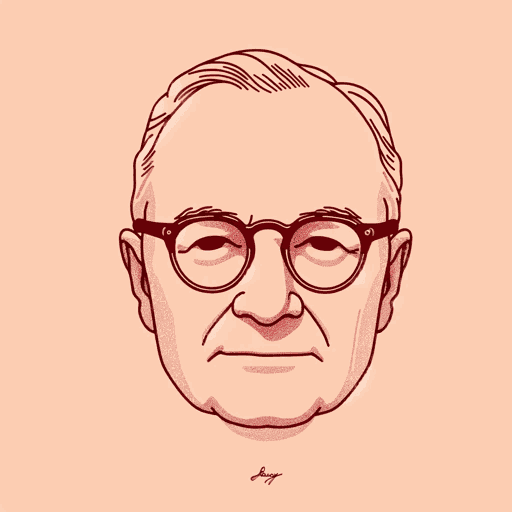
Truman
63 pages • 2-hour read
David McCulloughTruman
A modern alternative to SparkNotes and CliffsNotes, SuperSummary offers high-quality Study Guides with detailed chapter summaries and analysis of major themes, characters, and more.
Summary
Background
Chapter Summaries & Analyses
Key Figures
Themes
Index of Terms
Important Quotes
Essay Topics
Tools
Part 3, Chapters 9-10Chapter Summaries & Analyses
Chapter 9 Summary: “The Moon, the Stars, and All the Planets”
Chapter 9 examines the first months of the Truman presidency between Roosevelt’s death in April and the Potsdam Conference in July 1945. This period brought victory in Europe and set the tone for Truman’s leadership for the rest of the war. McCullough shows how Truman had to adjust to the circumstances in which he found himself. The Truman family also moved to the White House.
When Roosevelt died on April 12, the Allies were a month away from complete victory in Europe. In the first days, McCullough says, Truman looked “absolutely dazed,” while Bess “had been crying almost from the moment she heard the news” (422). Two hours after Roosevelt’s death, Truman was sworn in as President. The reaction of the public and that of Truman’s colleagues was mixed. Some argued that Truman was inadequate for the job. Others argued that he was honest and had common sense. His first speech to Congress asked the nation to stay united and defend its ideals. In the first weeks, Truman was preoccupied with the war and questions of foreign policy.
When Truman took over, American casualties were close to 900,000, and their lives were now his responsibility. Truman felt overwhelmed because relations with Russia were deteriorating due to differences over the postwar order in Europe. Truman was inexperienced in foreign policy and did not know Winston Churchill or Joseph Stalin personally. The President consulted the US ambassador to the Soviet Union, W. Averell Harriman, on the question of American-Soviet relations. There was disagreement between the American and British sides regarding working with the Soviet Union because Churchill was more hawkish.
Soviet foreign minister Vyacheslav Molotov met with Truman in Washington, DC on April 23, 1945. Molotov wanted the three Allies to treat each other as equals, but Truman confronted him about the postwar government in Poland. Meanwhile, the Soviet Army initiated its final push toward Berlin. On April 25, the Soviet and American troops linked up on the Elbe River, and on May 2, the Red Army conquered Berlin. On May 8, V-E Day, the news of victory in Europe was made official. On the same day, Truman turned 61.
Behind the scenes in the US, the Manhattan Project was moving according to plan. On May 31, the Truman administration decided to use the newly developed atomic bomb against Japan. However, no one was clear about the exact damage caused by such a weapon. There was some dissent. For instance, McCullough notes that statesman Henry L. Stimson said that “he didn’t want to see the United States ‘outdoing Hitler in atrocities’” (470). George Marshall wanted the weapon used against a military objective. Some were concerned about the Soviet Union developing comparable weapons. The central question in the war against Japan from everyone’s perspective was saving American lives. A land invasion of Japan would have been incredibly costly.
Chapter 10 Summary: “Summer of Decision”
The tenth chapter focuses on the end of World War II in the Pacific theater: summer through autumn of 1945. McCullough continues his analysis of Truman’s decision to use the newly developed atomic weapons. He also narrates the relationship and interactions between Truman, Churchill, and Stalin at the Potsdam Conference in July 1945.
In early July, Truman headed to Europe for the first time since the end of World War I to attend the Potsdam Conference in Germany—then under Allied occupation. The three leaders focused on similar issues as those of Yalta including Soviet entry into the war against Japan, the occupation of Germany, and the postwar order in Eastern Europe. Top US military officials such as Marshall and Douglas McArthur sought to gain Soviet support to reduce American casualties in the Pacific. Truman was under pressure to establish a relationship with Stalin and to maintain the relationship that Roosevelt developed with Churchill over their nine meetings.
Stalin reiterated the Soviet commitment to entering the war against Japan by attacking Japan-controlled Manchuria in August 1945, which pleased Truman. However, disagreement over Eastern Europe remained. In the end, McCullough says, Soviet control of Eastern Europe was a “fait accompli” (529). At Potsdam, Truman learned of the successful and highly destructive nuclear test carried out in New Mexico on July 16. Truman and Churchill decided to inform Stalin but without giving detail. Stalin appeared uninterested because he had learned earlier about the American project through spying. Now he wanted to speed up Soviet nuclear research.
Truman approved the use of nuclear weapons on July 31. The Americans bombed Hiroshima on August 6. To those engaged in the war against Japan, McCullough says, “the news came as a joyous reprieve” (534). To the Japanese, it was an indescribable nightmare with casualties estimated at up to 200,000. Of the total dead, only 10,000 were soldiers. Burns, shock, and effects of radiation lasted for months and years. On August 8, the Soviet Union declared war against Japan and entered Manchuria the next day. On August 9, the Americans used a nuclear weapon against Nagasaki. Emperor Hirohito offered unconditional surrender on August 10.
Chapters 9-10 Analysis
This section describes a brief period between April and September 1945 that was filled with events of global significance: Allied victory in Europe in May, the successful testing of nuclear weapons in July, Truman’s decision to use such weapons in Japan in August, and Japan’s subsequent surrender. The theme of War and Character features prominently in this section because it mirrors the formative experience that World War I played in his life. The Second World War served as a baptism by fire for Truman’s presidency. The author carries over the juxtaposition of Roosevelt and Truman from the previous chapter in the context of foreign policy. Roosevelt had established relationships with both Churchill and Stalin whereas Truman was a novice
Because the invention of the atomic bomb was so monumental, and its first use in Japan so horrific, “The Summer of Decision” is one of the only sections in which the author engages in historical analysis and employs historiography to offer different theories and interpretations. In contrast, much of the book only contains brief historical vignettes used to situate Truman’s life and to provide a broader background.
The question of the necessity of using atomic weapons in Japan divides into two general camps. The first accepts the official US argument of saving American and Japanese lives by using the bomb and preventing the necessity of a land invasion. The reasons for the Japanese unwillingness to surrender up until that point include two decades of militarism under Hirohito that permeating every part of Japanese society. Revisionist historians argue, by contrast, that the Soviet agreement to fight Japan made at Yalta and confirmed at Potsdam made the use of nuclear weapons unnecessary. Indeed, the Red Army numbered over a million and entered Manchuria hours before the American bombing of Nagasaki. Some historians also suggest that the Americans used atomic weapons to show their power to the budding rival, the Soviet Union. McCullough argues against the latter suggesting that there is no direct evidence of it. However, the growing tensions with the Soviet Union over the postwar order in Europe provide indirect evidence that the weapons may have had this secondary purpose.
McCullough discusses Soviet-American relations only from the American point of view. For example, the author quotes Stalin but does not explain Stalin’s motivations for disagreeing with his Anglo-American counterparts. American foreign policy did not recognize legitimate Soviet security concerns. Russia had been invaded by Poles in the 17th century, France and Britain in the 19th century, and Germany during World War II. The geopolitical situation in Europe was of direct relevance to the Soviet Union on a continent it shared. In contrast, the US was located on a different continent surrounded by oceans and weaker neighbors. Also, the Anglo-American side took its influence in Western Europe for granted yet questioned the Soviet presence in Eastern Europe—in part for the legitimate reason that Western European counties were governed democratically. Additional historical context texts would be helpful here.

Unlock all 63 pages of this Study Guide
Get in-depth, chapter-by-chapter summaries and analysis from our literary experts.
- Grasp challenging concepts with clear, comprehensive explanations
- Revisit key plot points and ideas without rereading the book
- Share impressive insights in classes and book clubs