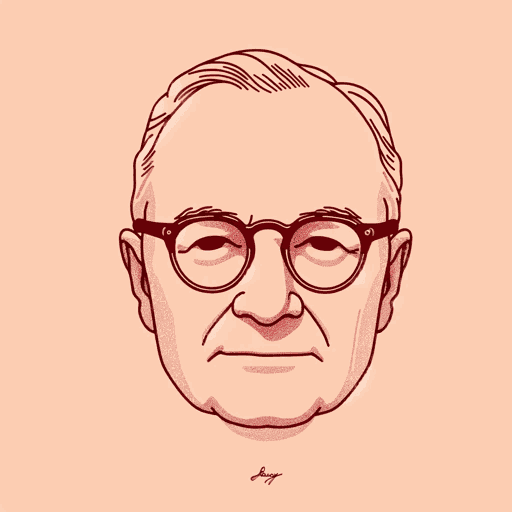
Truman
63 pages • 2-hour read
David McCulloughTruman
A modern alternative to SparkNotes and CliffsNotes, SuperSummary offers high-quality Study Guides with detailed chapter summaries and analysis of major themes, characters, and more.
Summary
Background
Chapter Summaries & Analyses
Key Figures
Themes
Index of Terms
Important Quotes
Essay Topics
Tools
Part 4, Chapters 13-14Chapter Summaries & Analyses
Chapter 13 Summary: “The Heat in the Kitchen”
Chapter 13 examines Truman’s decision to run for president in 1948. His political views remained uncompromisingly liberal as his January 1948 congressional speech indicated. He supported civil rights: from calling for a law against lynching to suggesting that Japanese Americans interned during World War II should get restitution. In private, however, Truman continued using racial slurs to refer to Blacks, which McCullough explains as “[o]ld biases, old habits of speech” (706). Other domestic issues ranged from housing to inflation.
In foreign policy, relations with the Soviet Union remained tense. Some believed that the Cold War made good politics because citizens would rally behind their president (709). American anti-Communism in international relations also affected domestic politics. This period was the start of Senator Joe McCarthy’s “Red Scare.” At times, the progressive platform within the Democratic Party was not unlike a less radical version of communist ideas, which sought economic justice through democratic evolution rather than violent revolution. Henry Wallace, for example, called for the nationalization of some industries, for US nuclear weapons to be handed to the United Nations, and for a reconstruction program for the Soviet Union.
The call to use Palestine—then a British-controlled territory through a United Nations mandate—to establish a Jewish state was one of the central issues linking domestic and foreign policy. The issue was complicated by in-fighting regarding the “Jewish vote” in states like New York. In America at large, McCullough says, the “popular support for a Jewish homeland was overwhelming” (714). However, Truman “had no wish to send American troops to guarantee the survival of the new Jewish state” in a majority-Arab area (715). The situation escalated in November 1947 when the United Nations voted for portioning Palestine, and even the Soviet Union supported the effort. Britain was to turn over Palestine to the UN in May 1948. On May 14, 1948, Israel was declared a state.
At the same time, Truman started his campaign. McCullough describes him as “folksy” and “often corny,” but the “crowds continued large and friendly” (744). On July 9, Eisenhower rejected a presidential run. At the Democratic convention, Truman was nominated by 948 votes. This event was the first time, argues McCullough, that Truman was not “a leader by accident” but rather “by the choice of his party” (762). In June 1948, the Berlin blockade by the Soviet side began, which led to the American-led Berlin Airlift. The airlift went on for several months primarily relying on American and British transports. In private, Truman wrote to Churchill that Communism was “our next great problem” after “the overthrow of Nazism and Fascism” (768).
Chapter 14 Summary: “Fighting Chance”
Chapter 14 continues to detail Truman’s 1948 reelection. Truman traveled 21,928 miles by train across the US for 33 days and met over 3 million people. For example, 100,000 met Truman in Oklahoma City, and over a million in New York City. Writing to his sister, Truman called this “the greatest campaign any President ever made” (773). This journey became known as the Whistle-stop Campaign on a train named Magellan in what the author describes as a “political roadshow” (774). Truman traveled across the continent to California, then toured the Midwest, then the northeast, and the last stop was his home state of Missouri. “No President in history,” McCullough argues, “had ever gone so far in quest of support from the people” (775). Truman “expressed love of home, love of the land, the virtues and old verities of small-town America” (782). He centered his campaign around the idea of fighting special interests and championing the people.
One concern for Truman was the aborted “Vinson Mission”—a secret plan to send Fred Vinson, the chief justice of the Supreme Court, to Moscow to negotiate peace amidst the Berlin blockade. This information leaked to the media, and Truman was accused of appeasement. In the meantime, former Vice President Henry Wallace campaigned across America for the Progressive Party. He traveled even more than Truman on a platform of peace with the Soviet Union in foreign policy and ending segregation and introducing national healthcare domestically. Eventually, the enthusiasm for this platform started to wane, and the media painted him as “playing Moscow’s game” (787). Another third-party candidate, Strom Thurmond, was on the opposite end of the spectrum calling racial integration in the US military un-American.
For the Republican candidate, Thomas E. Dewey, “[t]he dominating strategy,” McCullough says, was “to say as little as possible” (792). The media overwhelmingly supported Dewey. Dewey was even getting help from the FBI. With three weeks to go, Truman was behind in the polls. Things changed on election night. Dewey finally conceded the election just before midnight. Overall, Truman won with 303 electoral votes as compared to Dewey’s 189. McCullough says that “ethnic minorities voted strongly for Truman,” as did Catholics (835). The public and the media considered this victory “astonishing” and “startling” (832).
Chapters 13-14 Analysis
McCullough takes “The Heat in the Kitchen” chapter title from an expression Truman heard in 1930s Missouri, “If you can’t stand the heat, you better get out of the kitchen” (753). The author uses this idiom to describe the challenges that Truman faced in 1947 and 1948 with the rising tensions with the Soviet Union concerning the Berlin Airlift, the path to the establishment and recognition of Israel, and the launch of his election campaign. Similarly, chapter 14 title, “Fighting Chance,” refers to the transition from Truman’s perceived inability to win the 1948 presidential election to slowly gaining ground in the polls.
Two key questions in international relations were on Truman’s plate at this time. The first was the formation of Israel and the second was the Berlin Airlift. McCullough examines the complexities of the first question which combined domestic politics, civil rights, and foreign policy in the Cold War period. On the one hand, he believed European Jews who had suffered from the Holocaust deserved a homeland. On the other hand, he faced the complex politics of creating such a homeland in majority-Arab Palestine with its legacy of European colonialism. Americans like George Marshall also perceived the Middle East as a sensitive geographic area susceptible to Soviet expansion. On the other hand, it was the newly formed United Nations that was handling the question, and others argued that the US championing one side or the other was overstepping its bounds.
The Berlin Airlift exemplifies the escalation of Cold War tensions between the United States and the Soviet Union. As before, McCullough only presents the debates within the Truman administration. The US included West Germany in the Marshall Plan and then introduced a new currency. These actions challenged the quadripartite division established in 1945 by the Allies. The Soviet Union responded by blockading Berlin, while the US led an effort to airlift supplies. Truman’s repeated questions about Soviet goals suggest he did not appreciate the way US influence in Europe raised security concerns for the Soviets.
Chapter 14 features a juxtaposition of Dewey and Truman. The two men had similar backgrounds coming from small American towns. However, Truman was, McCullough says, a “late bloomer,” whereas “Dewey had soared almost from the start” (791). For example, a lawyer by education, Dewey became New York’s first Republican governor in two decades at the age of 40. It was Dewey’s popularity, political experience, and fatigue with the Democrats that made experts believe his victory over Truman was certain. And yet, McCullough says, “Not a single radio commentator or newspaper columnist, or any of the hundreds of reporters who covered the campaign, had called it right” (832). McCullough carefully traces Truman’s path to victory as part of his The Rise of an Underdog theme. He suggests that it was Truman’s consistent hard work, relatable personality, and campaigning among the people that gave him the necessary edge. For example, in Salt Lake City, Truman brought up his grandfather Solomon Young and his voyage across the plains as well as his friendship with Brigham Young, a leader in the Church of Jesus Christ of Latter-Day Saints. Elsewhere, he would say, “Would you like to meet the Boss?” in reference to his wife (810).

Unlock all 63 pages of this Study Guide
Get in-depth, chapter-by-chapter summaries and analysis from our literary experts.
- Grasp challenging concepts with clear, comprehensive explanations
- Revisit key plot points and ideas without rereading the book
- Share impressive insights in classes and book clubs