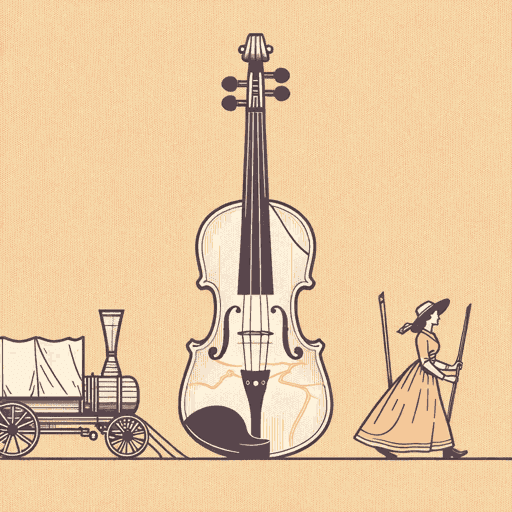
Under a Painted Sky
51 pages • 1-hour read
Stacey LeeUnder a Painted Sky
A modern alternative to SparkNotes and CliffsNotes, SuperSummary offers high-quality Study Guides with detailed chapter summaries and analysis of major themes, characters, and more.
Character Analysis
Samantha “Sammy” Young
Content Warning: This section of the guide includes discussion of racism, attempted rape, murder, child abuse, suicidal ideation, and anti-gay bias.
Samantha “Sammy” Young is the protagonist and first-person narrator of the novel. When the novel opens in medias res, she is a 15-year-old teenager in the middle of a nightmarish situation. Her father has just died in a fire, and she just killed the man who tried to rape her. From the start, Lee creates a resourceful character, since Samantha is the one who suggests she and Annamae disguise themselves as boys. Samantha hence exhibits some typical characteristics of action-adventure heroines in episodic narratives: resourceful and adventurous in the face of adversity.
In addition to being quick-witted and intelligent, she is also more formally educated. She is a classically trained musician and has been helping to support her family of her father and herself by giving violin lessons. Her dream, in fact, is to open a music conservatory. She knows several languages, including Latin, French, and Portuguese, and is constantly making references to art and literature throughout the story, such as the artist Michelangelo. She hence demonstrates cultural capital through which Lee contrasts her to other oppressed people on the trail—such as Annamae, who has liberated herself from enslavement.
Samantha is a character who transgresses boundaries. Not only is she a young woman navigating the world in a male disguise, but she also blends Eastern beliefs about fate and the Chinese zodiac with Christianity inherited from her adopted French grandfather. She uses aspects of her Chinese culture to guide and interpret her life, and to understand the behavior of others. She learned from her father to be proud of her heritage (266).
Samantha is Chinese American at a time when very few Chinese men, and even fewer Chinese women, lived in the United States. Her early life was spent in New York City, where her family was one of only two Chinese families there (107). She is seen as “exotic” by her would-be rapist. This oppressive view is compounded by the stereotypical image on the “WANTED” bulletin: Her “picture” is of an older Chinese woman wearing a cheongsam (a Chinese dress) and smoking a cigarette (289)—nothing like the demure, braid-wearing Samantha. The cheongsam is an anachronism since it is not believed to have appeared until the early 20th century (Lee, Linda T. “Han-Centric Dress: Fashion Subculture or a National Identity for China?.” Fashion: Exploring Critical Issues. Edited by Barbara Brownie, Laura Pettican, and Johannes Reponen. Brill, 2012, 99-108, 101). Lee presents this dress as a fetishized object that eroticizes Samantha, accentuating the way Chinese women are stereotyped by the white, patriarchal gaze. Ironically, this occurs on a poster meant to specifically identify her.
Samantha begins the story as an orphaned “Chinaman’s daughter” (1) and ends surrounded by her new and culturally diverse family. The two most significant members are the formerly enslaved Annamae, who is her sidekick, and the handsome but troubled West, who is her love interest. Samantha’s classical education and uncertainty are often contrasted with Annamae’s folk wisdom and self-assurance. Both girls face prejudice due to their ethnic and racial backgrounds. Samantha is referred to by the ethnic slur “Chinaman” by Anglo or white characters, or “chinito” by Peety, the Mexican character. She has interiorized some of this prejudice, as is seen when she doubts that West (whose heterosexuality is questioned at times) could ever be attracted to her, “because kissing a Chinese girl would be as indecent as kissing a boy” (235). In the last chapter, Samantha reconciles with her own sense of her identity.
Annamae (Andy)
As an enslaved person, little is known about Annamae’s heritage beyond her own lifetime. She does not have a last name in the story, and if she had, it would merely be the last name of her enslaver. She had two brothers, Tommy, the youngest, who died when he was seven, and Isaac, the oldest, who just turned 20. Annamae’s quest in the novel is to liberate herself from enslavement and reunite with her brother at Harps Falls, which is where the climax of the story takes place. Annamae is depicted as insightful and independent from the start of the story. She realizes that Samantha wanted to kill herself in the bathtub. Annamae had already been planning her escape from the slave state of Missouri on a “Moses train” (part of the Underground Railroad) when she meets Samantha. Annamae reminds Samantha several times that, as a female enslaved person, she has spent her entire life trying to protect herself. Although joining forces is beneficial to both, Annamae knows that she benefits additionally for passing as someone whom Sammy is enslaving, since it might protect her from being identified as a runaway. Like Samantha, Annamae has experienced loss and trauma in her short life, much of which is symbolized by her revulsion for onions, which were used to torture and humiliate her enslaved family.
Annamae is buoyed by her unflagging Christian faith in God and is undeterred in her goal to meet up with her brother at Harp Falls. Her goal adds a purpose to the journey, which Lee uses to shape the arc of the novel. Annamae has many practical skills, such as sewing and cooking, which she uses to help earn their place with the cowboys. Like Samantha, she is fond of music, but her knowledge is limited to spirituals or songs of the Underground Railroad. This is in contrast to Samantha’s training as a classical musician. Annamae does, however, possess great storytelling skills, an important literary form in the oral traditions of enslaved people. African cultures, from which Annamae is descended, have strongly developed oral storytelling traditions. These were brought to America by kidnapped African people and became part of early African American literary tradition. Anti-literacy laws enacted in slave states between 1740 and 1834 made it illegal to teach enslaved or free African Americans, reinforcing the importance of orality in the community’s culture (Maddox, Carliss. “Literacy By Any Means Necessary: The History of Anti-Literacy Laws in the U.S.” Oakland Literacy Coalition, 2022). Her stories serve as parables or lessons for the cowboys and Samantha. Annamae’s love interest in the story is the Mexican cowboy, Peety.
West Pepper
West Pepper is one of the three older teenage boys who join with Sammy and Andy to form the remuda (a herd of horses that are saddle-broken) or family. Like his cousin, Cay, and his friend, Peety, West is a cowboy from Texas. While still teenagers themselves, the cowboys are more physically and sexually mature than the younger “boys.” West is described as someone whose “perfect eyebrows and straight nose could have inspired Michelangelo” (54), and West’s physical attractiveness is confirmed by other young women he meets on the Oregon Trail. West is also a “flawed” character, which Lee also expresses physically, seen in his “frowning mouth and the slouch of his lean and muscled frame” (54). He remains aloof with Andy and Sammy for much of their journey together and is the most reluctant to allow the younger teenagers to remain traveling with the cowboys. He is a capable cowboy, excelling in the skills of shooting, roping, and riding, as is seen during the stampede roundup and the “cowboy lesson” days. He is also brave, risking his own safety to rescue Sammy from the burning tree during the animal stampede. Lee uses these qualities to drive both the humorous and the dramatic episodes throughout the novel.
West also has a dark and mysterious side, suggested by his scars. He was abused by his father when he was a child, in part because his father had an alcohol addiction and in part because there was something about West that was different that he could “never change,” no matter how hard he tried (165). Lee makes the true meaning of this “something” ambiguous to Samantha and the reader. At times, Samantha believes that his detachment from her is due to a revulsion at the thought of connecting romantically with someone who is Chinese. At other times, she wonders whether he is gay but does not want to act on it. It turns out that it was his racist prejudice that initially prevented him from admitting his feeling for Samantha.
Cayenne “Cay” Pepper
Cay is the first of the cowboys to be spotted by Samantha. He is described as extremely attractive to women with sandy curls and grass-green eyes. It is because of his womanizing that the young men must flee Texas. He has an outgoing personality in contrast to his introverted cousin, West. Reading his earlobes, Samantha decides that things comes easy to Cay, unlike West. Cay is very outspoken and at times impulsive, saying and doing things without considering the possible consequences. For example, he tells Sammy that the only “Chinaman” he has ever seen before was in a circus (56). He also jokes constantly, calling West “chicken” to goad him into arm wrestling (57), or calling Peety’s pantalones (Spanish for pants) “pantaloons,” which were either foreign or women’s clothing (57). It is also Cay’s idea that whichever group loses the fishing bet will have to sing “Yankee Doodle” unshucked, which means naked (90). While he is a friend to Samantha, Annamae, and the cowboys, he hence exhibits oppressive structures, such as racism and patriarchy, that Lee explores in the novel.
When Andy tells her stories, the others often try to guess at their lessons. At times, Cay’s guesses are the most simplistic because he interprets the stories too literally. West calls him a dummy and offers a deeper reading of the story. However, the snake and rabbit story (meant to represent Samantha and West, who are born in those years, respectively) is closer to Cay’s area of expertise: romantic love. Cay suggests that the two lovers should have run away together, which is closest to Samantha’s understanding that nothing can get in the way of true love. When he speaks to Samantha about the difficulty of finding the right girl, she understands the meaning but misunderstands who Cay is discussing; Cay is not talking about himself but rather about West. In fact, she doesn’t realize this to the very end of the story, just before West confesses his love for her. While Cay is presented as superficial, he is perceptive beneath his curly hair and green eyes, and Lee uses him to drive the romantic subplot between Samantha and West accordingly.
Peety
The final member of the cowboy trio is the wrangler, Peety. Cay jokingly introduces him as Pedro Hernando Niña, Pinta, and the Santa Maria Gonzales to make fun of Mexicans having so many names compared to Anglos. While in jest, this introduction shows to the reader that Peety has a marginalized experience on the trail. The middle names that Cay uses are the names of the boats used by Columbus when he explored the Americas, paving the way for European colonialism; Lee hence creates a subtext that highlights the originals of the forms of oppression that Peety and other characters experience on the trail.
Peety’s presence adds another layer of American history to the story: the history of Mexico and the United States. Texas, which is where he comes from, was part of Mexico until it was officially annexed after the Mexican-American War in 1848. Peety’s first language is Spanish, and that is the language that he uses when he sweet-talks the horses. His sense of his heritage contributes to the novel’s theme of Race and Racism in the Westward Expansion. Mexicans, according to Peety, do not harbor the same racism as Americans, countering Cay’s belief that “Chinitos” (young male Chinese) should marry “Chinitas” (young female Chinese). Peety proudly says that Sammy can find a nice Mexicana to marry in California because Mexicanos consider their heritage as Aztec and European. When it is revealed that the cowboys already knew that Andy and Sammy were girls disguised as boys, Peety reveals that his friendship with Andy has blossomed into love and a marriage proposal.
Isaac/Badge
Isaac is Andy’s older brother. They are separated when the siblings are sold to a new enslaver. Isaac was a kind older brother. He taught Andy how to make good bobbers for fishing and gave Soapy, the piglet, to their younger brother to reward him for overcoming his fear of horses. Isaac has an optimistic personality, always looking for the positive in a situation and helping his siblings to do the same. He gave Tommy the rock with the hole that Andy now wears on her charm bracelet, and told his siblings that if you “looked at a person through the hole, [you] could see the good in them” (173). This lesson reflects the bonds that form throughout the novel on the trail.
Later, Lee reveals Isaac’s alter ego, Badge. He is part of the Broken Hand Gang and was featured on the same “WANTED” bulletin as the cheongsam-wearing Samantha. While he did not commit all the crimes of which he was accused, he believes himself morally responsible. As someone liberating himself from enslavement, he is seen by society as guilty, reflecting Lee’s exploration of the power of perspective in historical narratives. When Isaac throws himself off the cliff while clutching both of the MacMartin brothers, he likens himself to a falcon. He also accuses them of being “cannibals” since they came to Harp Falls as bounty hunters. Samantha wonders if she is seeing an angel. When he falls, he only kills one of the brothers, but his action does give the girls enough time to get weapons and fight back rather than be killed immediately by Angus. Isaac is presented as a caring brother driven to a life of violent acts through the desperation of an enslaved man for freedom.
Ian and Angus MacMartin (Scottish Brothers)
Ian and Angus are the main antagonists in the story, and their tracking of Andy and Sammy to Harp Falls for the bounty leads to the climax of the novel. They are described as stocky with yellow stains under the arms of their once white shirts. The brothers are shown from their first appearance to be bullies and are lassoed and forced to apologize by West for their bad behavior. This humiliation adds to their desire for revenge. They attack Andy and an inebriated Samantha during a visit to one of the wagon camps and are lucky that Sammy is too drunk to shoot straight. When they recognize the description of Andy and Sammy on the “WANTED” bulletin, they decide to track them for the bounty. They represent a complex economic system that financially rewards those who support enslavement.
The MacMaster brothers, along with their father, represent another of the significant ethnic groups that travel the Oregon Trail westward. The majority of emigrants in the mid-1800s were English, Irish, and Scottish (“At the End of the Oregon Trail”). The novel also includes emigrants from France and Americans from previously settled areas of the United States. While the brothers epitomize the racism exhibited by white emigrants on the trail, they are balanced by their father, who is contrite about his sons’ behavior and gives Sammy a mule as an apology.

Unlock analysis of every major character
Get a detailed breakdown of each character’s role, motivations, and development.
- Explore in-depth profiles for every important character
- Trace character arcs, turning points, and relationships
- Connect characters to key themes and plot points