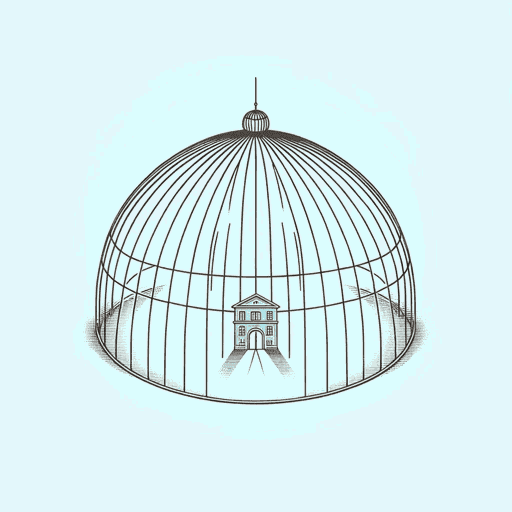
Under the Dome
61 pages • 2-hour read
Stephen KingUnder the Dome
A modern alternative to SparkNotes and CliffsNotes, SuperSummary offers high-quality Study Guides with detailed chapter summaries and analysis of major themes, characters, and more.
Important Quotes
“His last thought before the darkness that comes to us all, chucks and humans alike: What happened?”
(Chapter 1, Page 5)
The suddenness of the Dome’s descent catches both animals and humans by complete surprise. These last thoughts of a woodchuck ambling between the border of Chester’s Mill and the outside world are of shock. He is cut cleanly in half as the Dome descends, foreshadowing the absolute barrier that now exists between the Mill and the world.
“Behind him, the town whistle whooped like the end of the world.”
(Chapter 3, Page 28)
Junior Rennie has not realized that the Dome has come down; he has been too busy with murder. It is only the sound of the whistle that signifies something has gone wrong. The fact that something has, indeed, gone terribly wrong is indicated in the simile. It may not be the end of the world for everyone, but it turns out that the whistle predicts the end of Chester’s Mill.
“He could now see the approaching flashers of a police car, but far ahead of it—as if escorting the cops by virtue of some higher authority—was a large black vehicle that looked like a rolling coffin: Big Jim Rennie’s Hummer.”
(Chapter 5, Page 56)
Barbie notes the looming and ubiquitous presence of Big Jim Rennie. He is more important, even, than the police, it would seem. The simile here (“like a rolling coffin”) foreshadows Rennie’s inevitable demise near the end of the book. This quotation also hints at Rennie’s religious fervor that eventually has him comparing himself to God.
“Barbie had darker suspicions; this was a national security situation, after all, in a time when the whole country was paranoid about terrorism. Some calls were getting through, but fewer and fewer as the evening went on.”
(Chapter 7, Page 93)
This references the context in which the book is set, just a few years after the 9/11 terrorist attacks. In addition, it creates an ominous tone, as Chester’s Mill is slowly but steadily cut off from the outside world. Even communication beyond the town’s borders becomes regulated and difficult, increasing the paranoia and fear under the Dome.
“It was supposed to be a surprise audit, but Big Jim had gotten advance word. Not much; just enough for them to go to work with the computer program Claudette called MR.CLEAN. They called it that because it always produced clean numbers.”
(Chapter 8, Page 115)
First Selectman Andy Sanders remembers the corruption and collusion that he, his wife, Claudette, and Big Jim Rennie have engaged in regarding the town’s funds. Though the Dome accelerates and exaggerates some of the worst ethical choices made by the townspeople, their moral corruption and ethical lapses predate the alien intervention.
“‘I’m the editor of the local newspaper, after all, and I want to get some pix.’ She raised her voice a little more. ‘Especially a few of soldiers standing with their backs turned on a town that’s in trouble.’”
(Chapter 9, Page 147)
This showcases Julia Shumway’s default personality, full of bravery and determination. It also reveals her journalistic savvy, as she realizes the importance of visuals, how the image of the soldiers with their backs toward the town could resonate with viewers in ways that could be troublesome for the military and the government.
“‘The Constitution’s been cancelled in The Mill,’ Junior said, with absolutely no idea that he was speaking prophecy.”
(Chapter 10, Page 187)
This marks a turning point in the situation with the Dome, as Big Jim Rennie and his allies, including his son, Junior, begin to limit personal freedoms and democratic rights. Junior confronts Sam Verdreaux—nicknamed Sloppy Sam—over Sam’s determination to buy alcohol. Rennie has ordered all sales of alcohol halted on no authority but his own.
“But if we stay cut off, who in here’s going to listen to me? Get it through your head: this town has seceded. Not just from America but from the whole world.”
(Chapter 11, Page 229)
Barbie tries to inform Colonel Cox that no orders from the military, or even from the president himself, will impact the events unfolding in Chester’s Mill. He realizes that Rennie’s desire for power and control overrules any sense of duty to democracy—or even to his own constituency. The Mill functions independent of outside oversight, like the stranded children in Lord of the Flies, to which Joe McClatchey explicitly compares their situation under the Dome.
“His son, on his knees, gave him a dark and unreadable look. There might have been love in it—Big Jim certainly hoped there was—but there were other things, too. Gotcha now? Was Gotcha now part of that look?”
(Chapter 12, Page 293)
After Junior witnesses his father bludgeon Reverend Coggins to death, a tension develops between the two men. They are both murderers, both sharing the other’s secret. Thus, the possibility for blackmail looms large. Junior has always suspected his father would protect his position of power before he would protect his son; now he has leverage.
“Piper remembered how she’d first thought the mother and baby lying beside the road was a bag of garbage. And that, of course, was what they’d been to whoever did this. She stood up. ‘I’m going to talk to her.’”
(Chapter 14, Page 387)
Reverend Libby is determined to defend Sammy Bushey from the humiliating and dehumanizing attack on her—perpetrated by the new officers, as she comes to find out. Sexual assault is one of the ways in which Rennie’s hand-picked police force intimidates and controls the townspeople—a tactic often used in arenas of conflict and war.
“This was his championship game, and everything was breaking his way. He had the sense—the total belief—that nothing could go wrong during this magical passage; even things that seemed wrong would become opportunities instead of stumbling blocks.”
(Chapter 16, Page 448)
Big Jim Rennie’s overconfidence is palpable—and, ultimately, fallible. He compares his experience of amassing control in Chester’s Mill to the girls’ basketball games he enjoys watching. He particularly likes watching the athletes who seem unstoppable, who perform “in the zone” almost without conscious thought. This metamorphosizes into Rennie’s belief that it is God’s will that he take over the leadership of the town.
“Later on—much too late to do any good—Julia Shumway would piece together most of how the Food City riot started, although she never got a chance to print it. Even if she had, she would have done so as a pure news story: the five Ws and the H. If asked to write about the emotional heart of the event, she would have been lost. How to explain that people she knew all her life—people she respected, people she loved—had turned into a mob?”
(Chapter 16, Pages 464-465)
Another turning point in the devolution of civic order under the Dome, the riot was engineered by Big Jim Rennie. First, he decides to shutter the grocery stores—before supplies run short and with no other justification than his desire to control the flow of supplies—and then he recruits people to incite the crowd. Sam Verdreaux, for example, is paid (with alcohol) to throw rocks at the police guarding the store.
“But until now it had always felt geographically big to him, with plenty of room to roam. It was amazing how much it shrank in his mind once he realized that he and his mom and dad couldn’t just pile into the family car and drive to Lewiston for fried clams and ice cream at Yoder’s.”
(Chapter 17, Page 544)
Joe McClatchey wonders at how deeply the Dome has impacted his feelings about Chester’s Mill. It had once seemed nearly endless; now, it seems small and claustrophobic. The psychological impact of the Dome’s presence, cutting The Mill’s residents completely off from the outside world, cannot be underestimated.
“Barbie was also very thirsty, and it didn’t surprise him much when one of the new officers showed up with a glass of water in one hand and a sheet of paper with a pen clipped to it in the other. Yes, it was how these things went; how they went in Fallujah, Takrit, Hilla, Mosul, and Baghdad. How they also went in Chester’s Mill, it seemed.”
(Chapter 18, Page 585)
The suspension of democratic freedoms and constitutional rights under the Dome is complete. Barbie has been framed for murder and locked up, fully expecting to be interrogated under torture—which he is. Chester’s Mill is more akin to the lawless terrain of Iraq, now, than to the United States in which it geographically resides.
“She walked down the street with Horace pacing in state beside her, and on every telephone pole she put up a copy of the Democrat’s last issue. The headline—RIOT AND MURDERS AS CRISIS DEEPENS—seemed to glare out in the light of the fire. She wished now she had settled on a single word: BEWARE.”
(Chapter 19, Page 653)
Julia is determined to disseminate the Democrat newspaper as long as she possibly can. Information is power, and the residents of Chester’s Mill should be armed with the truth. Her dawning realization that the situation is growing more dire, as Rennie amasses more control and the Dome shows no signs of dissipating, creates an even greater sense of urgency.
“Rusty could think of only one possible explanation: the generator had created a radiation belt to discourage explorers such as himself. To protect itself.”
(Chapter 20, Page 730)
The aliens who are creating the Dome apparently have a vested interest in keeping the source of their power secret—at least to a degree. Barbie argues later that the aliens are also directing the bravest of their subjects toward the box; that is, they are playing a game in which The Mill’s residents do not fully understand the rules.
“‘More people will do this, won’t they?’ she asked when they had reached the end of the driveway. ‘Because suicide gets in the air sometimes. Like a cold germ.’”
(Chapter 22, Page 831)
An elderly resident of The Mill, Henrietta Clavard remarks on the oppressive—and psychologically damaging—atmosphere that runs rampant under the Dome. The losses that the townspeople have experienced, along with the uncertainty of their situation, propel some to despair. The simile here expresses urgency, as cold germs spread rapidly.
“‘Hang in there, kid,’ Private Ames said, and ran off to get his scolding. Ollie imagined it had to be a scolding, since you couldn’t very well demote a private. Surely they wouldn’t put him in the stockade or whatever for talking to one of the animals in the zoo. I didn’t even get any peanuts, Ollie thought.”
(Chapter 22, Page 847)
The soldiers on the outside of the Dome are not supposed to speak to those trapped under it, but Private Ames has made an exception for the poor, lonely child who has lost his entire family in the crisis. Ollie understands, with his precocious metaphor, that the townspeople are part of a cruel experiment, being held like animals in a zoo. The experience is clearly dehumanizing.
“‘What you do not know,’ Big Jim continued, ‘is that the Dome is the result of a conspiracy perpetrated by an elite group of rogue scientists and covertly funded by a government splinter group. We are guinea pigs in an experiment, my fellow townspeople, and Dale Barbara was the man designated to chart and guide the experiment’s course from the inside!”
(Chapter 22, Page 860)
Rennie is correct on at least one point: they are “guinea pigs in an experiment,” but that experiment is being conducted by a group of childish aliens, rather than by a sophisticated arm of the military-industrial complex. Barbie is merely a convenient scapegoat that Rennie can use to cover up his own corruption and crimes.
“The horizon beyond the Dome now appears blurred, and above the trees, the sky has darkened, due to accumulated particulate matter. It’s better when you look straight up, but still not right; the blue has a yellowish cast, like a film of cataract on an old man’s eye.”
(Chapter 24, Page 951)
The distortion of the view through the Dome serves as a metaphor for how the Dome affects the clarity of thinking under its reign. The more clouded the Dome becomes, the more isolated and panicked the residents of The Mill become. Employing the simile about the cataract only emphasizes the point: Nobody under the Dome can see clearly, literally, and metaphorically.
“Look, now. Look and see. Eight hundred people are crammed against the Dome, their heads tilted up and their eyes wide, watching as their inevitable end rushes toward them.”
(Chapter 24, Page 985)
Here, the author breaks the fourth wall, directly addressing the readers, one of many instances throughout the novel. In doing so, the author implicitly implicates his readers, at least emotionally. That is, while the readers are helpless to prevent the “inevitable end”—only the omniscient author retains that ability—they can feel the terror and fear that the residents experience.
“Only three hundred and ninety-seven of The Mill’s two thousand residents survive the fire, most of them in the northeast quadrant of town. By the time night falls, rendering the smudged darkness inside the Dome complete, there will be a hundred and six. When the sun comes up on Saturday morning, shining weakly through the only part of the Dome not charred completely black, the population of Chester’s Mill is just thirty-two.”
(Chapter 25, Page 997)
The scale of the horrifying end of Chester’s Mill is emphasized by the stark nature of the sheer numbers. Nearly two thousand people have perished in the space of a week under the psychological and physical torment of the Dome.
“Julia spat in the grass, then faced [Barbie] again. ‘I can’t believe we did this to ourselves. The things running the box—the leatherheads—set up the situation, but I think they’re only a bunch of kids watching the fun. Playing the equivalent of a video game, maybe. They’re outside. We’re inside, and we did it to ourselves.’”
(Chapter 25, Page 1011)
Julia’s point speaks to the larger argument that the author, at least implicitly, makes. The townspeople of The Mill—just like the townspeople of anyplace the reader might inhabit—do not need the presence of aliens or alien technology to dissolve into divisiveness, fear, and ultimately self-destructive tendencies. The seeds are there long before the aliens metaphorically fertilize the soil.
“Groh beamed and shook Ollie’s filthy hand. ‘Welcome back to the United States, son. Welcome back to the world.’”
(Chapter 26, Page 1065)
After the Dome lifts, one of the soldiers welcomes Ollie back—though one wonders what kind of life he will be able to lead, as an orphan who has witnessed the deaths of his entire family. The soldier’s comments also speak to the dissolution of democracy, of a cutting off of community experienced by the people trapped under the Dome.
“Barbie and Julia embraced next to the black square of ground where the box had been. Nothing would grow there, not ever again.”
(Chapter 26, Page 1067)
This notation is simultaneously hopeful and ominous, a warning of sorts. On the one hand, the Dome is gone, and there are, at least, a very few survivors. On the other hand, the scar left behind by the Dome—an emptiness that cannot foster life—remains behind as a haunting legacy of the human capacity for self-destruction.

Unlock every key quote and its meaning
Get 25 quotes with page numbers and clear analysis to help you reference, write, and discuss with confidence.
- Cite quotes accurately with exact page numbers
- Understand what each quote really means
- Strengthen your analysis in essays or discussions