Walking Down Park
A modern alternative to SparkNotes and CliffsNotes, SuperSummary offers high-quality Study Guides with detailed chapter summaries and analysis of major themes, characters, and more.
Background
Black Arts Movement
Nikki Giovanni is a prominent figure in the Black Arts Movement. This movement was a response to the Harlem Renaissance, pioneered by poets such as Langston Hughes, Lucille Clifton, Audre Lorde, and Sonia Sanchez. Critics of the Harlem Renaissance believed that Hughes and others were writing in the style of white Americans, making their work palatable for white culture. By contrast, the proponents of the Black Arts Movement created art that spoke directly to Black Americans. They wrote in a style that incorporated slang and the so-called “street language” of African American communities.
Many poets of this movement avoided capitalization and punctuation, meant to reflect a more natural form of communication that did not conform to American academia. In “Walking Down Park,” Giovanni writes without punctuation and capitalization. This allows the language to flow without stopping and mimics informal patterns of speech or writing informally for one’s friends instead of outsiders.
The poem also addresses many issues unique to the Black community. The speaker addresses other African American people directly, using the term “you” and “we,” asking variations of “did you ever wonder” several times. When she says, “we are the stock / exchanged” (Lines 12-13), she refers to Black people brought to the United States and sold like livestock. By using the pronoun “we,” she includes herself and implies that those reading the poem are included in this category with her. This suggests that those reading may be descendants of formerly enslaved peoples, but also that African Americans are still being treated as livestock.
Other lines address the concerns of Indigenous people. The Speaker references the fact that land in the United States used to belong to the Iroquois, Algonquins, and Mohicans, among others. She suggests that, prior to colonization, Indigenous tribes accorded nature more respect than Europeans and European descendants, and that people would have been happier had the Europeans not colonized the US. Like the Indigenous peoples, European and European-descended Americans displaced African Americans.
The line “black is beautiful” (Line 56) is a clarion call from the Black Arts and Black Power Movements. Reacting against a history of oppression, African Americans, specifically women, sought to reaffirm Black beauty. They incorporated traditional dress from African cultures into their wardrobe, including Daishikis, head-wraps, etc. Many poets of the time incorporated the phrase “Black is beautiful” or similar messages in their writing. Lucille Clifton, for example, wrote multiple poems praising her hips and other parts of her body. These poems distinguished her as an African American woman embracing her beauty.
Literary Context: Afrofuturism
Afrofuturism in literature often combines elements of science fiction and speculative fiction with Black history and culture. Mark Derry coined the term in “Black to the Future,” his 1994 essay that defines a new way of living and thinking for African Americans. Afrofuturism, however, has many definitions, and it can play out differently depending on the medium and from where the artist(s) resides. Some artists distinguish between African futurism, which includes writing and settings on the African continent, and Afrofuturism, which is writing and settings in Diasporic environments such as the US.
One aspect of Afrofuturism is that it addresses past/present inequalities and historical wrongs, speculating what might have happened had Europeans not colonized Africa. Afrofuturist stories pose hypothetical alternate worlds in which the present and/or future are altered. This reimagining shows different possible ways society can move forward by overcoming the wrongs of the past and creating a future where Black people and other marginalized and formerly colonized peoples have successfully overcome, undone, or never experienced the effects of colonization.
Afrofuturist writers, such as Octavia Butler and Danez Smith, express their ideas in multiple mediums and genres including poetry, fiction, and film. A prominent modern-day example of Afrofuturism is the movie Black Panther, which depicts a fictional African nation, Wakanda, that was hidden from colonizers and became an advanced civilization on its own terms.
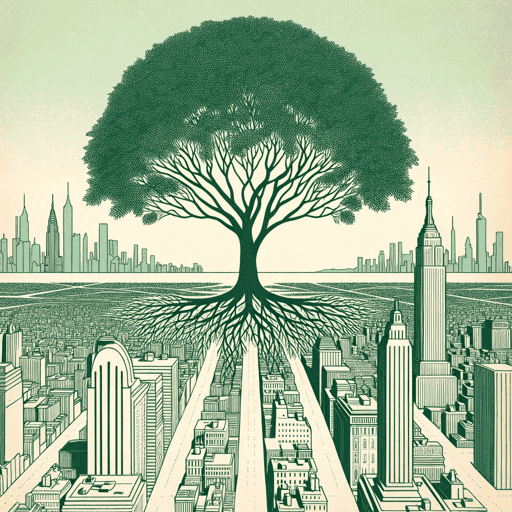
“Walking Down Park” is a prime example of Afrofuturism. It envisions a different past, one in which Europeans did not colonize America. It envisions the world from before the Europeans arrived, depicting it as greener and free. In the latter stanzas, the speaker describes a Harlem where “our herbs and roots” (Line 53) grow freely. Giovanni is suggesting what New York might look like if African Americans had not been brutally taken from Africa and robbed of their natural landscape and historical heritage. Harlem would be full of the sounds of Africa, the parrots and monkeys, and “me and you” (Line 58), meaning the speaker and reader, would be able to “[sit] in the sun” (Line 58) with other animals, laughing at them unfettered. It is a world more harmoniously attuned to nature, where people and animals interact and share space.

Get in-depth, chapter-by-chapter summaries and analysis from our literary experts.
- Grasp challenging concepts with clear, comprehensive explanations
- Revisit key plot points and ideas without rereading the book
- Share impressive insights in classes and book clubs
Related Titles
By Nikki Giovanni