Warlight
52 pages • 1-hour read
Michael OndaatjeWarlight
A modern alternative to SparkNotes and CliffsNotes, SuperSummary offers high-quality Study Guides with detailed chapter summaries and analysis of major themes, characters, and more.
Symbols & Motifs
Content Warning: This section of the guide includes discussion of animal cruelty and death.
The Greyhounds
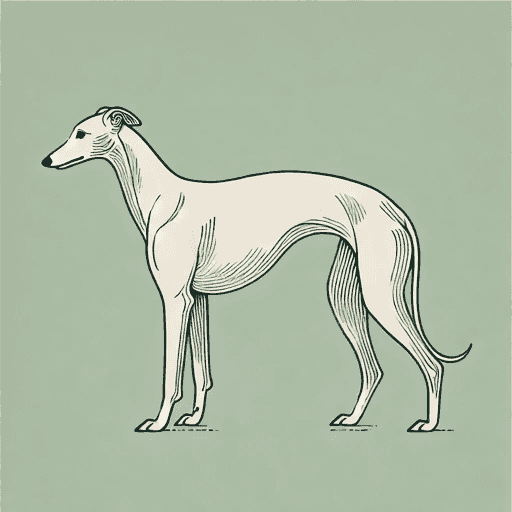
The greyhounds are symbols of displacement and anonymity and represent Nathaniel’s desire for belonging and freedom. Smuggled onto The Darter’s mussel boat and sold with forged papers, the greyhounds do not have traceable documents to confirm their identities. Nathaniel describes them as “wastrels with no recorded past, either kidnapped from a château or saved from a meat factory to be given a second chance. They were as anonymous as roosters” (75). Nathaniel’s upbringing is similarly disorienting as he and Rachel were uprooted and evacuated during the Blitz and after the war found themselves without their parents and raised by a group of strangers. The stories they were told were also “forged” in the sense that they were never told the complete truth about their parents’ absence and the work of The Moth and his colleagues. Like the scared and vulnerable animals hiding under blankets, the siblings had to accept their estrangement in their own homes, never quite knowing if they were in danger or “saved.” For Nathaniel, the dogs’ unrecorded past also parallels his own doubts about his past and desire to trace his parents’ history to help him understand himself.
At the same time, the greyhounds also represent a desire to break free from restrictions and run free. Nathaniel remarks that The Darter “scorned bloodlines among dogs as well as humans. ‘It’s never your family that’s the problem’” (85). For The Darter, lineage does not determine one’s identity and should not be the measure of one’s worth or potential. Nathaniel refers to the greyhounds’ value in being “the unknown element” (74), untethered to a predetermined past. On one of his outings with Agnes in a vacant home, he and Agnes allow the dogs to run free in the unfurnished space, a setting where the young couple could feel safe in their shared vulnerability. Nathaniel writes, “[W]e crashed our bodies into dogs that were in chaotic delight after being restrained for hours in the back seat of a car, now scattering their racing claws like high heels up and down the carpetless stairs” (88). Likewise, Agnes and Nathaniel freely explore the space, their bodies, and their dreams for the future in the liberating darkness.
Nathaniel also sees a similarity between the greyhounds’ unrestrained freedom and his and Rachel’s own unsupervised upbringing. He assesses, “Rachel and I were not too different in our anonymity from the dogs with their fictional papers. Like them we had broken free, adapting to fewer rules, less order” (93-94). At the end of the novel, Nathaniel has a pet greyhound and identifies with the animal’s longing for “something warm and human for security, a faith in another” (279). The pet represents an ambiguous ending, as in contrast to the image of the greyhounds running wild and free, Nathaniel remains in the Malakites’ walled garden and isolated home without any human contact.
Maps
Nathaniel’s desire to investigate his past and gain a sense of control over his present is often represented through the motif of maps. Maps appear throughout the novel: in the epigraph, the map room at the archives, the map he finds in his mother’s book, the relief map in his father’s office, and the maps he meticulously draws as a youth. He recalls, “I was obsessively drawing maps of our neighbourhood in order to feel secure. I thought that what I could not see or record would cease to exist” (133). Nathaniel credits his early residence in the Saints for initiating his habit, as the network of similarly named villages and inaccurate signposts left him disoriented as a youth. He recalls that during the war, coastal villages like his were erased from the maps and their signposts removed to thwart a possible Axis invasion. This erasure symbolizes his fear of literal erasure—his sense that his familiar world can disappear at any time. He compares the sense of being lost to feeling as if he’d “misplaced [his] mother and father” (133). Making maps allowed Nathaniel to cope with his feelings of abandonment and feel at home, protected, and equipped to navigate the world around him.
As an adult, maps continue to play a vital role in providing Nathaniel with a sense of order and safety. Mentally mapping his and his mother’s past through memories gives him a sense of continuity and place to combat his feelings of alienation and displacement. Yet Nathaniel learns that maps, like memories, are also constructions, traces that can be written and erased, misleading and redrawn. As he discovers that his mother’s story may ultimately be unknowable, Nathaniel refocuses his attention not on what the map depicts, but on what is left missing in the “creases” (Location 71). Rather than represent precision and control, maps come to signify the shadowy outlines of the past and the significant silences, such as the untold stories of Rose’s experiences. When Nathaniel moves into the Malakites’ home, he asks Mrs. Malakite to map the seeds planted in the garden. Even with her fine memory, Nathaniel sees new, unmapped sprouts emerging from the ground, symbolizing the ways the unexpected and unremembered manage to emerge into the light.
The Nightingale Floor
The 100-year-old wood floor at White Paint creaks under a person’s weight, and Nathaniel’s grandmother called it a nightingale floor because it alerted her of any unseen intruders. Though not mentioned in the novel, the term is borrowed from the Japanese uguisubari, or “warbler floors” that would chirp when walked upon and could be found in temples such as the Nijō Castle in Kyoto. In the novel, the floor symbolizes the desire for warning and security, a longing that has haunted Nathaniel since his parents’ absence. In a larger context, the nightingale floor also symbolizes the desire for peace in postwar England, where destruction and disruption impacted at least three generations, as represented in the floor’s location at Nathaniel’s grandmother’s house.
In the chapter titled “The Nightingale Floor,” Nathaniel describes his mother’s reliance on the floor to alert her to the real threat of retaliation from her work in intelligence. The floor provided the only sound in the otherwise noiseless house, and Nathaniel writes, “It comforted her, she told me, gave her safety. Otherwise, silence” (185). However, the chapter describes Rose’s death by an assassin outdoors, where the floor could not warn her. Rose, perhaps knowingly, lived with a false sense of security as a mode of survival. The tension between safety and silence was oppressive to Nathaniel as a youth, as he longed to hear his mother tell him the truth of why she left. He only finds out later as an adult that his mother’s silence was not out of coldness, but for his protection. In the final lines of the novel, Nathaniel leaves White Paint and “walk[s] loudly along the nightingale floor” (282). The gesture signifies his desire to not keep secrets, but to let whatever was once hidden or repressed be known and heard.

Unlock the meaning behind every key symbol & motif
See how recurring imagery, objects, and ideas shape the narrative.
- Explore how the author builds meaning through symbolism
- Understand what symbols & motifs represent in the text
- Connect recurring ideas to themes, characters, and events