What Stalks the Deep
48 pages • 1-hour read
T. KingfisherWhat Stalks the Deep
A modern alternative to SparkNotes and CliffsNotes, SuperSummary offers high-quality Study Guides with detailed chapter summaries and analysis of major themes, characters, and more.
Chapters 8-11Chapter Summaries & Analyses
Content Warning: This section of the guide includes discussion of graphic violence, injury, and death.
Chapter 8 Summary
Easton describes their encounter with the red-lit creature to the others, and Ingold is frustrated Easton did not wake him. The group assumes the creature is the same entity responsible for the sounds in the mine—”What are the odds of two horrible inhuman things lurking in the mine?” (83). Ingold argues that they do not know whether the creature is dangerous. Later, while sitting by the fire, Easton reflects on what they saw, briefly questioning the event but remaining certain that they had seen something strange.
Their discussion is interrupted when Elijah arrives, calling for Denton and explaining that a woman in Flatwood, Louisa, has been attacked by a bear and needs medical attention. He also reports that another townsman, Lee Mason, was killed. Denton gathers his medical bag and agrees to assist. Easton and Ingold accompany him.
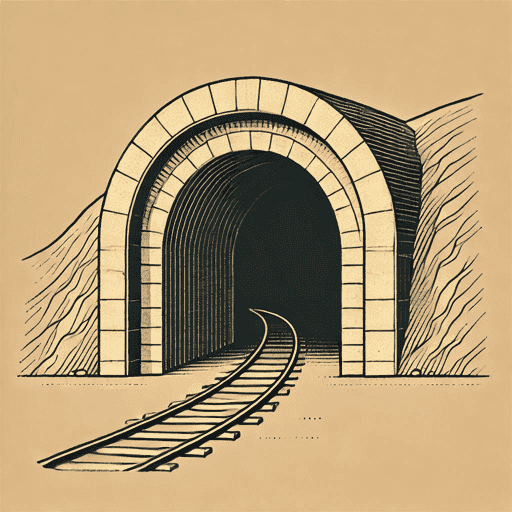
Elijah leads them across uneven ground and through dense woodland to the shack where Louisa has been taken. Denton begins treating Louisa’s injured arm. Easton greets a nearby hound and observes its typical canine behavior, noting, “Unlike Thunder, this dog was delighted to sniff me” (87).
Easton and Ingold examine Lee Mason’s body and find it hollowed out, noting that the wounds do not resemble those of a bear attack. They consider whether the attacker may be the same entity encountered in the mine, and Ingold says that they must return there to investigate further.
After stabilizing Louisa, Denton emerges and reports that she is unable to provide additional details about the attack. Easton walks to Roger’s nearby house and knocks but receives no answer. Although they consider entering, they decide against it. As Easton departs, they note that Thunder did not bark when they knocked on the door.
Chapter 9 Summary
The next morning, Denton returns to the mine alone to continue clearing debris. Kent expresses concern for Denton’s well-being, prompting Easton to recognize that Denton’s behavior may be more troubling than they’d acknowledged.
As Easton enters the mine, Denton informs them that they have cleared enough rubble to pass through. Denton, Easton, Ingold, and Angus climb through the opening and discover a narrow, spiraling tunnel along with discarded soup cans. Denton crawls into the confined passage, but Ingold intervenes, warning of potential dangers. Denton acknowledges the risks but insists on continuing the search for Oscar, stating, “He saved my life when I was seven […] I owe it to him to try” (96). Ingold relents, and the others agree to remain behind while Denton explores.
As they wait, Easton listens to the sounds of the mine and watches for the red light. Easton asks Angus whether he would search a mine for their body, and Angus responds that he would not, which Easton finds reassuring. Ingold informs Easton that Denton continues to struggle with the events in Ruravia at Usher’s house, which brought up memories of war.
Denton returns and tells them they must come see what lies at the end of the tunnel. The group proceeds down the narrow passage. Easton experiences claustrophobia, fearing they may become trapped. As they crawl forward, the tunnel walls begin to undulate, causing dizziness, and Easton suspects the space is shaped to accommodate the flat creature they had encountered. Closing their eyes, Easton continues until Denton calls to them. When Easton opens their eyes, they see a large chamber with a pearly floor. Upon examining it, Easton realizes that the surface is not reflecting their image but instead mimicking their appearance.
Chapter 10 Summary
Easton points out that the floor is mimicking them. Ingold explains that the floor is likely a shell-like structure belonging to an organism that uses chromatophore cells to mimic its surroundings as a form of self-defense. Ingold asserts that this discovery confirms the accuracy of Oscar’s earlier letters and suggests that his descriptions were not hallucinations, as the telegram implied.
Unsettled, Easton retreats up the tunnel, intending to return to camp. Upon reaching the upper passage, they see the red light again and alert the others. The group pursues the light, with Denton rushing ahead. He catches up to a retreating figure and calls out, “Oscar.”
Easton joins Denton and sees a figure dressed in mining gear and goggles. Denton recognizes him as Oscar, but the figure does not speak and instead communicates by writing on a slate, claiming that mine gas has rendered him unable to talk. The others arrive, and Angus draws his gun, ordering the figure to remove his goggles. When he complies, they realize that he is neither Oscar nor human.
Using the slate, the creature explains that mimicking eyes is difficult and states that it means no harm. Denton lunges at it, and Ingold restrains him as Denton demands to know Oscar’s whereabouts. The entity writes, “WE MEAN NO HARM. ONLY TALK” (113), explaining that he adopted Oscar’s appearance in hopes of gaining their trust and presenting them with a letter he has written. When Angus asks what it eats, it responds that it consumes small organisms in water but has also absorbed nutrients from soup. At Denton’s request, the being alters its appearance so that it no longer resembles Oscar.
Chapter 11 Summary
When the group returns to camp, the figure resembling Oscar begins writing with both hands simultaneously, producing different lines of text at once. After finishing, the others read the message. The entity asks them not to be afraid and explains that it has been sleeping underground for many years. It expresses a desire to keep its existence private, stating that it has been separated from a larger consciousness. The entity requests assistance in reuniting with what it identifies as the Wholeness, as it cannot break through its protective shell. Denton notes similarities between the Wholeness and the fungus encountered in Ruravia, though Easton disagrees with the comparison.
Ingold enthusiastically poses several questions, which the entity answers in writing. They learn that the Wholeness once existed in the ocean, spreading across the surface in a vast sheet. The entity clarifies that the Wholeness is a single organism and that it was separated from it during a mining explosion. It explains that two Wholenesses are capable of merging and exchanging information. According to its account, the Wholeness became trapped underground during an ice age and sought refuge in a deep cave. It had sent out a portion of itself, referred to as a Sentry, but that part never returned. After its own separation, the entity began observing miners and learning to imitate human behavior.
When Denton questions why the entity is being so forthcoming, it responds, “YOU ASKED,” prompting Denton to walk away, followed by Kent. Easton, who has been thinking of the being as Not-Oscar, asks what it should be called. The entity names himself Fragment.
Chapters 8-11 Analysis
Chapters 8-11 begin to clarify the ambiguity developed in the earlier chapters of the text. The attack that killed Lee Mason and injured Louisa confirms that the surrounding threat is violent and lethal. Easton describes the graphic sight of Mason’s body: “The abdomen was simply gone, flesh and organs torn away until I could see exposed backbone” (88). The visceral imagery raises the narrative stakes and urges both the characters and the reader to confront the idea that the mine contains a dangerous and unnatural entity.
Easton’s response to the corpse alludes to their familiarity with gore and death, highlighting How Trauma Shapes Threat Perception. Observing the mutilated body, Easton inwardly remarks, “Not the worst corpse I’ve seen, but certainly not a pleasant sight” (88). The understatement signals their familiarity with death. Past trauma has altered how Easton measures horror. Instead of reacting with revulsion at the sight of the body, Easton situates it within a lifetime of worse experiences. This normalization of graphic imagery emphasizes the idea that prolonged exposure to violence alters one’s emotional response over time.
Bodily sensation becomes central to the novella’s rising tension. Easton describes their visceral response while examining a mine shaft: “my stomach did not so much clench as reach up and grab my esophagus while screaming obscenities” (95). Here, Kingfisher incorporates exaggerated imagery, maintaining Easton’s witty tone without diminishing their fear. Crawling through the spiral shaft intensifies Easton’s sense of claustrophobia—"Crawling down the spiral shaft was worse than I had imagined. My shoulder pressed against the outer wall and my helmet kept scraping against the ceiling” (99). This physical compression is combined with the spiraling tunnel, which mirrors fear-driven rumination. Easton narrates their catastrophic thinking in a breathless run-on sentence: “what if [Angus] got stuck like a cork in a wine bottle and then I would have no way out and we would both be trapped and we’d die in here and no one would ever find our bodies” (99). Through these tense moments of sensory language, Kingfisher reinforces how the perception of threat triggers intense fear and catastrophic thought.In the context with the wider Sworn Soldier series, Easton's encounter with the pearl floor develops the novella’s thematic emphasis on The Boundary Between Monstrosity and Personhood. As Easton watches their reflection in the cave floor, the image transforms: “As I watched, my face opened its mouth, revealing rows of pearl teeth, in a silent scream of horror” (104). The floor imitates rather than reflects, signaling intelligence. This mimicry recalls the sentient fungus in What Moves the Dead, which animated and imitated human bodies. If the inhuman appears frightening when it resembles humans, the text implicitly complicates any assumption that human identity is inherently benign, underscoring the novella’s exploration of conformity and exploitation.
Fragment’s introduction confirms inhuman sentience while subverting the group’s expectation that any inhuman sentience must be hostile. By consistently filtering the narrative through Easton’s trauma-informed perspective, Kingfisher primes the reader to anticipate a dangerous entity. However, when Fragment communicates that “WE MEAN NO HARM. ONLY TALK” (113), the narrative pivots from expected violence to the more complicated task of intellectual and moral evaluation. This reversal reflects Kingfisher’s broader tendency to complicate conventional tropes with moral ambiguity.
Denton instinctively frames the encounter through prior trauma, interpreting Fragment as inherently dangerous because he is inhuman. Because of his prior experience with the sentient fungus in Ruravia, Denton equates inhuman sentience solely with danger. In contrast, Ingold responds with curiosity and excitement. When they first discover Fragment, Ingold wears “the beatific expression of a small boy who has just been given a puppy” (117). His fascination reflects curiosity rather than fear. Easton, meanwhile, occupies a middle ground between these positions. Although shaped by past trauma and primed for danger, Easton does not immediately assume Fragment is hostile. Instead, they remain skeptical yet open-minded, evaluating Fragment as they would any unfamiliar person. The contrast between these three characters’ positions monstrosity as a matter of perspective shaped by prior experience.
The introduction of Fragment and the human characters’ responses to the sentient life complicate the narrative. What began as a search for a missing person has evolved into an evaluation of personhood. Faced with a seemingly benevolent sentience, the characters must navigate the rising tension that accompanies their ethical dilemma in meeting Fragment.

Unlock all 48 pages of this Study Guide
Get in-depth, chapter-by-chapter summaries and analysis from our literary experts.
- Grasp challenging concepts with clear, comprehensive explanations
- Revisit key plot points and ideas without rereading the book
- Share impressive insights in classes and book clubs