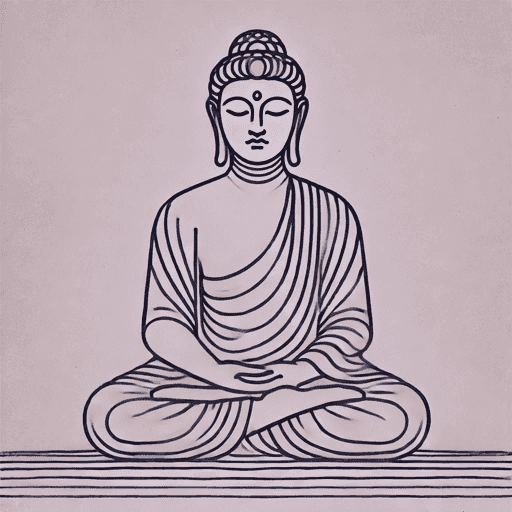
What the Buddha Taught
49 pages • 1-hour read
Walpola RahulaWhat the Buddha Taught
A modern alternative to SparkNotes and CliffsNotes, SuperSummary offers high-quality Study Guides with detailed chapter summaries and analysis of major themes, characters, and more.
Key Figures
Walpola Rahula
Walpola Rahula Thero was a Buddhist monk and university professor from Sri Lanka. Born in 1907, Rahula became a Buddhist monk at the age of 13. According to his biography on the Walpola Rahula Institute website, Rahula was educated by the Venerable Paragoda Sumanasara at a Buddhist monastery in Sri Lanka. He completed his monastic training there and later worked with a Buddhist missionary organization that sought to help people who were oppressed by the caste system in Sri Lanka. Rahula believed that the Buddhist clergy should not discriminate based on caste, as he felt that this opposed Buddhist doctrine.
As a young adult, he attended the University of London in Colombo, Sri Lanka, giving him the distinction of being the country’s first Buddhist monk to receive a university education. As Sri Lanka became independent from Great Britain, Rahula joined other monks in campaigning for social reforms such as free education. In 1950 Rahula moved to Paris to attend Sorbonne University as a post-graduate research fellow. He completed many important works during this time, such as translating ancient Buddhist texts into French. During this time, he also wrote What the Buddha Taught, which soon became a classic in literature on Buddhism. Rahula’s career in academia continued as he worked in positions at Northwestern University, the University of Sri Jayawardanapura, the Buddhist and Pali University of Sri Lanka, and finally, the Walpola Rahula Institute in Sri Lanka.
Rahula’s experience as a monk and his academic expertise in Buddhism as well as other religions makes him a trustworthy expert on the subject of Buddha’s teachings. His knowledge of the ancient language Pali, the now-extinct Middle Indo-Aryan language of the Buddhist canon, gives him the ability to directly translate Buddha’s words into English, allowing him to relay Buddha’s teachings as accurately as possible to his Western audience.
The Buddha
The Buddha, or “the enlightened one” was born Siddhattha Gotama (spelled Siddartha Gautama in Sanskrit) in the sixth century BCE. Gotama was born a prince; his parents were Queen Māyā and King Suddhodana, who ruled the Sākyas Kingdom in what is now Nepal. At age 16, Gotama married Princess Yasodharā, with whom he had one son, named Rāhula. As a young man, Gotama realized how all of humanity suffers, and left his family and life of privilege to search for a resolution to this suffering.
According to Buddhist tradition, Gotama embraced a life of asceticism for six years as he traveled through the Ganges valley and studied under different religious teachers from the Hindu tradition. He felt unsatisfied with the ascetic practices he learned and decided to follow a different path. Buddhists believe that a 35-year-old Gotama realized enlightenment one evening under a Bodhi tree. With this new mindset Gotama, now the Buddha, or the enlightened one, began preaching his beliefs to others. For the rest of his life, the Buddha taught people of all ages, social classes, and genders how to live a noble and happy life and realize enlightenment for themselves. The Buddha died in modern-day Uttar Pradesh at the age of 80. After his death people across Asia continued to embrace Buddhism, which now has hundreds of millions of followers worldwide.
In What the Buddha Taught, author Walpola Rahula reverently refers to the Buddha, whose teachings form the foundation of Buddhism. Rahula emphasizes the Buddha’s compassionate actions and egalitarian attitude, portraying him as a kind, intelligent, and open-minded person. He describes him as a “practical teacher” who only taught what he believed would be useful. Rahula writes, “He was a practical teacher, full of compassion and wisdom. He did not answer questions to show his knowledge and intelligence, but to help the questioner on the way to realization” (104).
He emphasizes that the Buddha was not a god or even a divine messenger, but was simply a man who used his own discipline and intelligence to realize truth. He writes, “The Buddha was not only a human being; he claimed no inspiration from any god or external power either. He attributed all his realization, attainments and achievements to human endeavor and human intelligence […] Every man has within himself the potentiality of becoming a Buddha, if he so wills it and endeavors” (24). Rahula explains that Buddhists respect the Buddha for showing people the path to enlightenment, and encourages the reader to dedicate themselves to understanding the Buddha’s teachings.
King Asoka
King Asoka, also known as King Ashoka and Ashoka the Great, was the third ruler of the Mauryan Empire in the third century BCE. He is renowned for his conversion to Buddhism, after which he changed his approach to leadership. Rather than continuing his father and grandfather’s example of military domination, Asoka embraced non-violence and declared that he would never attempt another conquest again. He also encouraged his subjects to behave peacefully and respect other faiths. Rahula believes that Asoka’s incredible change of heart is unique in world history. He writes, “This is the only example in the history of mankind of a victorious conqueror at the zenith of his power, still possessing the strength to continue his territorial conquests, yet renouncing war and violence and turning to peace and non-violence” (141).
Rahula uses Asoka as an example of how the wealthy and powerful can embrace Buddhist principles, and in doing so, have a positive effect on their societies. The author glowingly describes the king as a “great Buddhist Emperor” who set a “noble example of tolerance and understanding” to others by embodying the Buddha’s teachings (27). Rahula points to Asoka’s edicts, which were carved into stone pillars, as proof of his commitment to tolerance and non-violence. He quotes the edicts, emphasizing their Buddhist language: “‘One should not honour only one’s own religion and condemn the religions of others, but one should honour others’ religions for this or that reason…So concord is good: Let all listen and be willing to listen to the doctrines professed by others’” (28). Referring to Asoka’s conversion to Buddhism and unusually liberal edicts adds depth to Rahula’s theme on Tolerance, Respect, and Freedom of Thought in Buddhism.
Anāthapiṇḍika
Anāthapiṇḍika was a wealthy merchant and banker who was a contemporary of the Buddha. He converted to Buddhism after hearing the Buddha preach, and he helped to fund the construction of the Jetavana monastery. He became one of the Buddha’s main patrons and a lay disciple. Anāthapiṇḍika is featured in many traditional Buddhist stories.
In What the Buddha Taught, Rahula refers to Anāthapiṇḍika in his analyses of the Buddha’s teachings on wealth. The Buddha’s instructions to Anāthapiṇḍika reveal the four kinds of happiness: living free of debt, spending generously on others, having enough money to live well, and living a pure life without evil words, thoughts, or actions. The Buddha’s conversation with Anāthapiṇḍika shows that he recognized the importance of material conditions in creating human happiness, but urged his followers to place even greater importance on their spiritual health. Rahula explains, “...the Buddha finally reminded the banker that economic and material happiness is ‘not worth one sixteenth part’ of the spiritual happiness arising out of a faultless and good life” (136). By including anecdotes about Anāthapiṇḍika the author gives the reader another window into Buddhist scriptures and provides an engaging example of the Buddha’s teachings on wealth.
Pukkusāti
Pukkusāti was a young man and contemporary of the Buddha. Rahula describes the story of Pukkusāti’s encounter with the Buddha which is recorded in the Buddhist text the Majjhima-nikāya. One night the Buddha arrived at a potter’s shed to shelter for the night. He met Pukkusāti, who was already there. The Buddha learned that Pukkusāti had been looking for him and had no idea he was talking to the Buddha. He taught Pukkusāti the truth without revealing his identity, and Pukkusāti realized that he was learning from the Buddha himself. He was desperate to become one of the Buddha’s monk disciples and left to find robes and an alms-bowl. Sadly, he was killed by a cow before he could return, and Buddha stated that he had already realized the truth before his death.
This story illustrates Rahula’s point that “To the seeker after Truth it is immaterial from where an idea comes” (29). Even though Pukkusāti did not know Buddha’s identity, he still listened with an open mind and realized the truth of his teachings before he figured out that he was the Buddha. Rahula uses Pukkusāti’s experience to show that Buddhism values seeing and understanding over blind faith.

Unlock analysis of every key figure
Get a detailed breakdown of each key figure’s role and motivations.
- Explore in-depth profiles for every key figure
- Trace key figures’ turning points and relationships
- Connect important figures to a book’s themes and key ideas