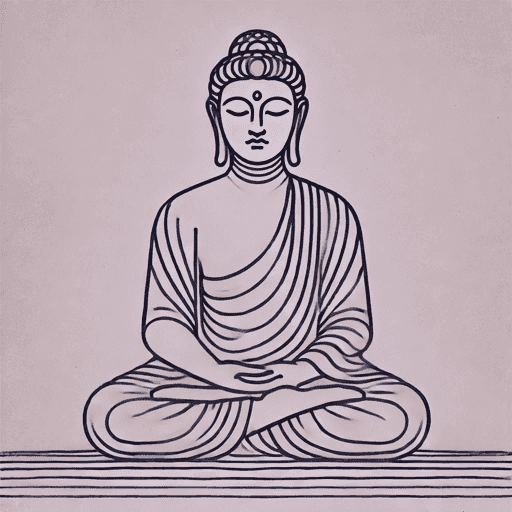
What the Buddha Taught
49 pages • 1-hour read
Walpola RahulaWhat the Buddha Taught
A modern alternative to SparkNotes and CliffsNotes, SuperSummary offers high-quality Study Guides with detailed chapter summaries and analysis of major themes, characters, and more.
Preface-Chapter 1Chapter Summaries & Analyses
Preface Summary
In 1958, Walpola Rahula reflects on the public’s growing interest in Buddhism, which prompted the publication of numerous books on Buddhism. However, not all of these resources are reliable. He laments that many interpretations of Buddhism, even by those educated in the topic, are full of inaccuracies and misinterpretations.
Rahula explains that What the Buddha Taught will focus on communicating the Buddha’s actual teachings as recorded in the Pali texts of the Tipitaka. Instead of simplifying Buddhism for a modern Western audience, Rahula will use as much of the Buddha’s own phrasing as possible to communicate his teachings as accurately as he can in an English translation.
What the Buddha Taught will address all of the main tenets of Buddhism, such as The Eightfold Path, The Four Noble Truths, The Five Aggregates, Karma, rebirth, and more. The author will also explain the two main schools of Buddhist thought, Theravada Buddhism and Mahayana Buddhism. While these two forms of the religion hold differences, they agree on the Buddha’s teachings as Rahula will describe them.
Biography Summary: “The Buddha”
The author provides a biography of the Buddha, who was born Siddhattha Gotama in North India in the sixth century BCE. Growing up as a prince and the son of King Suddodhana and Queen Māyā, Gotama had every comfort and luxury until, at the age of 29, he left his privileged life in search of an end to suffering.
For six years, Gotama traveled throughout the Ganges valley, meeting with religious teachers and subjecting himself to ascetic practices. Unsatisfied, he abandoned traditional religious teachings and began thinking for himself. One evening Gotama sat under the Bodhi tree, or “Tree of Wisdom,” by the Naranjera River and became enlightened. From then on, he was The Buddha, or “The Enlightened One.”
The Buddha gave his first sermon in modern-day Sarnath, India, at Deer Park. The Buddha preached to everyone, regardless of social class. He died in modern-day Uttar Pradesh in India at the age of 80. At the time of writing, there are approximately 500 million Buddhists around the world.
Chapter 1 Summary: “The Buddhist Attitude of Mind”
Buddhism is unique amongst world religions because its founder, the Buddha, did not claim to be a god or a messenger of a god. He was simply human and believed that all humans could attain enlightenment as he had.
The Buddha taught that “man is his own master,” and there is no “higher power” that controls or judges people (24). He encouraged people to liberate themselves through their own personal development, claiming that human intelligence and effort were enough to achieve liberation. As such, the Buddha never tried to control or manage his disciples or monks, explaining that he had revealed everything. There was nothing hidden in the “‘closed-fist of the teacher’” (24). Rahula claims that this “freedom of thought” makes Buddhism unique (24).
When villagers approached the Buddha on his travels and consulted him about others’ teachings, he told them that they were right to doubt religious teachings. He encouraged them to not simply accept traditions and doctrines as true but to decide for themselves what felt wrong or right. He encouraged them to think critically about his own teachings and merits, too, and said that they did not have to believe him unconditionally. While doubt can hinder progress, one must feel doubtful until one truly achieves an understanding of something.
Rahula claims that the Buddha was particularly tolerant, and this is notable compared to other religious leaders. When a wealthy disciple debated the concept of Karma with the Buddha, he was swayed by the Buddha’s argument and begged to become one of his disciples. However, the Buddha encouraged the man to remain loyal and supportive to his old religious teachers and consider his decision carefully. In later centuries, the Buddhist King Asoka showed similar religious tolerance. In his edicts, he instructed people to respect other religions, and in doing so, respect their own faith. Rahula claims that peace and tolerance are key tenets of Buddhism, and Buddhism has spread peacefully across the world rather than through military conquest.
Whether Buddhism is a philosophy or religion does not matter, and labels can be harmful if they distract people from understanding the truth. “Discriminative labels” such as ethnic and national labels can encourage bias instead of true understanding. For truth-seekers, the source of an idea is not important; it’s the quality of the idea that counts. Rahula recounts the story of Pukkusati, who listened and understood Buddha’s teachings even though he didn’t realize it was the Buddha he was talking to. The Buddha considered Pukkusati a wise man as he didn’t question who the Buddha was, instead focusing on understanding his ideas. Unlike other faiths, Buddhism does not require unconditional faith, instead encouraging understanding. The Buddha discussed his followers’ faith as based on knowing, seeing, or realizing rather than making themselves believe.
Importantly, the Buddha even instructed people to understand that their beliefs are just that—beliefs—and to not denigrate others’ beliefs as being untrue. He compared his teachings to a raft: People should use it to cross the river, or attain enlightenment, rather than carrying it around. This analogy means that the Buddha’s teachings are meant to be practical tools through which to arrive at one’s destination rather than a restrictive label and identity.
The Buddha’s teachings do not address metaphysical questions such as the reality of the universe or whether humans have souls. He explained to a follower that the “wilderness of opinions” on these subjects does not matter because the path to living a holy life is the same regardless (36).
Preface-Chapter 1 Analysis
In the author’s opening passages, he characterizes Buddhism as a pragmatic religion in which followers prioritize following Buddhist ideals over understanding every aspect of reality. By explaining the Buddhist state of mind or attitude to faith and practice, Walpola Rahula establishes one of the book’s major themes, Compassion and Non-Violence as the Heart of Buddhist Practice. Rahula demonstrates that the Buddha had a practical approach to teaching and faith, which built upon this foundation of compassion and presence. He explains, “The Buddha was not interested in discussing unnecessary metaphysical questions which are purely speculative and which create imaginary problems” (37). To support this point, the author shares the story of the Buddha downplaying the importance of existentialist questions about the universe and redirecting his followers to refocus on the practical everyday actions of living a holy life. The Buddha further explained that metaphysical questions are “not useful” and “not fundamentally connected with the spiritual holy life, [are] not conducive to aversion, detachment, cessation, tranquility, deep penetration, full realization, Nirvāṇa. That is why I have not told you about them” (39). By translating this passage, Rahula takes the position of the Buddha in relation to the reader, encouraging the reader to focus their research on understanding the holy life rather than expecting Buddhism to answer all of their metaphysical questions.
This approach signals that Buddhism is not concerned with theoretical perfection but with lived transformation, emphasizing how doctrines serve as tools, not dogmas. Buddhism is about following a path that relies on peace, compassion, mindfulness, and presence; to ponder metaphysical questions that may hold no clear answer is the opposite of presence as it represents an attachment to the unknown. The Buddha presented a simple moral framework through which to live one’s life and did not position himself as all-knowing; the simplicity of the path to enlightenment is free of weightier questions, focusing on how Nirvāṇa is achieved, not why the world is as it is.
The author also establishes Understanding and Resolving Suffering in this section. Rahula reveals that the Buddha did not claim to be a god or divine messenger; he simply experienced a powerful realization that he wished to share with willing disciples. The Buddha taught his followers that “man is his own master,” and claimed that everyone must undertake their own inner journey to understand and resolve their own suffering (24). Rahula explains, “He taught, encouraged, and stimulated each person to develop himself and to work out his own emancipation, for man has the power to liberate himself from all bondage through his own personal effort and intelligence” (24). By emphasizing the importance of personal agency in overcoming suffering, Rahula teaches the reader that, in Buddhism, there is no external source of salvation, just one’s own realization and discipline. This framing makes suffering both a universal experience and a deeply personal responsibility, suggesting that liberation lies not in divine grace but in awareness and effort. It also aligns with the Buddha’s refusal to claim special status; rather than positioning himself as a savior, he becomes a guide who empowers others to seek truth for themselves. This perspective allows a Buddhist to maintain control over their own life; as long as they live in accordance with Buddhist principles, they will achieve enlightenment.
In Chapter 1, the author also introduces Tolerance, Respect, and Freedom of Thought in Buddhism. His examples from Buddhist texts and Buddhist history portray Buddhism as a gentle and open-minded faith, especially when compared to the history of many other religions. He writes, “This spirit of tolerance and understanding […] [is] one of the most cherished ideals of Buddhist culture and civilization. That is why there is not a single example of persecution or the shedding of a drop of blood in converting people to Buddhism […] during its long history of 2,500 years” (28). Rahula aims to persuade the reader that Buddhists have consistently lived peacefully in accordance with the Buddha’s teachings, allowing people to join only if they felt independently compelled to do so. This sweeping assertion also serves as a critique of other religious traditions, many of which have histories of conquest or forced conversion. By contrast, Rahula presents Buddhism as a system in which belief is earned through insight, not imposed through authority.
One such example of peaceful conversion to Buddhism is King Asoka, a famous convert. Rahula claims that he faithfully followed the Buddha’s doctrines of respect and non-violence, even as the leader of a sprawling empire built on conquest. As the head of the Mauryan empire, King Asoka governed people from numerous ethnicities and faiths across the Indian subcontinent. Rahula refers to King Asoka’s edicts, which reveal his commitment to Buddhist principles. Rahula writes, “In the third century BC, the great Buddhist Emperor Asoka of India, following this noble example of tolerance and understanding, honoured and supported all other religions in his vast empire” (27-28). He quotes Asoka’s laws directly, writing that Asoka instructed his people to “honour others’ religions” and to “be willing to listen to the doctrines professed by others” (28). Rahula’s translations of Asoka’s edicts add depth to his claim that Buddhism is a religion of peace and respect. As the ruler of a sprawling empire, King Asoka might be expected to rule by force. By instead presenting him as tolerant of other religions, the text suggests that following Buddhist principles may lead to inner peace even in leadership positions where brutality is expected. The use of Asoka as a historical figure also reinforces the idea that Buddhist teachings are not limited to private spirituality; they have shaped governance, ethics, and intercultural respect on a societal scale.
Finally, Rahula draws the reader’s attention to a key structural feature of the Buddha’s teaching: its openness to doubt and debate. Rather than demanding belief, the Buddha welcomed questioning, including of himself. In this way, Rahula positions the Buddha not just as a spiritual teacher but as a model for intellectual humility. This reinforces the Buddhist view that truth must be realized, not inherited, and that the path to enlightenment is accessible to anyone willing to engage it honestly.

Unlock all 49 pages of this Study Guide
Get in-depth, chapter-by-chapter summaries and analysis from our literary experts.
- Grasp challenging concepts with clear, comprehensive explanations
- Revisit key plot points and ideas without rereading the book
- Share impressive insights in classes and book clubs