What We Can Know
64 pages • 2-hour read
Ian McEwanWhat We Can Know
A modern alternative to SparkNotes and CliffsNotes, SuperSummary offers high-quality Study Guides with detailed chapter summaries and analysis of major themes, characters, and more.
Part 1, Chapters 16-21Chapter Summaries & Analyses
Content Warning: This section of the guide includes discussion of emotional abuse, illness, death, and sexual content.
Part 1, Chapter 16 Summary
Thomas becomes sensitive to his environment. He starts learning about the butterflies and flowers that he can observe on the island, comparing them to their counterparts in the Blundys’ time. This fills him with melancholy for the things that were lost in the intervening years. He takes a virtual tour of an Oxford bookshop in 2018, which worsens his mood as he marvels at the wealth of the shop’s history shelves.
Rose feels wonder, not sadness, looking at the same elements in nature. Thomas argues that standards of beauty generally degrade to adapt to the world of the beholder. Rose worries that Thomas is making himself unhappy for no reason, seeing as he cannot do anything about the natural world as a literary scholar. When it becomes clear that Thomas is once again lamenting the loss of Francis’s poem, Rose urges him to give up his quest to find it.
Thomas continues to examine the records of everyday exchanges between Vivien and Francis from the 1990s to the 2010s. He starts to imagine Vivien as someone he is also falling in love with. Rose is offended and accuses Thomas of wanting to be with Vivien instead. Once they reconcile, Thomas resolves not to bring up Vivien in Rose’s presence again. Otherwise, their lives are generally harmonious. Rose finishes writing her paper.
Part 1, Chapter 17 Summary
Thomas describes the national artificial intelligence service (NAI), which the students refer to as The Machine. Because the NAI is heavily supervised to limit student use and to prevent them from using it to write their coursework, the students use it to seek life advice, believing that the NAI knows them better than anyone else would. Many of them continue using it in their adult lives. As a humanities scholar, Thomas only uses the NAI in a research capacity.
In late 2120, Thomas’s research work stalls when he has accumulated too much knowledge on the Blundys. When Thomas considers turning to another research topic, Rose suggests using NAI to help him organize his thoughts. NAI recommends visiting the Kitchener archive, indicating that Vivien might have secretly visited Harry and shared her copy of the poem with him.
Rose suggests co-teaching a seminar on the history of AI as a way to relate to the students’ reliance on it and encourage them to think historically. Thomas reluctantly agrees, and they start preparing a multimedia presentation that traces the origins of computing all the way to AI’s role in the climate wars. One graduate student walks out on the seminar, and another student, Kevin Howard, speaks for the class, expressing that they do not see the seminar’s point. They are uninterested in the lost world of the past and prefer to think about the present. Tired of Thomas and Rose’s nostalgia, they collectively agree to absent themselves from the seminar.
Part 1, Chapter 18 Summary
After the disastrous seminar walkout, Thomas and Rose are humiliated in the academic community, leading to an administrative review of the Humanities Department. This causes an unspoken strain between the spouses, broken only by Thomas’s decision to revisit the Bodleian to investigate whether Vivien and Harry might have met to discuss the poem.
During the voyage to Snowdonia, Thomas meets another scholar, Lars Corbel, who specializes in North American studies. When Corbel shares his familiarity with Blundy’s poems, Thomas discovers a kindred spirit. They chat about the English language’s stability, arguing that many things caused it to remain largely unchanged since the pre-Inundation era. Riding the funicular up to the Bodleian, Corbel uses the vehicle’s mechanism as an optimistic metaphor: The weight of recurring sins will bring humanity into its best form. Upon reaching the Bodleian, Thomas learns that Drummond is sick.
Thomas is tired when he sees the Blundy archive once again and reconsiders the value of his endeavors. He mindlessly reads through several emails between Francis and Vivien in 2003, when Vivien was still married to Percy. Vivien complained about Percy’s symptoms and related one incident in which she lost her temper. During this time, Percy begged Vivien not to put him in a care facility. Later on, Vivien expressed her sense that the Percy she married was already dead to her. The emails suggest that Francis visited Vivien at home, though they met outside the house to avoid Percy’s attention. In his replies, Francis reassured Vivien and promised to visit her again soon.
Thomas has no record of the conversations that took place during Francis’s visits. It is suggested that Francis tried to help Vivien place Percy in a care facility, but they never followed through with this plan, and soon, Percy died. Thomas goes deeper into the archive to look for traces of Vivien and Harry’s post-Dinner interactions. His search turns up empty.
Over dinner with Corbel, Thomas learns about his political activism. Conversely, Corbel is stunned to learn of Thomas’s innocence of social politics, which have remained substantially unchanged since Blundy’s time. The elite exercise their power and influence over minimally educated citizens to lead the government committees at the national and local levels. Corbel stresses that this is common knowledge, which privately embarrasses Thomas.
The following morning, Corbel leaves. A librarian passes a letter from Drummond to Thomas. Thomas does not read it immediately. He finds an unfamiliar note that Francis wrote in 2001, describing the pursuit of an object that will inevitably disappoint the pursuer upon being reached. Francis goes on to say that loss is natural to existence. Soon after, Thomas decides to finish his visit and return home early.
The voyage to Port Marlborough is stalled by a storm. Thomas arrives on campus in the early hours of the following morning. When he enters the house, he finds that Rose is engaged in an affair with Kevin Howard, their seminar student.
Part 1, Chapter 19 Summary
Thomas moves into a single unit, sharing a bathroom with a medieval history scholar named Cyril. Cyril’s obsession with his research subject makes it impossible to talk about anything else. To distract himself from the pain of Rose’s affair, Thomas commits himself to living an ascetic life in competition with Cyril. He immerses himself in his research but knows he cannot make any more progress because he has exhausted his subject. Instead, he rereads increasingly quotidian notes on Percy and Vivien’s life together.
Aside from his work as a violin maker, Percy is revealed to have been a banjo player who often played at a jazz pub. This is how Vivien first became infatuated with Percy, who came to recognize her after multiple attendances at his performances. As she became acquainted with Percy’s kindness, Vivien fell deeply in love with him. Her journals from this time exist in stark contrast to the messages she wrote to Francis about her contempt for Percy in his final days. Thomas notes some gaps in the coroner’s report on Percy’s death, owing to the transfer of recorded information post-Inundation and Percy’s body’s late arrival to the hospital, where he was immediately declared dead. Percy’s death is attributed to a fall down the stairs.
In the wake of Percy’s death, Vivien expressed remorse for her treatment of him in her journal. Rachel assisted Vivien in dealing with Percy’s possessions. Francis, meanwhile, focused on work, and he was not recorded to have engaged with Vivien again until nearly a year after Percy died, when they traveled together to Amorgos, Greece.
Thomas takes stock of his ruined marriage and career. Over the next few months, he continues teaching and argues with Rose over her infidelity and his failure to support her emotional needs. Thomas immerses himself again in his research, this time focusing on Francis’s reputation at the time of his death. He acknowledges Francis’s vanity and the fact that his gift to Vivien did more to honor himself than her.
One evening, Thomas rediscovers the note from Drummond that was given to him. In the note, Drummond explains that he was talking to his niece, Dolly, about the mysterious number in Vivien’s journal. Dolly believes that it was map coordinates leading to a site near the Barn. Drummond reinterpreted Vivien’s previous note about a “seedge” to mean “south-eastern edge.” He now suspects that Vivien buried something at the coordinates and only asks for Thomas to share the findings with him.
Thomas worries that because so much time has passed, Drummond has already gone to the site himself. While rushing home, Thomas decides he wants to share the news with Rose.
Part 1, Chapter 20 Summary
Thomas prepares to travel to the Barn. Although a significant portion of Oxford was submerged in 2042, the area around the Barn was spared, as its high altitude turned it into an island. Thomas will need to charter a boat to reach the island.
Kevin is living with Rose, so Thomas tries to bump into her in between classes. When they meet, Rose assures Thomas that she and Kevin ended their affair after Thomas discovered them. Thomas shares Drummond’s discovery with Rose, who immediately suspects that Vivien buried the poem. She urges him to rush to the Barn to unearth it. Thomas invites her to join him, hoping to convince her to use her inherited wealth to finance the trip. She enthusiastically accepts it as a form of contrition.
Though they continue to live apart, Thomas and Rose repeatedly meet to plan. They prepare for the possibility of being apprehended, as the site is military property. They decide to set out during the reading break in March. They argue over how to track the coordinates because GPS no longer exists.
Eventually, they have sex again, after which Rose explains that she rejected Kevin’s declaration of love. She threw him out immediately after, ending their affair. Thomas confronts her over her motivations behind the affair, believing that Rose manipulated Kevin’s feelings with their imbalanced power dynamic. He soon comes to understand that Rose is warning him against forcing her to accept the kind of relationship that she didn’t want with Kevin. Thomas decides to wait until after their trip is done to figure out how to reconcile their relationship.
Rose charters a ship to the Barn site. When the reading break starts, they meet with Jo Mideska, the captain of the Salty, to begin their expedition. On their way, the three plan how to regroup after they reach the island. After some discussion about their respective mixed heritages, Thomas recalls that the Derangement caused a large number of the global white population to die out. White people are now considered a minority who experience regular discrimination.
Part 1, Chapter 21 Summary
The ship arrives on the island, but Rose and Thomas wait until the next morning to begin their trek. Rose leads the way while Thomas consults the compass. Because of the island’s thick foliage, it is difficult for them to get far without losing sight of one another. They push on through various environmental challenges before reaching what they believe is the site of the Barn. There, they set up camp.
After a sleepless night, during which Thomas fears the presence of wolves and longs for intimacy with Rose again, he is startled by the realization that he can see the layout of the Barn. He imagines meeting Vivien and telling her about his purpose there. The fantasy Vivien urges him to leave. Thomas and Rose recognize several landmarks, including the garden and Vivien’s old study.
Once they trace their coordinates and measure the distance Vivien specified from the south-eastern edge, they begin excavating. After several hours of digging, they take a break. Thomas discovers the same stream that Vivien used to walk by and realizes it is unchanged from her time. This makes him feel like he is in communion with Vivien’s memories.
Thomas brings Rose to the stream, where she washes her face and drinks. He later realizes that he wants to continue his relationship with Rose, in spite of her affair and his indifference to her needs. Late in the afternoon, Thomas uncovers a metal container in the soil. They continue digging through rain into the evening, unearthing a smooth case that weighs between two to four kilograms. They elect to open it with an archeological expert’s help, though Thomas finds it impossible to sleep when the poem’s recovery may be just hours away.
That night, he thinks about the historical upheaval that has occurred since the Blundys’ time. What unites them is their capacity to live despite those upheavals and the sense of the world’s imminent end. He begins to doubt that civilizational regression is permanent and believes that literature will always carry some hope of reviving the progress of the world. Human destruction and restoration are merely cycles of progress.
The next morning, Thomas and Rose return to Jo’s ship with the container in their possession. Thomas sustains a minor injury during the trek, but eventually, they reunite with the ship and board with the container. As they embark on their return voyage, Thomas suggests opening the container, and Rose agrees. They are disappointed to find a smaller sealed case inside the first one.
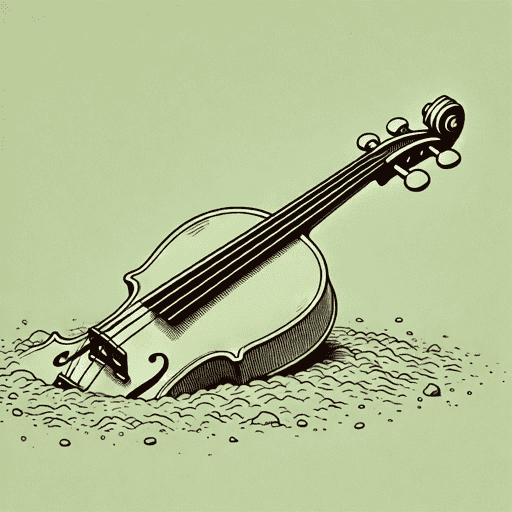
They break it open and find Percy’s violin and a manuscript wrapped in plastic. Thomas weeps upon realizing that the manuscript isn’t poetry but prose. Rose scans the manuscript and reassures Thomas that things will be alright. She guides Thomas’s hand to her belly, suggesting that she is pregnant.
Part 1, Chapters 16-21 Analysis
The end of Part 1 sees Thomas balancing his historical obsessions with the collapse of his personal life. With this tension, the novel drives one of its biggest ideas about the dynamics between history and the present, and what humanity gains from reviewing its losses.
The novel has been building Thomas up as a cautionary tale, building its examination of Living With Hope in Times of Crisis by highlighting how his fixation on the past is an obstacle to seeing hope in his future. His obsession with the past has prevented him from understanding the concerns of the present. Even when he finds a kindred spirit in Lars Corbel, he is embarrassed by his failure to relate to Corbel’s political concerns. Corbel underscores Thomas’s shame by referring to the political hierarchy of their society as “common knowledge,” as if to suggest that Thomas has wasted his time immersing himself in useless knowledge that has put him out of touch with his own world.
Corbel’s remark on “common knowledge” also reinforces the shame that Thomas and Rose suffer at the hands of their students when they attempt to historicize artificial intelligence in a seminar. Unlike with Corbel, however, the incident with the students in Chapter 17 concretizes the crisis of the humanities that Thomas first warned of in Chapter 9. The students reject the study of humanity’s past because they refuse to carry the knowledge of failure with them and use it to inform their own decisions. They are arrogant, believing themselves better than their ancestors because they are evidence of humanity’s survival of foolish times. However, this idea is complicated by the fact that Kevin Howard, the students’ representative, becomes the interloper in Thomas and Rose’s marriage, suggesting that Kevin can attend to Rose’s emotional needs better than Thomas can. He is a man of the present, whereas Thomas is fatally flawed by his attachment to the past.
Rose does not engage in her affair with Kevin to antagonize Thomas but to awaken him to his failure to live in his time and place. For Thomas to embody the tenets of his educational philosophy, he must learn from his failure to act upon the present. This drives The Value of Failure as a theme on a more personal level. Corbel articulates this when he shares his optimistic insight: “[W]e see our same old mistakes coming at us again, but their weight will see us to the top” (148). In the middle of his expedition with Rose in Chapter 21, Thomas concludes that he wants to shape his future around Rose’s presence. Part of this means acknowledging his faults toward her and resolving to make amends. In turn, Rose’s willingness to accompany Thomas on his expedition signals her openness to reconciliation. She knows how much the discovery of Francis’s lost poem means to Thomas, even if she has urged him to give up his obsession with recovering it. It is only when Thomas presents Drummond’s lead that she realizes that his obsession has finally entered the realm of possibility. It is no longer an impossible quest, but something that can either satisfy or disappoint his greatest obsession.
At the end of Part 1, the narrative suggests that the discovery of the poem would have hindered Thomas’s character development. For him to achieve his goal would prevent him from embodying the insights he has learned over the course of his relationship with Rose. His disappointment, on the other hand, concretizes his sense of failure, from which he will learn to live in the present. While Vivien chose not to include the poem among the items she buried at the Barn, the manuscript she did leave will nevertheless help to illuminate the gaps in Thomas’s research and resolve his quest once and for all.

Unlock all 64 pages of this Study Guide
Get in-depth, chapter-by-chapter summaries and analysis from our literary experts.
- Grasp challenging concepts with clear, comprehensive explanations
- Revisit key plot points and ideas without rereading the book
- Share impressive insights in classes and book clubs