What We Can Know
64 pages • 2-hour read
Ian McEwanWhat We Can Know
A modern alternative to SparkNotes and CliffsNotes, SuperSummary offers high-quality Study Guides with detailed chapter summaries and analysis of major themes, characters, and more.
Symbols & Motifs
Content Warning: This section of the guide includes discussion of death.
“A Corona for Vivien”
The poem at the center of Thomas’s study, “A Corona for Vivien,” by Francis Blundy, is a motif that supports the theme of Dispelling the Myth of the Great Artist. Symbolically, the poem represents Francis’s legacy and its relationship to cultural imagination. In the first chapter of the novel, Thomas presents the poem as a lost masterwork. Its defining characteristic is the fact that only one copy of the poem is known to have existed since the night of its debut at the Second Immortal Dinner. In the absence of the poem, the public at large relies on impressions of the poem’s first audience to shape their understanding of the poem’s content. Later in the novel, it is revealed that the dinner guests exaggerated or misrepresented the content of the poem to the press, lionizing Francis in order to save face.
Francis’s reputation evolves, and he becomes seen as an icon for the environmentalist movement and for monogamous love, contradicting the facts of his life. Thomas reveals that Francis vehemently denied climate change, a view he expressed on the same evening he debuted his poem. Similarly, it is difficult to frame Francis as a champion of monogamy when it is openly known that Francis was having an affair with Vivien while she was still married to Percy Greene. In this way, McEwan highlights the disparity between reputation and fact: The popular idea surrounding an object seldom matches the truth about that object’s true nature.
This is cemented by the revelation that the poem is less of a gift to Vivien than it is an ode to Francis’s cunning as a poet and as an amoral figure. Toward the end of the novel, Vivien realizes that the poem depicts Percy’s murder, and she becomes resentful of its existence. Vivien destroys the poem to prevent Francis from controlling Percy’s memory, though this unwittingly grows the poem’s mystique in the popular imagination. It takes Thomas’s scholarly efforts and Vivian’s memoir to correct the public record and dispel the myth of the great artist by revealing his human failings.
Vivien’s Journals and Manuscript
Vivien’s private writings are a recurring symbol for the illusion of privacy. When they are first introduced in Part 1, Chapter 1, Vivien ostensibly writes her journals with the assurance that she is their only reader. In her memoir in Part 2, she even discusses her reliance on her journals to recall the sequence of events as her memory becomes limited. However, Thomas’s deep scrutiny of Vivien’s journals undermines her privacy, implying that this is the cost of her association with a reputable figure like Francis Blundy.
The error in Thomas’s assumption is that the journals represent the whole truth of Vivien’s character. The discovery of her manuscript in Part 1, Chapter 21, awakens Thomas to the limits of his scholarly interest, exposing the gap between his fantasy version of Vivien and her truest, most private self. Among the details disclosed in her memoir are the events surrounding Christopher, the brief life of Diana, and the truth of Percy’s murder. Vivien’s memoir incriminates her with the revelation of her amoral indifference but also emphasizes her attempt to take responsibility for her inaction. Near the end of her memoir, she acknowledges her readers, revealing that her writing was constructed with an audience in mind, supporting the novel’s exploration of the disparity between one’s public and private lives.
Percy’s Violin
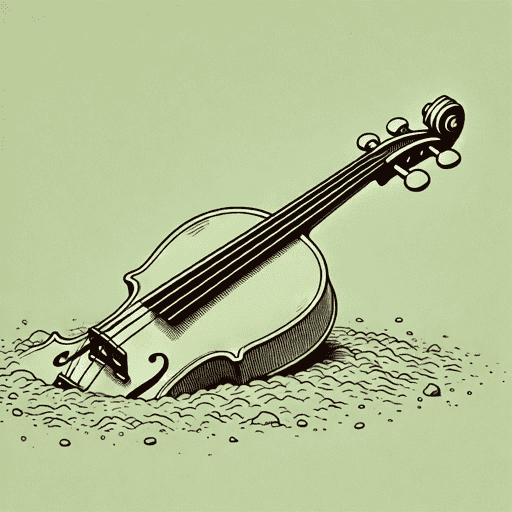
The motif of Percy’s violin illustrates the novel’s theme of Living With Hope in Times of Crisis. The violin is first introduced in Part 1, Chapter 10, and it is described as a personal replica of the Vieuxtemps Guarneri violin of 1741. The violin embodies Percy’s passion for his craft, which he shares with Vivien’s nephew, Peter. It is unearthed by Thomas and Rose when they recover Vivien’s container from the burial site in Part 1, Chapter 21.
When Percy becomes ill with Alzheimer’s disease, Vivien becomes increasingly distant from him as she loses the sense of the man she loved. A crucial moment in Vivien’s memoir in Part 2 depicts her re-entry into Percy’s shed, which she intends to clean as a gesture of her devotion to him. Upon seeing the Guarneri replica, she is seized with anger for the strain in her relationship and nearly smashes the violin to pieces. What stops her is the sight of Peter’s work tools, reminding her that the Percy she loves still exists, as evidenced by the warm relationship he maintains with Peter. The violin thus fills her with hope that Percy is still with her.
Near the end of the novel, Vivien explains that she buried the violin with the hope of sharing it with a talented musician in the future, honoring Percy’s original intentions for the instrument as he was working on it. This represents Vivien’s hope that humanity will persist in spite of the disasters that hound it at the time of the memoir’s writing in 2020. By destroying Francis’s poem and preserving Percy’s violin, she champions the latter as the kind of art that should guide humanistic thinking in the centuries to come.

Unlock the meaning behind every key symbol & motif
See how recurring imagery, objects, and ideas shape the narrative.
- Explore how the author builds meaning through symbolism
- Understand what symbols & motifs represent in the text
- Connect recurring ideas to themes, characters, and events