59 pages • 1-hour read
Where the Lost Wander
A modern alternative to SparkNotes and CliffsNotes, SuperSummary offers high-quality Study Guides with detailed chapter summaries and analysis of major themes, characters, and more.
Chapters 12-15Chapter Summaries & Analyses
Chapter 12 Summary: “The Green”
Content Warning: This section of the guide includes discussion of death and sexual content.
Chapter 12 begins in Naomi’s point of view. The smaller wagon train camps by the Big Sandy River. Ma has a bad cough, and Wolfe must be fed goat’s milk with a spoon to supplement her milk. John eats with the Mays every night. He tells a story one night of the love between a Pawnee man and a Comanche woman. Though the groups are enemies, the man loves the woman so much that he becomes a Comanche. John says the story is about “Peace between people” (184). Ma later says it is the story of John and Naomi, and that in asking for Naomi’s hand, John promised William he would become part of the May family and help care for them.
The perspective shifts to John. The train reaches the Green River, where John goes to look for a good place to cross. In the distance he sees a band of more than 100 Shoshoni people, mostly women and children, fording the river. As he watches, a pack mule struggles in the water, throwing two children and a woman with a baby girl into the river. The baby is swept away, and John rushes into the water to rescue her. He pats her back and brings up the water she has swallowed.
When the mother takes the baby, John is astonished to find that she is Ana, a Shoshoni woman whom he befriended when she was a servant in Jennie’s household years before. She is now married to the chief of her band and goes by the name Hanabi. John leads the train across the river as the Shoshoni help the emigrants with their supplies. Hanabi reveals to John that his father gave her a mule and found a wagon train for her to join when she was ready to return to her people.
The Shoshoni feed the emigrants to thank them for saving Hanabi’s baby. When Hanabi sees the Mays feeding goat’s milk to Wolfe, she takes the baby and breast-feeds him. Winifred says she had pictured the scene in a dream.
Chapter 13 Summary: “Fort Bridger”
Chapter 3 begins in John’s point of view. The train parts with the Shoshoni the next day and crosses the waters of Blacks Fork. John speaks to Abbott about going on ahead of the train to Fort Bridger so he can buy the supplies he needs to set up a new wagon for himself and Naomi. Abbott agrees, and John rides on ahead with Wyatt and his animals.
However, John is disappointed in Fort Bridger, which is nothing like Fort Laramie. There is a trading post with overpriced items and a blacksmith, but little else in the way of supplies. Teddy Bowles, the trader, asks if John is willing to sell his jack donkey, and John offers his stud services in return for selling him goods at fair prices. They are interrupted when Wyatt reports a confrontation between Indigenous persons and white settlers outside the fort.
The perspective shifts to Naomi. She reflects on how few belongings she had when she was married to Daniel and how John is too proud and stubborn to marry her unless he has his own wagon. Ma enters John’s name in the family Bible as if he were already married to Naomi, accidentally dropping ink and blotting out her own name.
The point of view returns to John. In front of the fort, a group of Mormons is barring a mounted band of Shoshoni people, led by their chief, who want to enter the fort to trade. They are looking for Jim Bridger, the mountain man who founded the fort. Bowles and a man named Louis Vasquez leave the fort and say that Kelly, the Mormon captain, is out of line. John recognizes Vasquez, a fur trader who once bought a Lowry mule. A Mormon shouts that two of their men were shot and scalped by Shoshoni, and Jim Bridger is stirring up trouble by selling gunpowder and liquor to them.
Wyatt tells Vasquez’s wife, Narcissa, that John speaks Shoshoni. She relays this to Vasquez, saying that John could speak to Chief Washakie on Kelly’s behalf. John realizes this chief is Hanabi’s husband and goes to ask him what he knows about the attack. The chief is insulted and replies that he wants to trade. When John asks again, the chief says the men who were killed probably deserved to die.
Washakie asks if John is white; he replies that his father is white and his mother was Pawnee. He introduces himself and says Hanabi lived with his family. At this, Washakie says it wasn’t his men who killed the soldiers; it was probably another chief named Pocatello, who doesn’t like white men.
After completing his trade, Washakie gives furs and buffalo meat to John as a gift “for Hanabi,” then rides away. Vasquez introduces himself and Narcissa. He says he is thinking of letting the Mormons have the fort, since it is hard getting supplies there and the Utes and Blackfeet are causing trouble.
They learn that John wants a wagon, and when he tells them why, they offer him their own room for the night of the wedding.
Chapter 14 Summary: “The Cutoff”
Chapter 14 begins in John’s point of view. He mates his jack donkey with one of Vasquez’s mares, and Vasquez introduces him to Jefferson Jones, the blacksmith. Jones says there is a ridge nearby where several wagons crashed, and he will assemble one from parts if John gives him a mule. John agrees.
The point of view switches to Naomi as she stands in Narcissa Vasquez’s parlor. Narcissa has found a spot in her garden for the ceremony. She loans Ma a dress to wear and provides fresh undergarments for them after they bathe. The members of the wagon train stand around as Deacon Clarke marries John and Naomi.
The perspective changes again as John describes watching Naomi in the Vasquez’s room, drawing a picture as a gift for Narcissa. She is wearing his shirt, indicating that they have already made love, and they do so again. In the morning, John sends a letter to his father and Jennie to say that he has married Naomi and has found Ana. He signs it “Your son, John Lowry” (224). He is going to stay behind at the fort for a few days while his wagon is being built, and the train will go on without him.
Chapter 15 Summary: “Sheep Rock”
Chapter 15 begins in John’s point of view as he and Jefferson find enough wagon parts to assemble John’s wagon. With some difficulty, they transport the pieces to Fort Bridger.
The point of view shifts to Naomi. Two days out from Fort Bridger, Naomi writes a message for John and Wyatt, saying where the train will make its next stop, and ties it to a tree. They reach Sheep Rock, where the group was originally going to wait for John, but Abbott says they need to leave the next morning whether or not John arrives. He does not come, and Naomi leaves another message.
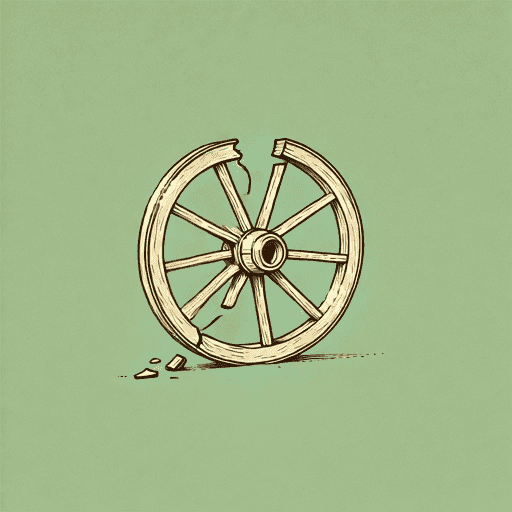
After they have traveled 10 miles, the group leaves the main road to search for water. Pa’s wagon wheel breaks and Elsie Bingham goes into labor.
John’s perspective resumes as he and Wyatt pass Sheep Rock in John’s new wagon and find Naomi’s first message. Five days have passed since Jefferson began assembling the wagon. They see smoke in the distance, along with two small figures. As they approach the smoke they realize the figures are Will and Webb May.
The boys run to John and stammer out the news that Will accidentally killed an Indigenous man with a bow and arrow, and they in turn killed Pa, Warren, Mr. Bingham, and Ma and Mrs. Bingham. The boys hid during the attack, Will lying on top of Webb to protect him. John demands to know what happened to Naomi, and Webb tells him, “They took her away” (234).
John investigates the smoking wagons and sees the bloodied corpses of the three men and the burned corpses of the two women, who died together in the Bingham wagon. He buries them as best he can and takes their oxen, which the attackers have left behind. After yoking the oxen to his wagon, he sends the three boys off in it to join up with the wagon train while he searches for Naomi. He has his horse, and he will take a few mules with him.
Webb says, “I hate Indians” (239), to which John asks if he hates him, because he is one. When Webb says he loves John, John replies, “There’s good and bad in all kinds of people” (239).
Chapters 12-15 Analysis
John continues to explore The Complexities of Cultural Identity in these chapters as he commits to a marriage with Naomi and has more interactions with Indigenous persons. His rescue of the Shoshoni baby and his discovery that its mother is Jennie’s former servant, Hanabi, give him the chance to rediscover important connections. Hanabi’s husband, Washakie, will soon become the most important character in the book after John and Naomi. The author builds a case for the plausibility of the reunion between the two old friends by revealing that John’s father helped Hanabi substantially when she was ready to leave Jennie’s household, ensuring that she returned to her people. This revelation also adds to John’s growing understanding of his father and furthers the development of their relationship, to the point that he can sign his letter to his father as “Your son, John Lowry” (224).
The narrative once again depicts the Indigenous peoples as aggressive and violent while depicting the white settlers as consistently peaceable and innocent victims of Indigenous attacks. The Mormons at the trading post object to the entry of Washakie and the other Shoshoni because they believe members of the Shoshoni shot and scalped two Mormons, apparently for no reason. When Washakie denies that any of his men were involved, he nevertheless claims it must have been another Indigenous chief, Pocatello, who probably carried out the murders just because he “doesn’t like” white men. This is yet another instance in the text in which the Indigenous characters are depicted as unprovoked aggressors against white settlers, reinforcing the sense that they are the ones responsible for all the violence and instability in the area. In a similar vein, Vasquez speaks of handing over control of the fort to the Mormons because, he says, the Utes and Blackfeet are causing trouble.
By contrast, the text continues to depict most of the white settler characters favorably. In emphasizing that John’s father treated Hanabi well and helped her reunite with the rest of her people, the text portrays John’s father as having a kindly, paternalistic attitude toward his Indigenous servant, leaving her with a debt of gratitude toward him. Similarly, Bowles and Vasquez initially defend the Shoshoni who wish to enter the trading post by criticizing the Mormon captain for barring their entry, before the Mormons explain themselves by recounting the recent murders that have angered them. Bowles and Vasquez’s intervention depicts them as inherently fair-minded toward the Shoshani—a fair-mindedness that the Shoshani characters are pointedly lacking in, since Washakie shrugs off the murders of the Mormons even though he doesn’t know why they were targeted.
In Chapter 15, the story reaches the scene described in a dreamlike trance by Naomi in the Prologue, with the attack of the Indigenous warriors on the white settlers. The author describes its bloody aftermath through John’s perspective, not Naomi’s. As horrific as the deaths were—and as much as John loved Winifred May in particular—he was related to the Mays only through marriage. In his position, he is able to describe the scene with more detachment than Naomi provided and to quickly bury the dead and commit to finding her.
In the scene between Webb and John at the end of Chapter 15, Harmon suggests that it is impossible to stereotype either Indigenous or white people as inherently evil. As John says in response to Webb’s declaration that he hates all Indigenous people, all kinds of groups have some good and some bad people—“Indians and emigrants alike” (238). However, in the novel, only the Indigenous characters commit bad and violent acts, which means that the novel reinforces colonialist stereotypes.
Winifred and Washakie both experience visions in this section, and for both characters, the motif suggests acceptance of something entirely new. Having dreamed that an Indigenous woman would breast-feed her baby, Winifred can accept that the action proceeds from kindness after she watches Hanabi feed Wolfe. Her vision also foreshadows the fact that a second Indigenous woman will breast-freed Wolfe after the baby is kidnapped.
Names and the act of naming symbolize destiny in the novel. John Lowry is growing into his “Two Feet” identity; Naomi’s last words to him before she is kidnapped are “I love you, Two Feet” (195). His mixed heritage turns out to be a great asset when it comes to negotiating at Fort Bridger, although his fixation on getting a wagon at any cost will lead to disaster.
In another instance of the symbolic meaning of names, Winifred enters John’s name into the family Bible as if his marriage to Naomi has already taken place, simultaneously eradicating her own name with an ink spot. John is destined to be the savior of the May family, as Winifred envisioned, just as she is destined to die.

Unlock all 59 pages of this Study Guide
Get in-depth, chapter-by-chapter summaries and analysis from our literary experts.
- Grasp challenging concepts with clear, comprehensive explanations
- Revisit key plot points and ideas without rereading the book
- Share impressive insights in classes and book clubs