59 pages • 1-hour read
Where the Lost Wander
A modern alternative to SparkNotes and CliffsNotes, SuperSummary offers high-quality Study Guides with detailed chapter summaries and analysis of major themes, characters, and more.
Important Quotes
“I stare because self-preservation is easiest if you know exactly who and what you are dealing with.”
(Chapter 1, Page 10)
At the beginning of the novel, John Lowry is a loner who trusts very few people. His guarded nature is the result of both the slurs he has heard from Pawnee and white people about his mixed ancestry and the fact that he does not feel he belongs in either culture. His love for Naomi May will eventually help him to become more trusting and to let others into his emotional sphere.
“He is a boy without a family, Sarah.”
(Chapter 1, Page 16)
While John believes his stepmother, Jennie, doesn’t truly love him, her actions from the time when he comes into her household show that she does. Queried by her daughter about John’s racial identity, Jennie replies simply that John needs a family regardless of his part-Pawnee heritage. Over the course of the novel, John will be able to recognize that both Jennie and his father have always loved him.
“The more you love, the more it hurts. But it’s worth it.”
(Chapter 1, Page 26)
Jennie voices one of the novel’s major themes, the idea of The Power of Love, to John as he takes leave of her to embark on the journey with the wagon train. The words echo in John’s memory when he discusses the possibility of marrying Naomi with her mother, Winifred. While the couple will endure unimaginable losses and hardships that will for a time create a distance between them, their love does eventually heal their rift and prove triumphant in the end.
“In acceptance, we put our energies into transcendence.”
(Chapter 2, Page 41)
Winifred May has mystical visions and believes in a world beyond the earthly realm where what “could be” happens. She calls this realm transcendence and believes one can reach it by rising above the things that can’t be changed. In time, John, Naomi, and the novel’s most important supporting character, the Shoshoni chief Washakie, come to believe in Winifred’s idea. Their shared vision of transcendence is a world in which racial barriers no longer exist.
“So be a turtle.”
(Chapter 3, Page 59)
Naomi has an answer for every obstacle John presents to try to prevent their love from blossoming. He insists that cultures can’t mix and compares the notion to having fins but trying to live on land. Her answer, “So be a turtle,” encourages him to try a new way of seeing himself. The quote supports the theme of The Complexities of Cultural Identity. The way forward for the immigrants and Indigenous people alike is to reinvent themselves as nimble survivors who have the skills necessary to thrive in a new landscape.
“It’s like he has come to help us. I’m beginning to sink, like Peter, and he reaches out his hand and lifts me up.”
(Chapter 4, Pages 62-63)
Harmon uses various techniques to soften the scene of the violent murders of Naomi’s parents, including previewing the attack in the Epilogue and foreshadowing. Winifred May’s dream of John as a savior who walks on water, like Jesus, foreshadows her death in the attack. She knows she is going to die and that John will take on her role of sustaining the rest of the May family when she is gone.
“It’s what I know. They’re strong. And stubborn. And smart. The best parts of a horse and a donkey rolled into one.”
(Chapter 4, Page 75)
Mules are a symbol for John Lowry himself. He identifies strongly with the animals he breeds for living because, like him, they are the result of mixed parents and retain the best part of each parent. The symbol supports the theme of The Nature of Home and Belonging. A mule’s parents, a horse and a donkey, don’t belong together in the natural world, yet like John and Naomi, they can unite to create something new and good.
“I am hoarding my strength and my stamina for life, and I will not spend it on death.”
(Chapter 6, Page 97)
Naomi’s in-laws think she is cold because she doesn’t mourn adequately for the deaths of her husband, Daniel, or his sister, Lucy. To Naomi, however, grief is draining and she believes she must use her strength to save herself and those she loves. Her stoicism, typical of those pioneers who survived the long and difficult journey to California, will enable her to survive her ordeal when she is kidnapped.
“They’re good boys, all the Mays. It’s like my father said. It’s all in the mother; the jack doesn’t make much difference.”
(Chapter 8, Page 133)
While John is thinking specifically of William May here, all the fathers portrayed in the novel are fairly ineffectual compared to the mothers. John’s own father loves him but can’t admit it; William is nothing without his wife, Winifred; and Naomi’s former father-in-law, Caldwell, is a bigot and a troublemaker. In contrast, John’s stepmother and Naomi’s mother are strong, principled women, and Elmeda Caldwell becomes a good friend to the Mays. Through these characters, Harmon makes the point that pioneer women were as much a part of the success of the wagon trains as were the men.
“Pa takes the boys to the big turtle rock to sign their names. He brings a chisel and a mallet, and they spend the day climbing and combing the monument, making their mark among the rest.”
(Chapter 10, Page 156)
Names and the act of naming function as a symbol for destiny in the novel. In this scene, William May brings Webb, Wyatt, and Will to sign their names on Wyoming’s Independence Rock, a landmark west of Fort Laramie for travelers on the Oregon Trail. The three boys will be the only males in the May family who make it to California. Warren dies of cholera, William is murdered in an attack by a Shoshoni band, and little Wolfe dies in infancy while being held by the Shoshoni.
“That’s what marriage is. It’s shelter. It’s sustenance. It’s warmth. It’s finding rest in each other. It’s telling someone, You matter most.”
(Chapter 11, Page 170)
Winifred’s advice to John—to pursue Naomi despite the fact that he can’t offer her shelter—speaks to the theme of The Nature of Home and Belonging. Winifred, like Naomi, understands that belonging to someone is more important than having a home with them. John still doesn’t fully understand this, however. His proposal to Naomi includes a vow to find a wagon of their own to continue on the journey, even though his plan will indirectly contribute to the deaths of Naomi’s parents. Through the character, Harmon shows that some truths are hard-won.
“These days we’re living, they’re hard. And they’re heavy. And it doesn’t take long to just start throwing everything that doesn’t matter by the roadside…and knowing what you can’t live without.”
(Chapter 11, Page 173)
Naomi is speaking figuratively about the speed with which her relationship with John developed, comparing her need for him to those household goods the pioneers decide to keep on their journey. The characters frequently see goods abandoned by the trailside to lighten a wagonload. A chest full of bone china and a dining room table with six tufted chairs around it are among the most memorable of these objects.
“I’m going to let him drive, wherever he needs to go and whatever he needs to do, just as long as he lets me ride beside him.”
(Chapter 13, Page 200)
The wagon John wants to buy so that they he and Naomi can have privacy on the trail after they are married is a bone of contention for the couple. John, who never felt at home in Jennie’s household, craves a home, whereas Naomi has never had a room or bed of her own yet feels at home anywhere. Although Naomi is not conventionally feminine by the standards of her time, she realizes she must let John have his way in this and other decisions so that he can keep his pride. Her feelings toward John deepen her characterization; the author doesn’t force her to be anachronistically modern with regard to her relationship.
“We women want to make the world brighter, don’t we? Even if we have to fight our men every step of the way.”
(Chapter 14, Page 217)
The character wanting to brighten the world, Narcissa Vasquez, was the real-life wife of the fur trader Louis Vasquez. The couple was based in Fort Bridger during the novel’s time period. Harmon says in her author’s note that while she took some liberties with Narcissa’s description, she was known to be “small and vivacious” (338). In the novel, Narcissa’s personal beauty and love of beautiful things offer a sharp contrast to the tedious and repetitive routine of the wagon train and provide a fitting backdrop for John and Naomi’s marriage ceremony.
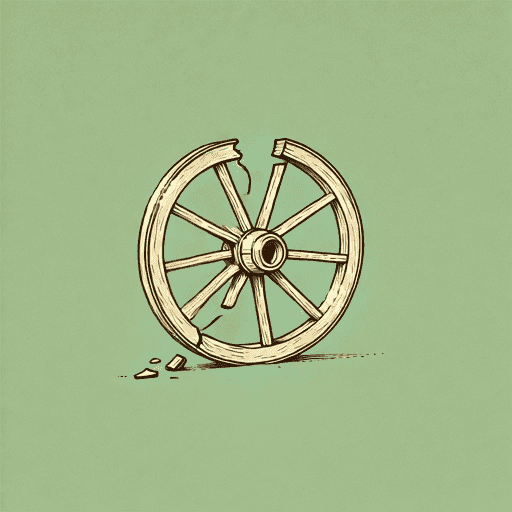
“Pa’s wagon hits a rock and busts a wheel, and Elsie Bingham, sitting on the back of Tumble, tells us she’s through.”
(Chapter 15, Page 230)
This is the point at which the present-day story “catches up” to the scene of the attack described in the Prologue, which begins with the words, “The wheel is in pieces” (1). Some layers of understanding have accumulated since that preview of the attack. In the Prologue, for instance, there is no hint that Naomi has married John. However, in the Prologue Naomi described the attack and much of the forced march that followed as if she were floating in the air above it. It falls to John, to whom the perspective quickly switches after the present-day story reaches the attack, to make the details of the attack concrete by describing its grisly aftermath.
“There’s good and bad in all kinds of people. Indians and emigrants alike.”
(Chapter 15, Page 239)
One of The Complexities of Cultural Identity in the novel is that, with a few exceptions, no character is all good or all bad, whether they are Indigenous, white, or of mixed ancestry. The exceptions are Mr. Caldwell, who is an unprincipled bigot, and Pocatello, the revenge-driven leader of the Shoshoni band that kills five people and kidnaps Naomi and Wolfe. Each loathes the other’s ethnic group. The rest of the characters, as John points out to Webb, are a mix of good and bad. John, in particular, saves the lives of the remaining May siblings after the attack but is forced to kill one of Pocatello’s people in self-defense.
“The woman who nursed my mother’s child sits with the woman who stole my mother’s child. And I am lost.”
(Chapter 17, Page 267)
Several thematic points are packed into this observation of Naomi’s as she sees the women from different Shoshoni bands sitting together. It supports the theme that cultural identify on the frontier was complex. The Shoshoni feel a spirit of brotherhood despite their widely differing attitudes toward war and the incursion of the white settlers. It also touches on the difference between home and belonging. The repetition of the word “lost” in Chapter 17 clearly defines the meaning of being “lost” as the opposite of belonging to a person or persons through love. Separated from John and her brother Wolfe, the two people Naomi loves most, she is bereft of love and the sensation of belonging to someone.
“A brother for a brother.”
(Chapter 18, Page 270)
The disposition of Naomi and Wolfe’s futures at the gathering of the Shoshoni exemplifies the different attitudes of the Shoshoni leaders. The war-loving Pocatello believes his band should keep both captives; Biagwi, whose wife has adopted Wolfe, believes only the child should be retained, and Washakie, the far-seeing realist, believes both siblings should be returned to the white settlers. It is Biagwi’s belief, that the death of his brother can be avenged by the retention of Naomi’s, that prevails. At this point in frontier history, many Indigenous peoples are trying to sustain their ancestral lands and beliefs in the face of the government-backed invasion of white settlers.
“You have all things.”
(Chapter 18, Page 278)
Hanabi speaks with the authority of one used to moving from summer to winter grounds: If one has animals, shelter, and a companion, one has “all things.” The words take on a different meaning for John as he winters with Washakie’s band and Naomi begins to heal from her emotional wounds. He is able to go from believing he has nothing because he is unhoused to comparing their shelter to a welcoming raft or ark where the two of them can be together. During this time, he comes to fully embrace the more sustaining belief that wherever he is together with Naomi is home.
“Endurance…is a whole different kind of battle.”
(Chapter 20, Page 296)
John’s words to Naomi echo the scene in Chapter 6 in which Naomi refuses to spend her energy on grief. She has been doing just that, however, because the shame Naomi feels after being raped in captivity contributes to her estrangement from John. His reminder that she was fighting for her survival, just as she has been fighting all her life, helps to heal the rift between them.
“‘Maybe we are all stretched across the banks,’ he says, thoughtful. ‘Living in the land of yesterday and the land of tomorrow.’”
(Chapter 21, Page 308)
Washakie follows up his joke about how John tries to live in two lands at once, “Indian and white” (308), with this somber reflection. He describes the conflict that has been playing out for the Shoshoni people on the frontier as each band deals with the white settlers in their own way. The past, or “land of yesterday,” represents their traditional ways, while the future, or “land of tomorrow,” represents a compromise with the US government involving the adoption of new, agrarian ways. With the exception of Washakie, few leaders are willing to accept a compromise despite the fact that, as John reflects, the “land of yesterday” is disappearing.
“I tell her I am trapped where the lost wander, and I don’t see any way out.”
(Chapter 22, Page 315)
The novel takes its title from this statement, made by Naomi as she waits in limbo at Washakie’s winter camp, unable to leave without Wolfe and unable to take him away. The title choice emphasizes that the book is not so much about the overland journey made by the two main characters but by the emotional challenges they face along the way. John’s are straightforward, the result of his mixed ancestry, while Naomi’s are complicated by her love for both John and Wolfe. Only the child’s death can release her from being “lost.”
“I was told […] to choose peace with the white man whenever I can. So that is what I will do.”
(Chapter 22, Page 321)
Washakie’s vision correctly predicted such modern inventions as cars and airplanes, suggesting that the part of his vision that told him to choose peace with the white settlers will also be correct. In fact, the historical Washakie, who became the head chief of the Eastern Shoshone and whose life spanned nearly the entire 19th century, signed treaties with the US and was allowed to keep much of the group’s ancestral lands. Choosing the way of peace did enable his people to survive.
“Footprints, too small to be a man’s, too large to be a child’s, sit on the surface of the snow. Beside the footprints, the toes clearly delineated, is a small set of paw prints.”
(Chapter 22, Page 328)
Mysterious footprints appear to four of the novel’s characters: Mary, Lost Woman, John, and Naomi. All appear after a birth or death, and Lost Woman tells Naomi that they are signs of comfort from the spirit world. The motif signals that all is well, whether in this world or the next. The paired prints of woman’s footsteps and that of an animal seen by John in Chapter 22 represent Winifred May guiding her dead child, Wolfe, to heaven.
“Maybe there is a place called transcendence where all the blood runs together and we’re one people, just like in Washakie’s dream.”
(Epilogue, Page 333)
John, Naomi, and Washakie all come to the same conclusion about transcendence, Winifred’s term for rising above the things that cannot be changed by considering other possibilities. Each character, in their own way, sees a future in which racial differences are erased. Their vision of racial equality would be tested by the Civil War, which began just three years after the novel’s Epilogue ends.

Unlock every key quote and its meaning
Get 25 quotes with page numbers and clear analysis to help you reference, write, and discuss with confidence.
- Cite quotes accurately with exact page numbers
- Understand what each quote really means
- Strengthen your analysis in essays or discussions