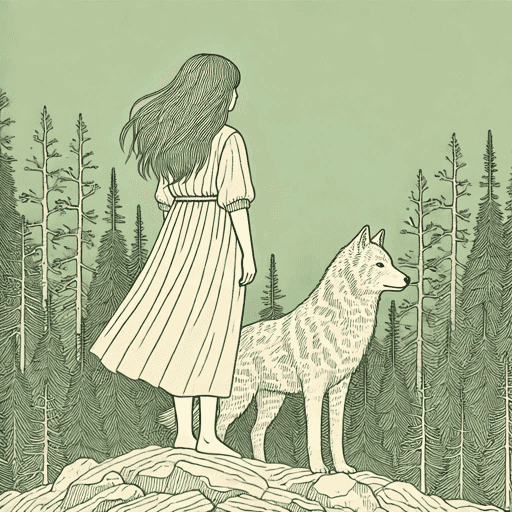
Willa of the Wood
62 pages • 2-hour read
Robert BeattyWilla of the Wood
A modern alternative to SparkNotes and CliffsNotes, SuperSummary offers high-quality Study Guides with detailed chapter summaries and analysis of major themes, characters, and more.
Chapters 18-35Chapter Summaries & Analyses
Content Warning: This section discusses physical and emotional abuse, cultural erasure and assimilation, murder, violence, animal suffering and death, child death and injury, and the systemic abuse of Indigenous people.
Chapter 18 Summary
The guards drag her to the central hall of the Hollow, where the Faeran people have all crowded to watch her presumed punishment. Some people seem excited, while others despair, but all have no choice but to watch her receive her dues. The crowd chatters about what she has done, and Willa looks at her friend Gillen in the crowd, but Gillen looks away, leaving Willa utterly alone. Willa looks around the hall, wondering how beautiful it must have been once, when it was named the Hall of the Glittering Birds rather than the Hall of the Padaran. Willa notices her grandmother crumpled on the floor, blending, and realizes with relief she has somehow hauled her way to the hall to protect Willa if she can.
The padaran appears, large, bronze, and intimidating; he is supposed to be a god, but Willa thinks he looks too young and strong to be as old as he is supposed to be. The padaran bends and asks Willa where she has been and why the guards have hauled her to him.
Chapter 19 Summary
Willa refuses to admit to doing anything wrong, and the padaran grabs his spear and tells her that he knows all that she has done and seen. He screams at her about how her duty is to her people and her clan and then accuses her of having abandoned him and her people by coming home without a take and not coming to him directly. He threatens to expel her from the clan, a fate worse than death.
As he yells, Gredic runs in and grabs her satchel, which she pretends to try and keep from him; to his shock, however, the satchel is empty except for two hidden copper pennies. Willa notices that the padaran seems wary of this and doesn’t believe it, so he demands to know if that is truly all she has brought.
Chapter 20 Summary
Willa calmly explains that the pennies are what she brought for Gredic, since he always steals her takes. She asks for permission to move across the room, and then goes to her grandmother, taking her satchel and bringing her real take to the padaran. She gives him coins, dollar bills, arrowheads, and jewelry—a bountiful take that shows her supreme loyalty to the clan.
Gredic begins to grovel and insists that she stole their take, and the padaran asks for her defense. Willa, knowing that the padaran believes her but wants to see her response, lifts the bag and says that Gredic should be able to tell her what is left in the bag if what he says is true.
Chapter 21 Summary
Gredic insists there is nothing of value left in the bag, and Willa agrees that it is not of value to him—and then hands the padaran a bundle of tobacco, his most-coveted item. The padaran is pleased and calls Willa by name, making the other jaetters furious. Willa can tell the padaran is impressed with her deceptiveness, but just feels ill and cold. She dwells on the suffering of the Cherokee boy and the kindness of the human man after he shot her. She feels more sustained by those emotions than her own leader’s love.
The padaran studies Willa’s grandmother, who looks frightened, and then asks Willa where she got the items. Willa refuses to answer at first, knowing he will be angry; he moves closer and smells her, accusing her of smelling like animals. Then he grabs her shoulder and demands that she follow him.
Chapter 22 Summary
Willa follows, having no other choice, and enters the padaran’s private quarters, winding all the way to the top. The top room is filled with human items, to her surprise: The padaran had implied he was selling the items for goods, not collecting them for himself. He insists that he must study them so they can survive.
He shows her some of the items and explains their rudimentary use, but she is dubious that the Faeran need machines to live like he claims. He shows her a telescope, which excites her, since it allows them to see the edges of the world; he has been using it to spy on his own people. He then leads her to his actual private chamber, past many rotting halls, which is decorated like a human bedroom with a bed instead of a Faeran nest. The padaran then takes her to the side of the mountain and tells her that he can either make her immensely powerful or harm everything she loves if she lies to him. She insists she has been loyal, but the padaran just asks if she knows why they are on the side of the mountain.
Chapter 23 Summary
The padaran explains the power of the humans, including the world outside of the mountains, which Willa disbelieves. To survive, they must be stronger than the humans, who want to kill the world; they must kill, too. He tells her that he is selecting certain jaetters to not steal, but to use traps and weapons to hunt animals for human bounties.
Willa is horrified by the steel trap he shows her, and more horrified as he leads her down a carefully marked path so the Faeran can avoid the brutal traps. He leads her to a den in the base of a tree, and she hears wolf pups crying; she realizes it is Luthien’s den, and he intends to kill them all.
Chapter 24 Summary
Willa quickly realizes the padaran is attempting to assess her loyalty and ensure she doesn’t remain loyal to the wolves over him. She also realizes that if the human tried to help her, it means the padaran has been wrong about humans the entire time, and is probably wrong about other things, too. Willa watches Luthien, and, knowing she is endangering everything, grabs a guard’s spear and hurls it at Luthien as a warning.
Chapter 25 Summary
The spear hits the trap, and Willa warns Luthien in her native tongue to get the pups and run. The furious padaran and the guards lurch for her with their spears and hands, but Willa escapes, running and blending through the forest. Knowing they will not stop hunting her, she drapes herself over the rock marking a trap location and blends. Not seeing the rock, the padaran runs by and steps into the bear trap, crumpling and screeching with pain. As Willa runs, she realizes the padaran’s impressive bronze appearance has melted away to a gray, withered, old Faeran person. She runs back towards Dead Hollow, knowing the jaetters and the people in the clan will turn on her grandmother next.
Chapter 26 Summary
Dead Hollow is somehow in disarray. Willa sprints back to her den to find her grandmother bleeding out on the floor, attacked fatally by Gredic. Her grandmother tells her to protect the old ways and tells her a name that will destroy everything: “Naillic.” Mamaw tells her to leave and follow the trail of blood, and Willa holds her gaze as she dies, reliving all their memories together. She begs her grandmother not to go and wonders where her spirit will go when she dies.
She looks around and realizes she doesn’t know how to escape, then looks at the bloodstain on the woven floor and realizes what her grandmother meant.
Chapter 27 Summary
Willa realizes the floor is hollow and digs through the matted sticks, harming her hands as she goes, but tearing through ferociously. She then uses magic she is afraid of—inspiriting the dead—to wake the sticks back up and repair the whole, even though it takes her life force to do so. She then descends into the belly of the Hollow until she finds the stream that runs underneath the mountain, littered with the bones of hundreds of dead Faeran killed for what they knew. She lets the stream take her, reliving the suffering of all her people and the padaran’s real self, until numbness takes her and time ceases to be real.
Chapter 28 Summary
Willa, semi-conscious, floats into the forest, but has no energy to pull herself to shore. Beavers pull her to the riverbank, where she lies for a long time, unable to move or feel.
Chapter 29 Summary
Willa wakes up and is hungry. She notices that the water is clear and evening is setting in, meaning she has been lying there for hours. She is overwhelmed by grief from the memories of what has transpired. She realizes she has no family and will never hear her own language again. As she grieves, a doe and fawn find her, and the fawn drinks and watches Willa, seeming to sense her emotional state.
Willa speaks quietly to the fawn, who comes over and curls up next to her. They sleep together until night, with the doe nearby, and then Willa wakes to see blue ghost fireflies—spirits her grandmother had told her about—which soothes her. Willa realizes that the forest is alive and can sustain her, and the padaran betrayed her, not the other way around. She realizes she is still Faeran, and nothing can take that from her. Sustained, if still grieving, Willa stands and leaves to climb to the top of the Great Mountain so she can see the world.
Chapter 30 Summary
Willa tests herself and her body and climbs to the top of the mountain, surprising herself. She then uses her woodcraft to climb an ancient pine tree on the summit so she can get even higher. She climbs into a bank of clouds, which clears almost mystically to reveal the enormity of the mountain range and thousands of shades of green and blue. She remembers overhearing two humans talk about whether the earth was flat or round, and decides both were wrong: “It was mountains” (156). She decides the world can be many things at once.
She watches a hawk flying somewhere below her, realizing they see the same world, and then the clouds close, encouraging her to return to the land. She smells something acrid and looks away, seeing smoke and then a huge explosion, murdering thousands of trees and animals. Tears well in her eyes as she watches the forest fall and burn.
Chapter 31 Summary
Willa sprints down the mountain past landmarks she knows and loves, determined to save any animals that she can. She hides as she hears humans and sees a group of Cherokee families running through the forest, clearly distraught and carrying their belongings. As she watches them, she realizes that they are looking for something and have lost people they love; she wonders if it is connected to the stolen children of the Faeran. A boy around her age senses her, but Willa hides from him successfully. Another explosion occurs, terrifying Willa and the Cherokee, who run away as Willa runs towards the explosion.
Chapter 32 Summary
Willa runs into smoke and fire and discovers an entire area of horrifically cleared forest. Trees that are hundreds of years old are felled with no regard for their life or value. Willa watches as the men—accompanied by a train—continue to destroy the forest and tries to imagine why the humans would do such a thing.
She stumbles away and quickly finds an area laid out with the corpses of birds, foxes, and other animals, all unable to be saved. The earth collapses under her and sends her spiraling into the rapids, where she sees a gigantic black cougar staring at her, also caught in the logjam.
Chapter 33 Summary
Willa clings to a root to survive, watching the mountain lion, who is wounded and caught underneath a log in the river. Willa wants to help but also doesn’t want to risk her own life by getting close to such a fierce predator. The blue jays begin to warn her that the loggers are approaching, but when she looks up, she sees Faeran—specifically Gredic and his jaetters—on the cliff. Knowing they will kill both her and the panther when they find them, she moves over to the panther but gets caught in the water flow just as the jaetters see her.
Chapter 34 Summary
Willa tries to go underwater to help the panther, but the water’s force overwhelms her. Suddenly, river otters appear and help her move through the water more easily. They seem to try to persuade her to let go of the branch she is gripping, and she realizes the logjam is about to burst and send everyone careening down the river whether she holds on or not. She lets go, and the otters show her how to move with the current and glide. She swims to the panther and sees a trap embedded in its back leg.
Chapter 35 Summary
Willa apologizes to the panther, unable to save her, but when the water rises above her and the panther’s head, she sees that the panther is still staring at her, as if sure that Willa can do something. Willa works up the strength and courage to go underwater to work on the trap, but the braces and levers do not function. Willa decides to use woodcraft to enliven the branches in the logjam, and uses their strength to break open the trap, freeing the panther, who grabs at Willa to survive and gashes her thigh with her claws.
Willa and the panther come to the surface as the jaetters appear, and the panther sprints away, striking down Kearnin as she goes and saving Willa’s life. Willa stands on the edge as Gredic sprints for her and then falls backwards into the river, letting the current take her away like an otter.
Chapters 18-35 Analysis
In this section, Willa’s conflict with the padaran and the oppressive behavior of the Faeran people comes to a head, continuing the text’s exploration of The Importance of Identity and Belonging. The godlike role of the padaran is very quickly revealed as an illusion due to Willa’s craftiness. She reveals that his appearance—intimidating, large, and a beautiful bronze-like color—is achieved through blending, although in a vastly different way than she uses it.
The bronze color of the padaran is a symbol of his disconnect from the natural world. Bronze is not a naturally occurring element but an alloy of copper and tin. While even the other, grayed Faeran people resemble the natural world, the padaran looks like something only human beings could make. While this makes him stand out from the rest, it also highlights that his persona is constructed, and that he is too allied with the human world to lead the Faeran people in a healthy direction. The image the padaran projects—of power, control, and wealth—is different from his real self, which is as gray and slimy as any of the Faeran he has victimized. However, since the Faeran have lost their knowledge of blending, nobody except Willa can recognize him for the false prophet figure he is.
The padaran’s fascination with human culture, but inability to utilize the objects he hoards, shows both his false persona and the ultimate harm he causes to the Faeran people. He forces the jaetters to steal human goods but does not use them either to benefit the people or himself. It is heavily implied that his push to hunt and sell pelts to the humans is just to further feed his personal greed, not to help the Faeran people survive like he claims. “Human culture,” within the novel, symbolizes excess and greed. While Willa slowly learns to respect the way Nathaniel lives, much of the human world takes too much and gives back too little, like the loggers. The padaran has embraced the worst of these impulses, hoarding human goods for no reason except selfishness. For the padaran, human goods represent control. He believes that if he can become human, he can protect himself from the encroaching environmental doom the humans pose, but his greed and refusal to acknowledge the needs of his people dooms them.
The novel contrasts the greed and destruction of human society with the balance and interdependency of the natural world. The realities of the natural world—the balance of death and life, predator and prey—is not portrayed as evil, but normal and healthy. In response to the padaran and the jaetters’ oppression, Willa’s powers come out in full force, with her using woodcraft to escape and survive. She can drain her life force to animate dead plants as well as communicate with living plants and get them to gently cooperate with her will. Willa’s darker magic is, however, not without a cost, as she must sacrifice her own energy to revive dead plants. This is why it is not evil: It maintains the balance in the world, even if it is disturbing to watch. The actions of the loggers and the padaran are evil because they are unbalanced, and take without giving back, but Willa always contributes to the flow of the world as it should be.
The disturbance of this flow often has severe consequences. Willa saves Luthien’s life from the padaran’s trap, but Luthien never appears in the novel directly again, even when Willa needs her most. This absence both prepares the way for Willa to bond with the human world and symbolizes the severe impact the Faerans’ actions have on the natural world. Although Willa tries to resist it, the effect of her people disrupts her connections to Luthien and to animals in ways she cannot control. Willa maintains connections to other animals, like the otters and the panther, but loses her friend and protector due to the selfishness of her people.
Luthien’s disappearance also reflects the reality of the Appalachian Mountains: Wolves were entirely driven extinct from the region due to human interference not long after the time period the novel is set in. The delicate balance of the natural world is easy to disrupt, even for people who love it, and Luthien’s absence marks that something has been irreparably broken.

Unlock all 62 pages of this Study Guide
Get in-depth, chapter-by-chapter summaries and analysis from our literary experts.
- Grasp challenging concepts with clear, comprehensive explanations
- Revisit key plot points and ideas without rereading the book
- Share impressive insights in classes and book clubs