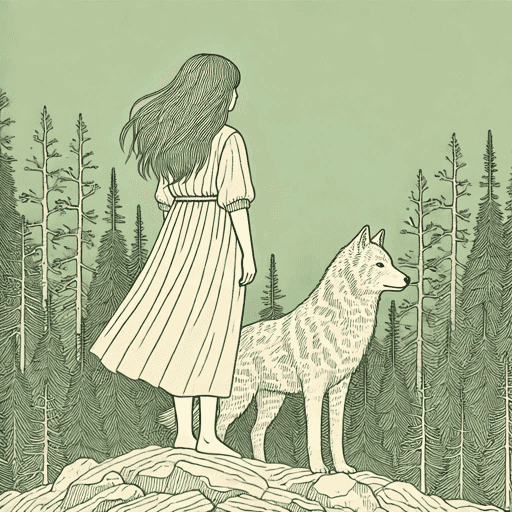
Willa of the Wood
62 pages • 2-hour read
Robert BeattyWilla of the Wood
A modern alternative to SparkNotes and CliffsNotes, SuperSummary offers high-quality Study Guides with detailed chapter summaries and analysis of major themes, characters, and more.
Chapters 36-55Chapter Summaries & Analyses
Content Warning: This section discusses physical and emotional abuse, cultural erasure and assimilation, murder, violence, animal suffering and death, child death and injury, and the systemic abuse of Indigenous people.
Chapter 36 Summary
Willa surfaces a long way away from the logjam and the jaetters and tries to rest on the riverbank, recovering from all she has seen and done. She is horrified by the damage done to the forest and the carelessness of the humans, but proud of what she did to save the panther and proud of her love and bond with the forest.
Willa eventually realizes she is desperate for companionship and needs a place to call home. She is unsure at first where to find it, until she remembers the kindness of the homesteader. She decides to follow the river to his home.
Chapter 37 Summary
Willa watches the man work at his mill from the forest’s edge, accompanied by his dog. She is perplexed by the mill’s function and assumes it must be magic. The mill’s wheel nearly breaks, but the man fixes it, looking angry and triumphant to have done so. Willa watches as he emerges with grain and grinds it into flour, and then watches with distaste as he splits wood, but realizes he seems to be exhausted and sad about something. He begins to sob, and she connects her own emotions with his. Afraid, she steps forward so he can see her at the forest’s edge.
Chapter 38 Summary
The man is shocked to see her but doesn’t reach for his weapons; he instead simply says, “[y]ou’ve come back to me” (193). They stare at each other for a while until Willa has enough and disappears back into the forest.
Chapter 39 Summary
Willa continues to watch the homesteader go about his daily life the next day, from dawn until dusk. She moves to sourwood trees near the house and introduces herself to them, then climbs into their branches and nestles near some baby squirrels. For the first time that night, she doesn’t dream of taking things from people.
Chapter 40 Summary
The next day, the dog is standing at the base of the tree, staring up at her, although not aggressively. The man calls the dog, Scout, to his side, but Scout doesn’t budge.
Eventually Scout gives up, and Willa descends invisibly to watch the man again. She follows the man into the forest as he walks and then appears before him, streaked in her normal green colors. They watch each other nervously for a while, and the man apologizes for shooting her and tells her she is welcome, and he will never hurt her again. He introduces himself as Nathaniel, and she reveals that she can understand him. He smiles at that, and she explains she isn’t used to talking to him. He offers her food, but when he moves, she sprints away.
Chapter 41 Summary
Willa sleeps in the same tree. The next morning, Nathaniel leaves food at the base of the tree for her, then goes into the forest with Scout. He returns dejected that night, and she stands at the forest’s edge again, making the dog excited. Nathaniel asks for her name, and despite reservations, she tells him that her name is Willa. She explains that she is an orphan, and he is confused that nobody cares for her—and more confused that she isn’t Cherokee.
He invites her into the house. She is nervous, but he explains that there is no bad blood between them anymore, and she will be perfectly safe. He asks her what she wants, and she asks for cookies. He doesn’t have any, but he offers her cornbread and venison. She refuses the venison but accepts the cornbread.
He explains how his mill business works. She listens to him talk, interested in how kind and ordinary he is, but finally demands to know why he kills trees. He explains that he must if he wants to live, and she decides he is like a wolf, which offends him. Willa enjoys the cornbread, and senses that she and Nathaniel are already making each other a bit happier.
Chapter 42 Summary
Nathaniel and Willa spend some time together, learning about each other and each other’s ways and knowledge. She is confused that English has only one word for green, while Faeran has 40 to 50.
Some days, Nathaniel goes alone into the forest, crossing the dangerous river, and he comes back sad and defeated. Willa yearns to know what he is feeling, and eventually goes to the river to brood, remembering her grandmother and sister and how happy her childhood was. Nathaniel comes and sits beside her, and they silently share the burden of loss, even though they do not know what has happened to one another.
Chapter 43 Summary
While Nathaniel is out, Willa practices blending, using woodcraft to get ferns and undergrowth to grow over her and conceal her. She observes a slug, which makes her wonder about the padaran’s real identity.
Nathaniel finds her in the woods and asks about her woodcraft, which she explains. He is intrigued and asks her to come to the edge of his property to look at something. Willa agrees, although she doesn’t understand the concept of property. She identifies the tracks of four humans who have been in the area recently.
Nathaniel explains that people have been marking trees to cut down on his property because a logging company is trying to push him off his land so they can build a railroad. He insists she never return to this area of the forest, so the loggers don’t hurt her. Willa suddenly identifies a net trap, angering Nathaniel, who cuts it down and then takes Willa home.
Chapter 44 Summary
Willa and Nathaniel continue their routines. Willa shows Nathaniel the otters in the stream, and he shows her the bees he keeps for honey. To his alarm, the bees swarm her unprotected body, but she calmly explains she is just communicating with them and teaches him about how bees talk. He asks how she survives; she tells him she just survives “here,” with no other explanation.
Chapter 45 Summary
After dinner that night, Willa dwells on whether Nathaniel’s use of wood is evil. She presses him on what land ownership means, and he explains that the Steadman family has owned the land since 1783. She is still confused, and he asks the reverse question, wondering why she doesn’t have a home. He then explains that humans don’t just disturb the land, but shape it: They brought honeybees and planted sourwood trees and clover to help the honey taste better. She is perplexed that the bees are not native to her land and more perplexed that humans plant trees as well as cutting them down. She calls Nathaniel a wolf again, annoying him, but he seems pleased when she explains that she loves predators and doesn’t begrudge them for needing to use the land to live.
Chapter 46 Summary
Willa sits with Scout on the couch while Nathaniel makes a list of things he needs from Gatlinburg the following day. She yearns to belong to the house and realizes she wants to have the simple life Nathaniel leads. Nathaniel invites her to stay in the house that night, and she agrees, but leaves to make a cocoon out of twigs and stalks first. He hangs it in his room by the window.
As they rest, he quietly calls her “Willa of the Wood,” which she likes. She realizes she hasn’t told him anything about her actual past because she wants to stop thinking about it. She wonders what he might be hiding from her, too.
Chapter 47 Summary
Nathaniel leaves for Gatlinburg the next morning, warning Willa to hide if any loggers appear. Willa, uncomfortable in the empty house, takes care of the animals and then walks down the river, unable to stop herself for some reason. She follows the path Nathaniel takes, observing wildlife, and finally hears the loggers in the distance.
She runs through the forest back home and then notices the meadow in the distance where Nathaniel stands and cries sometimes. She wonders what is there, and against her better judgment, walks to the center of the meadow. She finds four graves there, with four crosses, and realizes that Nathaniel’s family is also dead. She knows she shouldn’t ask about them and believes it will destroy everything if she does.
Chapter 48 Summary
Nathaniel returns from Gatlinburg in a sour mood, and cuts wood angrily to get his temper out. Willa cautiously asks about writing, and he gently teaches her how to write, showing her how to spell “Willa” and “Alliw.” Willa quickly realizes that Alliw’s name is the reverse of her own, marking them as halves of a whole. He expresses empathy for her family’s deaths, and she wonders how they truly died. She asks Nathaniel to spell concepts of the woods, like specific bear sounds, which amuses him. He explains that writing is used to keep records of the past and of other people. Later that night, he tells her stories of his history on the land, with generations of his family.
The next day, Willa tells him to be careful of the loggers as he goes on his journey down the river. She returns to the graves and tries to use her rudimentary understanding of letters to spell out the names, but cannot. Nathaniel returns angry again that night, making Willa afraid, but as he sees her, he brightens, announcing that he’s “glad to be home” (251).
Chapter 49 Summary
The next day, Willa spells the names on the graves again. She spells the first three names—Ahyoka, Inali, and Hialeah—but can’t make sense of them for a while, until she realizes they are Cherokee names. The final name, however, makes her stop, because halfway through, she realizes she knows it, and doom overwhelms her.
Chapter 50 Summary
The final name is Iskagua, or Iska—the same name as the boy she gave cookies to in Dead Hollow. Willa is overwhelmed with guilt that she didn’t save him and was afraid to talk to him, realizing she is much older and wiser now and was obligated to try and help him. Now he is probably dead. She decides she must tell Nathaniel the truth, and, crying, returns to the house.
Chapter 51 Summary
Willa goes to find Nathaniel, but bees start swarming and stinging her, confusing her. Nathaniel, trying to calm the bees down, begs for her to help, but the bees are mindlessly slaughtering each other. Willa watches as the bees murder the queen and the hive fractures, with nearly all the bees dying or abandoning the hive.
Nathaniel and Willa dejectedly return to the house. Willa surmises that the bees were Ahyoka’s. Nathaniel tells her about Ahyoka, his wife for 15 years before her death. He explains that he’s trapped in an unwinnable fight with the loggers, who are clear cutters bent on destroying the mountain forests. They threatened his family to try and get his land. Willa asks to know how Ahyoka died.
Chapter 52 Summary
Nathaniel explains that 20 or 30 men attacked his house in the night. They knocked him out, and when he woke up, Ahyoka and the children were gone. Hialeah was 12, Iska was 10, and Inali was 5. Willa calls Iskagua “Iska,” startling Nathaniel, who hadn’t used his nickname before. Scout then led Nathaniel to the riverbank, where he found blood and the clothes of his children on the riverbank. He explains that he shot Willa out of the trauma of that night, because he later found Ahyoka downstream, “her body pinned against a rock under the water” (267). He hasn’t found the bodies of his children but made graves for them to move on.
Nobody in Gatlinburg believes his tale, and the sheriff is even investigating Nathaniel for the crime. Willa realizes that it was the Faeran who attacked the family and stole the children, but can’t figure out how to tell him the truth without ruining their relationship. She wonders if Iska is still alive and if she can free him. Before she can say anything, they hear axes in the distance. Nathaniel grabs his gun and announces they’re going after the loggers.
Chapter 53 Summary
Willa stays in the background as Nathaniel confronts the loggers, who insist they can do whatever they want and accuse Nathaniel of killing his wife. Despite Scout’s attempt to save Nathaniel, the men start to beat Nathaniel up. Willa desperately melds herself with the forest to use powerful woodcraft to move the entire roots of the trees and grab the men. One of the trees absorbs one of the men entirely, completely desiccating him, and the other men run in terror. Other men get absorbed into the roots as they flee, but the boss grabs his gun and aims it at Nathaniel. Scout jumps in the way of the gun to protect him.
Chapter 54 Summary
Willa calms the trees and goes to Nathaniel, who is cradling a dying Scout. Nathaniel begs Willa to help Scout, but Willa knows Scout is too far gone. Nathaniel embraces Willa and weeps as he loses the last member of his family.
Chapter 55 Summary
Willa takes Nathaniel home and tries to comfort him, but she knows nothing will work. She decides against telling him about Iska just in case Iska is already dead; she also knows he will storm Dead Hollow alone and die if he thinks Iska could be alive. She knows she must go try and save Nathaniel’s children, but hates the idea, knowing that Nathaniel will no longer want her or love her if she returns his real family to him.
Willa decides she must leave, but cannot express any of her feelings to Nathaniel, who falls asleep peacefully. She heads into the forest silently, “just the way she had come” (282).
Chapters 36-55 Analysis
The third section of the novel heavily revolves around Willa’s evolving relationship with Nathaniel, who rapidly becomes her friend and father figure, caring for her in the absence of both of their families. Willa is initially wary, but what ultimately draws them together is empathy, highlighting the power of understanding and reflecting The Importance of Identity and Belonging.
Willa and Nathaniel are in very similar situations, even if some of the details are unknown to them. The Faeran harmed both of their families, and modernity is destroying their way of life and history—whether that be the corruption of the Faeran people, or the loggers determined to destroy Nathaniel’s land at any cost. Willa and Nathaniel recognize that their similarities are more powerful than their differences. They do not always fully understand one another: Willa is not technically human (although the book is unclear on the specifics of her species), and Nathaniel is an adult with adult concerns and a human perspective on the world. They overcome these differences by recognizing a powerful, deep grief within one another, choosing to support and love one another rather than antagonize or blame each other.
An important part of this empathy is that they must forgive and move on from the real harm they have done to each other while continuing to confront The Challenges of Growing Through Grief. Nathaniel shot Willa, while Willa stole many important and valuable goods from Nathaniel. Vital to their mutual forgiveness is that neither of them wants to be defined by these actions. Nathaniel apologizes repeatedly for harming Willa and makes a conscious effort to help her feel safe, while Willa processes the trauma around being a jaetter, realizing she has broken free from a cycle of harm. A turning point comes when Willa sleeps and no longer dreams about taking things for the padaran. This shift shows that Willa’s actions were something that deeply bothered her, and being around Nathaniel and feeling safe has allowed her to start healing from that hurt. Both can move on and love one another as family because they recognize that they were both acting out of trauma, not out of a genuine desire to cause harm to one another.
Many scenes in this section also compare and contrast their view of the world, showing Willa’s innate, supernatural connection to the natural world in opposition to Nathaniel’s clumsier, but still genuine, attempts to connect to nature. The scene with the bees highlights their differences. Willa can spend time with the beehive without the beekeeper’s suit; she can talk to the bees, in a sense, and understands their language and needs. Nathaniel, on the other hand, deeply respects the bees but must protect himself if he wants to utilize their hive or even care for them.
Importantly, however, neither of them is “right” or “wrong” in this scene. The bees thrive because of human intervention, not despite it, and Willa’s recognition that the natural world is not always cut and dry is vital to her growing respect for Nathaniel. Similarly, Nathaniel needs to see visually that Willa’s connection to animals is supernatural to properly understand and respect her as a wild creature who is nonetheless in need of a loving home. Both characters are connected to nature in different ways, and this scene helps them understand that there is no wrong way to interact with nature so long as you respect and love it.
At the end of this section, Willa leaves Nathaniel to find and save his kidnapped children, invoking The Role of Family in Resisting Oppression. After reading the gravestones and discovering the truth, Willa realizes she has a responsibility to others. Willa’s inability to share what she knows with Nathaniel highlights how, due to her trauma, she cannot imagine that revealing the truth might lead to a positive outcome; instead, she views truth only as something that destroys happiness and ruins love and hope. Willa does not yet grasp that truth is something that can heal and save because, from her perspective, truth is responsible for the deaths of her family and the destruction of her people. This, however, is not true: Lies, and the intense protection of them, is responsible for suffering, and truth is the only thing that can reveal those lies and lead to a better outcome. Willa must finish her journey to understand this, however, by protecting her new, fragile family from the lies and harm of the padaran.

Unlock all 62 pages of this Study Guide
Get in-depth, chapter-by-chapter summaries and analysis from our literary experts.
- Grasp challenging concepts with clear, comprehensive explanations
- Revisit key plot points and ideas without rereading the book
- Share impressive insights in classes and book clubs