62 pages • 2-hour read
Willa of the Wood
A modern alternative to SparkNotes and CliffsNotes, SuperSummary offers high-quality Study Guides with detailed chapter summaries and analysis of major themes, characters, and more.
Character Analysis
Content Warning: This section discusses physical and emotional abuse, cultural erasure and assimilation, murder, violence, child death and injury, and the systemic abuse of Indigenous people.
Willa of the Wood
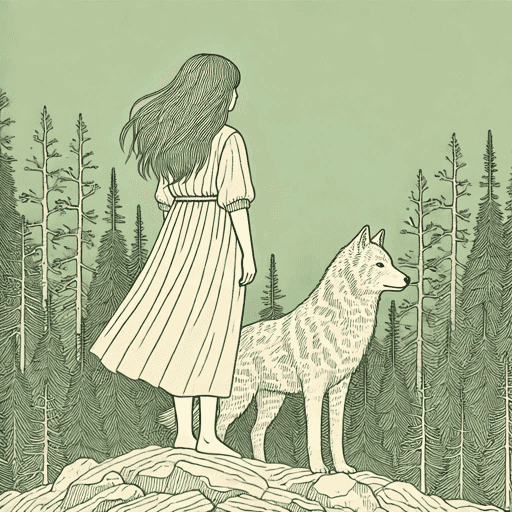
Willa is the protagonist and hero of the novel, a 12-year-old Faeran girl and the last remaining person with the woodwitch and blending abilities hereditary to her people. Willa is empathetic, brave, and cautious, with a deep connection to the natural world and a curiosity about new things and experiences.
At the start of the novel, Willa is a jaetter, or young thief of the clan. She was put through traumatic jaetter initiation at a young age, making her an excellent thief but also centering her life around pleasing the padaran to survive. As the novel progresses and Willa’s relationships deepen, Willa decenters her identity from around being a jaetter and becomes “Willa of the Wood,” an identity capable of loving many different creatures and ways of life.
Willa’s character arc is heavily shaped by grief and loss. Her twin sister and other half, Alliw, has been dead for half of her life, and she has no parental figures except for her mamaw (grandmother). Throughout the novel, Willa clings to parental figures for support. She clings to the padaran, who rejects and tries to kill her; she calls out to Luthien for help, but she is not a wolf and therefore cannot belong to Luthien any more than Luthien can belong to her. Much of Willa’s character development centers around the understanding that grief and love can and should coexist. Willa’s ultimate growth happens as she develops a bond with the human homesteader Nathaniel. This relationship helps Willa overcome her biases and fears, enabling her to discover both her inner value and bravery in a safe, parental environment where she is loved and welcomed. Willa ends the novel still grieving the loss of her loved ones and her people, but with a new family and a new place to belong and call home.
Nathaniel Steadman
Nathaniel Steadman is the deuteragonist of the novel, who plays a supportive mentor role to Willa and becomes her father figure by the novel’s end. He is a human homesteader and miller who has worked on his family’s land in the Smoky Mountains for his entire life, and as a result, he defines himself heavily through his heritage there.
Nathaniel is grieving the death of his wife and the presumed deaths of his children, and his sadness colors much of his characterization. However, he is also loyal, kind, and gentle, determined to be a good father even with the loss of his three children. Although Willa at first believes him to be intense and seemingly cruel, her changing perspective eventually reveals that he has a deep love for nature and a desire to protect it, only using it to survive and to improve his life and the life of those he loves.
Nathaniel’s narrative growth is shaped, viewed, and controlled by Willa’s, but he is not a flat character; she is the vehicle by which he grows to understand the forest better and to slowly recover from the trauma of losing his family. Nathaniel is desperate for closure, but caring for Willa helps him to soften and view the world as beautiful again. By the time Willa discovers the truth, Nathaniel is much more stable, even though he continues to search for his children’s bodies in the river. Losing Willa, however, makes him despair, going as far as to leave his homestead, which is symbolic of him giving up his own identity.
The return of all his children—Willa included—recenters him as a devoted father and protector, and he expands his definition of fatherhood to include Willa as part of his family, symbolizing his growth beyond the devouring grief that characterized him for much of the novel.
The Padaran/Naillic
The padaran of the Faeran people, whose real name is Naillic, is the primary antagonist of the novel and Willa’s uncle. He is an imposing Faeran man and their spiritual leader, who masquerades as a god to control them and force them to live according to his whims.
The padaran is greedy, cruel, and violent, with little regard for any life so long as he gains money or power. He views people—whether human or Faeran—as tools to be used and corrupts the Faeran people so completely that they kidnap human children, slaughter animals, and literally grow ugly under the weight of his evil demands. Both Willa and the padaran can blend and come from the same family, but Willa’s love for the Faeran people and the natural world is true, while the padaran views everything as a means to his selfish ends.
The padaran’s two appearances are the primary tool that characterizes him as a liar. He uses his abilities to look like an intimidating, broad-shouldered bronze god, but his real appearance—exposed when he is threatened or in pain—is that of a hunched, gray, slimy old Faeran man. This shows both the explicit corruption at his core and the lies he maintains to stay in power.
The padaran is also characterized by his familial connection to Willa. The novel emphasizes the importance of the twin bond throughout, meaning that the reveal that he killed his own twin to maintain power sends shockwaves through the Faeran community. While the Faeran can be persuaded to kill animals, the evil of the padaran is so thorough that it tips them into riot and destruction. There is no growth in the padaran’s internal character arc; he does not change, but rather changes from Willa’s perspective as she learns the cruel truth about him and his role in her family’s demise.
Mamaw
Mamaw is an important secondary character and mentor figure within the novel. As Willa’s grandmother and the last remaining woodwitch in the tribe (except for Willa, who is not formally a woodwitch but does have magical abilities), she is a person of considerable power but is treated as less than nothing by the Faeran because they no longer trust her. Mamaw is wise, caring, and protective of Willa. She is devoted to the old ways, but more devoted to protecting Willa at any cost, even if it means compromising her beliefs and boundaries. Mamaw’s determination to protect Willa and still maintain Willa’s sense of independence and the “old ways,” however, ends up costing her life, as Gredic and the others kill her to retaliate against Willa’s rebellion.
Mamaw is a flat character. She is more of an ideal to Willa, as her last remaining family member and the last surviving symbol of the way things were. Her death symbolizes that there is no going back, either for Willa or the Faeran people: While the Faeran people can develop into something new after the padaran’s death, they can never recover who they were, because they killed the last person who could truly tell them how to live. Mamaw’s death also drives Willa deeper on her personal journey by helping her realize that she cannot stay with her own people but must find a new family to care for her.
Gredic
Gredic is the most important of the four jaetters Willa combats with and is the only one with a distinct personality beyond being cruel and brutish. Gredic is cunning, cruel, and controlling, determined to have total control over Willa’s actions and take for his own benefit. He has an abusive and domineering relationship with Willa, since he is very willing to harm and even kill her but is also deeply possessive of her, viewing her as the only thing he has left after his own twin dies. Ultimately, Gredic represents Willa’s foil within the novel. He is who she would have become if she did not have Mamaw and the memories of her family to sustain her—cruel and broken by the jaetter initiation, with no purpose in life except surviving and pleasing the padaran by whatever means necessary.
Gredic does not grow over the story in any positive way; instead, he gets worse, becoming even crueler and more possessive of Willa after her return to the Hollow. His controlling nature is so intense that Willa sees no way to evade him except to kill them both by jumping into the abyss together. Gredic’s only goal within the novel is self-preservation, even if it kills or severely harms others, making his death a form of poetic justice: He clings to Willa so desperately that he dies. He portrays a negative masculinity and childishness, someone who refuses to grow despite trauma and hardship as Willa does. He must die for the Faeran people to survive, which Willa mourns, but ultimately accepts.
Gredic is the most important of the four jaetters Willa combats with and is the only one with a distinct personality beyond being cruel and brutish. Gredic is cunning, cruel, and controlling, determined to have total control over Willa’s actions and take for his own benefit. He has an abusive and domineering relationship with Willa, since he is very willing to harm and even kill her but is also deeply possessive of her, viewing her as the only thing he has left after his own twin dies. Ultimately, Gredic represents Willa’s foil within the novel. He is who she would have become if she did not have Mamaw and the memories of her family to sustain her—cruel and broken by the jaetter initiation, with no purpose in life except surviving and pleasing the padaran by whatever means necessary.
Gredic does not grow over the story in any positive way; instead, he gets worse, becoming even crueler and more possessive of Willa after her return to the Hollow. His controlling nature is so intense that Willa sees no way to evade him except to kill them both by jumping into the abyss together. Gredic’s only goal within the novel is self-preservation, even if it kills or severely harms others, making his death a form of poetic justice: He clings to Willa so desperately that he dies. He portrays a negative masculinity and childishness, someone who refuses to grow despite trauma and hardship as Willa does. He must die for the Faeran people to survive, which Willa mourns, but ultimately accepts.
Hialeah, Iska, and Inali
Nathaniel’s three children are all characterized distinctly but occupy similar roles within the narrative as secondary characters who are primary motivations for both Nathaniel and Willa’s plot and internal growth. Hialeah, the eldest, is brave, determined, and protective; Iska, the middle child, is hopeful, kind, and gentle; and Inali, the youngest, is shown the least and primarily characterized as timid, shy, and in need of protection. All three children are extremely important to both Nathaniel and Willa and are an important part of Willa’s acceptance into the Steadman family, even though it is implied she always had a place whether or not they ever made it home.
Hialeah’s bravery and determination contrasts with her treatment by the Faeran, who punish her for her spirit and put her (and Inali) in the worst part of the prison system to try and break her. Iska, on the other hand, is sweet and understanding, and is present in the story the earliest, even before Willa has met Nathaniel. Iska, more than Nathaniel, is Willa’s bridge into accepting humans as people deserving of love and respect; her empathizing with him enables her to build other relationships and drives her to rescue him later in the novel. Iska is hopeful and dreams of rescue, even when it seems unrealistic, and believes deeply in other people, even when he barely knows them, like Willa. He represents the childhood Willa could have had if not for the cruelty of the padaran, and represents the future she can have as a part of the Steadman family.

Unlock analysis of every major character
Get a detailed breakdown of each character’s role, motivations, and development.
- Explore in-depth profiles for every important character
- Trace character arcs, turning points, and relationships
- Connect characters to key themes and plot points