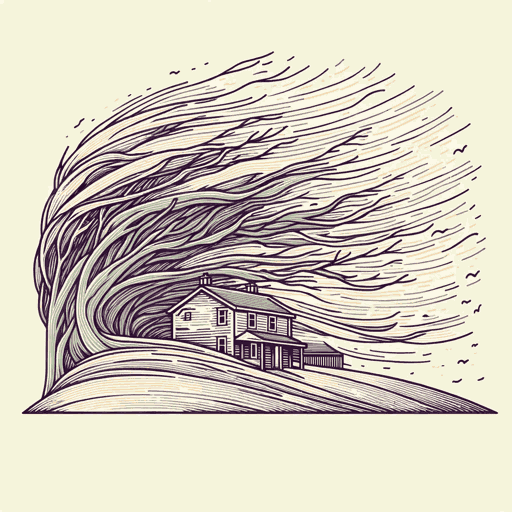
Wind
Wind
A modern alternative to SparkNotes and CliffsNotes, SuperSummary offers high-quality Study Guides with detailed chapter summaries and analysis of major themes, characters, and more.
Background
Literary Context
Like many of Hughes’s poems, “Wind” is centered in the natural world, but in contrast to most poetry produced by his contemporaries, nature is symbolic—almost mythological in scope and detail. In contrast to the formal and idealistic poetry of the Western literary tradition, Hughes wrote verse that sprang from the secret inner world of the subconscious. The descriptions are spare rather than pastoral, dramatic rather than passive. Thematically, Hughes’s poems broke from the safer observational subject matter and presentation to present harrowing struggles in the psyche as evidenced by the human versus nature struggle that sets the context of "Wind."
While Hughes’s poetry is not confessional as that of his wife Sylvia Plath’s—whose thinly veiled poetic subjects were nearly always herself—the couple’s troubled marriage cannot be fully separated from his poetry. During their brief union, Hughes and Plath served as the other’s muse, editor, and literary champion. After Plath’s death by suicide, Hughes quit writing for a time to immerse himself in Plath’s oeuvre; this influence is evidenced in his later work, including Birthday Letters—a collection devoted to his experience and remembrance of their relationship. While the volume was not published until 1998, shortly before his death, Hughes wrote the individual poems over a period of decades.
Historical Context
Hughes’s rural childhood informs his poetry, as does his youth and coming of age during the years of WWII: His father was a veteran of WWI, and Hughes completed two years of service in the Royal Air Force after high school graduation. Following the wars was a lengthy period of the Cold War with its attendant concerns over a potential nuclear conflict. Hughes’s unflinching focus on the ruthless power of the natural world manifests in the struggle of both political and personal relationships. Nature serves as a symbolic but ever-present character in “Wind” as well as Hughes’s body of work, which is violent and capricious to the occasional point of malevolence.
In contrast to the pastoral nature of the poetic tradition Hughes wrote against, his poetry is epic and far-reaching, evidencing his supreme command of Shakespeare, Chaucer, and other classic writers in the literary canon. Hughes studied and committed to memory many of these works, including some of Shakespeare’s entire plays. Similarly, Hughes’s poems encompass entire worlds and personas, from “Crow” to “The Thought Fox” to “Hawk in the Rain” to the much-anthologized “Pike.”

Get in-depth, chapter-by-chapter summaries and analysis from our literary experts.
- Grasp challenging concepts with clear, comprehensive explanations
- Revisit key plot points and ideas without rereading the book
- Share impressive insights in classes and book clubs