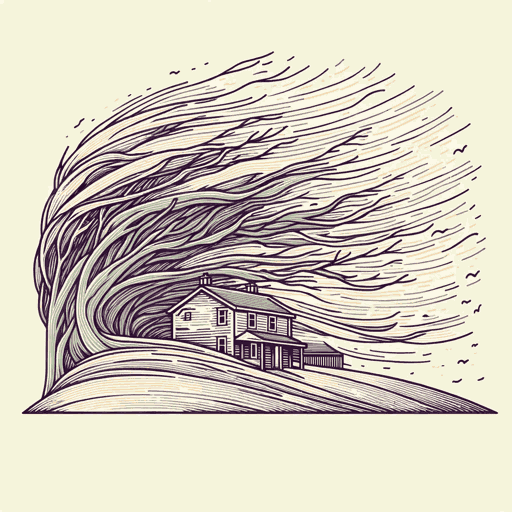
Wind
Wind
A modern alternative to SparkNotes and CliffsNotes, SuperSummary offers high-quality Study Guides with detailed chapter summaries and analysis of major themes, characters, and more.
Themes
Struggle Between Humans and Nature
The world of a Hughes poem is one in which nature and humanity are in constant conflict and one in which humanity is always the weaker party. Nature simply does what it does and any struggle against the natural order, no matter the cost, is fruitless.
In “Wind,” Hughes describes the awesome violence and power of a storm. There is nowhere to hide and nothing is safe: not the trees nor the land—not the sheltering house, and certainly not the inhabitants. Here, the wind’s force is simultaneously powerful and threatening to everything in its path. The landscape and the living creatures are subject to the wind’s wrath. It blows where it wants, from every direction, and belies all sense of stability or safety.
Indeed, the shelter provided by the house is no match for the wind. Like a wave-tossed boat, it begins “far out at sea all night” (Line 1) and ends with even the foundation pulled at the “roots” (Line 24). The house functions as an extended metaphor for the human couple, so readers understand the pair is entirely vulnerable to the wind's power. This struggle is clearly evidenced when the speaker’s physical body is directly assailed by the wind which “dented the balls of [their] eyes” (Line 11). Humans are no match for nature; any clash will end in defeat.
“Wind” indicates that any human attempt to engage in a battle against nature is a waste of energy. The only reasonable action is to watch the power on display and hope to be spared from the brute strength. No matter the inner emotional strength, intelligence, or physical prowess of human beings, people are no match for nature's force.
Struggle in Human Relationships
No stranger to the storminess of human relationships, Hughes often wrote about domestic life struggles. As with its dominance in the physical storm of the poem, the wind metaphorically controls the discordant relationship of the human couple within the house.
Written during his brief marriage to Sylvia Plath, “Wind” reveals the equally unpredictable grappling of one partner against the other. The house becomes a metaphor for the relationship, and it has been “far out at sea all night” (Line 1), suggesting the couple has been actively at odds for some time. Juxtaposed with the violence outside the house, the stormy relationship inside the house has its own frights and struggles.
When there is nothing to be done but quietly sit and take the wind’s beating, the couple—although motionless and silent—are terrorized, clutching their hearts and unable to interact. The sense is clear that while they are not actively engaged in a power struggle, the silence is not congenial. Instead, the violent "world war" has transformed into a "cold war." The wind has driven the couple further apart from each other, despite the fact that they sit quietly together in front of a “great fire” (Line 19). Neither can read, coherently think, or engage with the other in any way. Their stony silence contrasts with the stones outside which “cry out” (Line 24) with the wind’s beating.
The progression of the weather mirrors the destruction of the relationship. Its foundation, like that of the house, has perhaps been uprooted by the interpersonal storm raging between them. As the speaker imagined might happen with the “tent” (Line 12) hills which seem to “strain” against the rope anchoring them, the couple’s relationship might also “bang and vanish with a flap” (Line 14) due to the tension and internal scuffle.
Nature and Its Power
Given Hughes’s background and involvement in the natural, it is no coincidence that the power of nature is so often displayed in his poetry: “Wind” is no exception. As with much of his other work, all of nature—and the wind in particular—functions as a distinct and powerful character that, divine-like, both controls and manipulates all living beings and manmade objects with a will of its own.
The force of the wind is boundless and unpredictable. It terrorizes the land and the living dwellers and is wholly indifferent to either human understanding of morality or the bitter effects of its power to destroy. During the hours of the poem, the storm rages, recedes, and rages again more violently than before. Nothing is spared from its action—neither the trees nor the fields, hills, house, birds, or people. Despite the bravery displayed by the speaker in going outside to retrieve coal for a fire, the wind not only does not relent, it increases enough to “dent” (Line 11) the powerless human’s very eyeballs before launching a direct attack on the house itself.
Described in terms that evoke violent strength, the wind “stampedes” (Line 3) like an army of horses, “wields” (Line 6) even the light like a knife, and causes the hills and fields to “drum” (line 12) and “quiver” (Line 13). It effortlessly overpowers all creatures in its wake—bird and human alike. Even a firmly planted house is no match for the wind's strength and can only “tremble” (Line 23). The wind is so strong, it battles the other natural elements, from birds in the air to the earth itself.
Brutally forceful and all-encompassing, the wind is at war against the world, and it emerges, as it always does, the victor, leaving the inhabitants, like the stones, “crying out” (Line 24) for nonexistent mercy. The speaker returns by the poem’s end where he began as both a passive observer and chief casualty of the wind’s power and vigor.

Unlock every key theme and why it matters
Get in-depth breakdowns of the book’s main ideas and how they connect and evolve.
- Explore how themes develop throughout the text
- Connect themes to characters, events, and symbols
- Support essays and discussions with thematic evidence