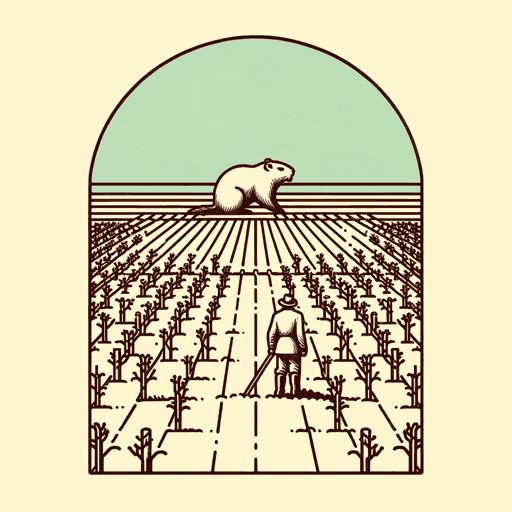
Woodchucks
Woodchucks
A modern alternative to SparkNotes and CliffsNotes, SuperSummary offers high-quality Study Guides with detailed chapter summaries and analysis of major themes, characters, and more.
Further Reading & Resources
Related Poems
“After Love” by Maxine Kumin (1970)
Kumin describes a married woman’s reflections in bed after a moment of intimacy.
“In the Park” by Maxine Kumin (1989)
Kumin considers the mortality of humans and the human explanations for death and the afterlife.
“After Apple-Picking” by Robert Frost (1914)
Like Kumin, Frost often set his poems in rural New England. This poem describes the speaker’s recollections of an ordinary day picking apples as the speaker falls asleep. The simple and direct language of the poem also echoes Kumin’s style.
“The Armadillo” by Elizabeth Bishop (1979)
Kumin’s style is often seen as similar to Bishop’s direct and simple language. Bishop’s “The Armadillo” describes a street carnival Bishop attended. When fire balloons are released into the sky, the balloons set the natural world on fire, and the poem recounts the resulting horror. Like Kumin, Bishop uses natural images to both create ecocritical commentary and allude to larger sociopolitical issues.
“The Ambition Bird” by Anne Sexton (1981)
Despite their close friendship and frequent collaboration, Kumin and Sexton have dramatically different poetic styles. Sexton is a confessional poet. In “The Ambition Bird,” the speaker uses the image of a bird to stand in for the existential crisis the speaker is experiencing regarding ambition and purpose.
Further Literary Resources
“Maxine Kumin talks of farm life and poetry” by Howard County Poetry and Literature Society (1997)
In this interview for “The Writing Life,” Kumin talks with poet Henry Taylor about her life on her farm, her poetic form, and her friendship with Anne Sexton. She also reads a selection of her poetry.
“Postscript: Maxine Kumin (1925-2014)” by Philip Schultz (2014)
Philip Schultz, a poet and friend of Kumin, memorializes her life and career in this poem written after her death.
“Remembering Anne Sexton: Maxine Kumin in Conversation with Diane Middlebrook” edited by Nancy K. Miller (2012)
In this interview, Kumin describes her friendship with Sexton. Kumin also talks about references to Sexton within her own poetry.
An Interview with Maxine Kumin by Martha George Meek (1975)
This interview was conducted shortly after the publication of “Woodchucks” and Kumin won the Pulitzer Prize. In this interview, she describes her life, her artistic philosophy, and how her life and art intersect.
“Introduction to the Holocaust” by the United States Holocaust Memorial Museum
This introduction to the museum’s website gives a detailed overview of the Holocaust, which “Woodchucks” discusses.
“Ecocriticism” by Smith University
“Woodchucks” could be read as a work of proto-ecocriticism as Kumin considers the effects of humans on animals. This article explains the movement and its different concerns.
Eichmann in Jerusalem: A Report on the Banality of Evil by Hannah Arendt (1963)
Arendt reports on the trial of German Nazi leader Adolf Eichmann in this book adapted from a series of articles in The New Yorker in 1963. In this book, she coins the term “banality of evil,” which Kumin draws upon for her poem’s thematic concerns.
Listen to Poem
Maxine Kumin reads her poetry, including “Woodchucks”
Alongside poet Alan Dugan at the Coolidge Auditorium in 1974, Kumin reads 12 of her poems. At 13:21, she reads “Woodchucks.”

Get in-depth, chapter-by-chapter summaries and analysis from our literary experts.
- Grasp challenging concepts with clear, comprehensive explanations
- Revisit key plot points and ideas without rereading the book
- Share impressive insights in classes and book clubs