Your Inner Fish: A Journey into the 3.5-Billion-Year History of the Human Body
Your Inner Fish: A Journey into the 3.5-Billion-Year History of the Human Body
A modern alternative to SparkNotes and CliffsNotes, SuperSummary offers high-quality Study Guides with detailed chapter summaries and analysis of major themes, characters, and more.
Summaries & Analyses
Quizzes
NEWReading Tools
Symbols & Motifs
The “Inner Fish”
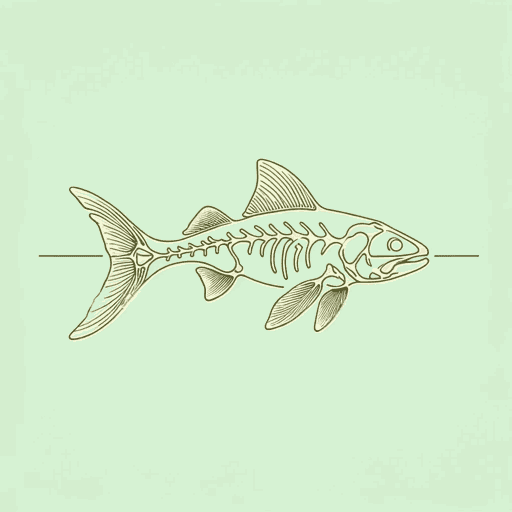
One of the most frequent motifs that Shubin employs is that of an “inner fish” that exists within the human body (8). The image first occurs in Chapters 1 and 2, when Shubin describes his hunt for the fossil of Tiktaalik. Shubin explains that Tiktaalik is significant because it contains traits of both fish and amphibians, and provides deep insight into how fish first came to evolve limbs and walk on land. For Shubin, one of the most fascinating elements of Tiktaalik is the fact that it contains the bone structure of a limb within its fins. This same bone structure—a single long bone, two interlocking bones, and a wrist bone—is found inside the limb of every limbed animal on Earth, from reptiles to birds to humans. As Tiktaalik is the earliest living creature to have limb bones, scientists can trace the history of human limbs back to Tiktaalik. For Shubin, this is akin to having an “inner fish” within our bodies.
The notion of an “inner fish” extends beyond skeletal structures. In Chapter 3, Shubin describes his colleague Randy Dahn’s experiments with shark embryos. Dahn discovers that Sonic hedgehog, the gene that builds limbs in human embryos, plays a similar function in building shark fins. For Shubin, this discovery is sign of another “inner fish” within human bodies: “The ‘inner fish’ that Randy found was not a single bone, or even a section of the skeleton. Randy’s inner fish lay in the biological tools that actually build fins” (79). For Shubin, everything from our bodily structures to our genetic code contains evidence of our shared history with fish. In Chapter 11, Shubin notes that his usage of “inner fish” is a shorthand for all the creatures that exist within the human body— he could have also titled his book “Your Inner Fly, Your Inner Worm, or Your Inner Yeast” (262).
Zoos
In the first and final chapters of Your Inner Fish, Shubin uses zoos imagery to explain evolution and “descent with modification” (232). Both of these concepts are based on a foundational “biological law of everything” that all living organisms descend from genetic parents (231). However, as organisms pass down their genetic information, mutations occur, slowly leading to the development of new species with different biological traits. One of the goals of biologists is to observe living species and reconstruct the tree of evolution, tracing how animals evolved from each other.
To illustrate how biologists construct this evolutionary tree, Shubin invites readers to imagine walking through a zoo where animals could grouped according to traits they share. Some of these categories, such as all animals with a “head and two eyes,” would contain all of the creatures in the zoo. Other categories, such as all animals “with limbs,” would only contain some of the zoo’s animals (such as reptiles, birds, and mammals). Biologists assume that animals in the more general categories (such as fish) must have evolved earlier than animals in the more specific categories (such as mammals).
Hot-Rod VW Beetle
In Chapter 11, Shubin compares the human body to a souped up “hot-rod VW Beetle” in order to describe how it is destined to “fall apart” due to its evolutionary history (246). Shubin describes a Volkswagen Beetle “jerry-rig[ged]” with adapted parts (245). Though one might be able to force the Beetle to travel faster than it was originally designed to do, the car has a “limit” as to how much it can be altered (246). Shubin uses this image of a hot-rod VW Beetle as a metaphor for human bodies:
In many ways, we humans are the fish equivalent of a hot-rod Beetle. Take the body plan of a fish, dress it up to be a mammal, then tweak and twist that mammal until it walks on two legs, talks, thinks, and has superfine control of its fingers—and you have a recipe for problems (246).
Many structures in the human body are not designed to be used the way that humans use them, which makes them fragile. Shubin describes a number of human ailments caused by our evolutionary past, including hernias and obesity. By understanding the complex evolutionary history of our body, Shubin believes we can better understand the causes of such ailments, as well as how to combat them.

Unlock the meaning behind every key symbol & motif
See how recurring imagery, objects, and ideas shape the narrative.
- Explore how the author builds meaning through symbolism
- Understand what symbols & motifs represent in the text
- Connect recurring ideas to themes, characters, and events