70 pages • 2-hour read
All the Glimmering Stars
A modern alternative to SparkNotes and CliffsNotes, SuperSummary offers high-quality Study Guides with detailed chapter summaries and analysis of major themes, characters, and more.
Chapters 1-6Chapter Summaries & Analyses
Chapter 1 Summary: “December 28, 1994: Koromush Barracks, Southern Sudan”
Content Warning: This section of the guide includes discussion of graphic violence, physical abuse, emotional abuse, child abuse, and child death.
Phillip Bol, a sergeant in the Sudanese People’s Liberation Army, waits with his men for the approaching Lord’s Resistance Army (LRA). They’re expecting an attack on their barracks, so they wait on the edge of a burned field with elephant grass beyond.
A flare goes up, lighting the grass before him. He sees dozens of children covered in shea butter and singing a hymn. The children in front are unarmed, their elbows linked as they clap and look to the sky. Behind them are children carrying AK-47s and rocket launchers. They open fire on Bol’s men as they exit the grass.
Chapter 2 Summary: “June 1987: Rwotobilo, Uganda”
George Opoka takes his seven-year-old son, Anthony, with him to explore the area where they live in Uganda. He shows him important landmarks near their village, noting three tall trees and Awere Hill. However, he warns Anthony to never go on the hill because Joseph Kony preaches there.
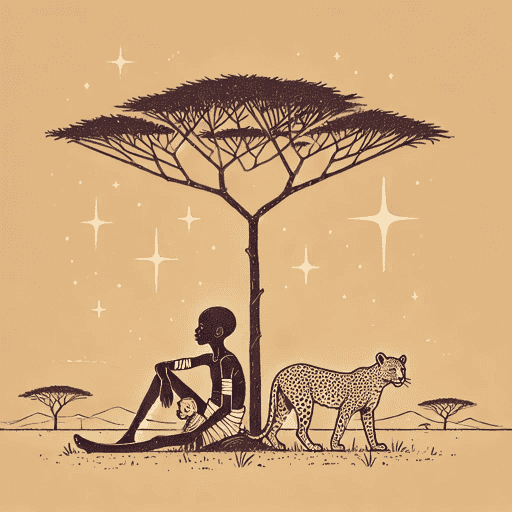
That night, George shows Anthony the stars. He explains that if Anthony can memorize them, they’ll always serve as a guide for him in the dark. He then tells Anthony that he needs to remember to always be a good person as he grows up. Whenever he’s unsure what to do, George tells him to ask himself: “What would a good human do?” (13).
Anthony returns home with his father. As he eats with his mother, Acoko, she asks him what he learned. Anthony tells her that he learned how to navigate in the dark so that he’ll never be afraid. However, Acoko warns him that he should always be afraid of what roams in the dark and that life isn’t always just about happiness but also about “survival.”
Chapter 3 Summary: “September 1988: Amia’bil, Uganda”
Sixty kilometers to the southeast, four-year-old Florence Okori wakes up to help her mother, Josca, with the chores. As she walks back with buckets of water, she’s overwhelmed by fever and dizziness, collapsing to the ground. Her father, Constantine, takes her to a hospital. She has malaria.
After 13 days unconscious, Florence recovers. She’s in a room with 30 other children, as measles recently ravaged unvaccinated parts of Uganda. Her nurse, Miss Catherine, tells her that she must stay until her fever breaks.
Over the next several weeks, Florence’s fever spikes frequently, and many of the other children die. On Christmas Eve, Florence wakes up to see her mother standing by her bedside. Miss Catherine tells her that Florence is too weak; however, Josca insists that Florence needs to be with her family. She carries Florence three kilometers back to their village. Florence tries to say that she can walk, but Josca tells her that she “would carry [her] forever” because “love is the strongest force there is” (22).
Back at home, Florence is greeted by her many siblings, her father, and her cousin, Jasper, whose parents died last year. As they rejoice at her return home, Florence is overwhelmed with love and gratitude.
Chapter 4 Summary: “May 1992: Rwotobilo, Uganda”
Anthony, who is now 12 years old, trains every day for the district race. As he runs, he passes his Uncle John’s house. He was killed by LRA soldiers. Anthony remembers how his father warned him to never become a soldier, because soldiers “hold powers over others” (29), which his father views as the worst thing in life.
Anthony wins the race. He barely beats last year’s champion, Patrick, in the final few meters. Afterward, he celebrates with his classmates and friends.
A rainstorm starts brewing in the distance. Anthony sees Patrick and his friends in the water just as a torrent of water causes them to lose their footing and pushes them downstream.
Anthony runs downstream, following the boys. Patrick manages to grab onto roots but is stuck in the middle of the river. Anthony’s teachers help him form a human chain, and he jumps into the river to pull Patrick back, helping him to shore.
Patrick is elated that Anthony saved his life. He insists that he’ll remember what Anthony did for him and repay him.
Chapter 5 Summary: “April 1993: Amia’bil, Uganda”
It takes Florence 20 months to fully recover from malaria. Through it all, her mother carries her everywhere, insisting that she’ll recover despite the fate of most of the other children.
When Florence starts school at seven years old, she’s behind all the other students. However, she works hard to catch up and eventually is at the top of her class. At the end of the school year, her favorite teacher, Mr. Alonsius, gives her two notebooks, one for her schoolwork and one to record her dreams for the future.
Florence often goes with her father to look for medicinal herbs. She begins to learn what each of them do and decides to become a nurse.
Chapter 6 Summary: “September 14, 1994: Rwotobilo, Uganda”
As Anthony walks home from school, having won the district race for three straight years, he thinks of Patrick. In November 1992, his village was raided, and he was taken by LRA soldiers. At night, Anthony and his brothers travel to Gulu for protection from LRA night raids.
When Anthony gets home, his father congratulates him on becoming head boy. Anthony is sad that his mother isn’t there to celebrate. She left his father earlier in the year to live with her family. However, Anthony’s father tells him that his mother wrote a letter asking to see Anthony.
That night, Anthony and his siblings sleep in the village so that they can begin the harvest early the next morning. When Anthony wakes up, he starts working and is joined by his 10-year-old brother, Charles, shortly after sunrise. However, shortly after they begin working, LRA soldiers invade their village.
Anthony and Charles rush to Charles’s home, where they find soldiers threatening his mother. They turn to Charles, shoving him to the ground; however, Anthony steps in, insisting that they take him instead.
Several LRA soldiers take Anthony and a few other boys, tying their hands behind their backs. They’re forced to walk for hours, and more soldiers and recruits join them.
That night, as Anthony lays down to sleep, he meets a younger boy, James. Also, he notes the landmarks around him as well as the stars, insisting to himself that he’ll find his way back someday.
Chapters 1-6 Analysis
As a work of historical fiction, All the Glimmering Stars interweaves factual historical events into the narrative. The novel’s setting, Uganda following the Ugandan Civil War, is a key component of the novel, as it examines human attributes and emotions like love, agency, trauma, and family during a difficult period in history. Sullivan uses specific dates and locations to mark each chapter, grounding events in an accurate historical timeline.
The text opens with a scene from a moment in the novel’s future, following a character, Seargent Bol, who is present only in the first chapter. This narrative decision introduces the novel’s primary conflict—the war within Uganda—while also establishing the mood. The eerie, haunting way that Sullivan describes the approaching children in the battle conveys conflicting elements. Children are singing and shooting guns. The mood is one of sadness, as readers can envision Kony’s abhorrent use of children in his army. However, it’s also a mood of fear and horror in that these children have been turned into murderers. This duality persists throughout the novel, as it describes both the dangerous and heart-rending side of Kony’s war, emphasizing its tragic nature.
Through a shifting, limited third-person point of view, Sullivan explores the lives of both Anthony and Florence. In the first section of the text, he examines their lives outside the LRA, revealing that both are hardworking, responsible children with good families and dreams for their futures. This point of view humanizes both characters, evoking sympathy for the tragic direction that their stories will take.
Central to both Florence and Anthony’s characters is the important role that their families play in their lives. Both characters have important moments in the first section of the text that exemplify the value of their families in their maturation and development. For Florence, her mother’s help in recovering from malaria is a defining moment in her childhood. After her mother carries her back to their home, she tells Florence: “You are my daughter, Florence. I love you with all my heart and soul. And love is the strongest force there is. If I had to, I would carry you forever” (22). Florence reflects on this moment several times in the text, and the idea of “carrying” those she loves becoming an important motif for her character. Similarly, when Anthony’s father takes him out for the first time to teach him how to navigate by the stars and learn the land, it creates a sense of pride and belonging within Anthony while emphasizing George’s faith that his son will grow up to be a “good human.” George tells Anthony to always ask himself “What would a good human do?” (13), a motif that Anthony remembers and repeats to himself as he’s pulled into Kony’s war. These two motifs (carrying others and being good) introduce The Power of Love to Heal and Transform as a theme. The love that Anthony and Florence receive from their families in the first section of the text continues to impact them throughout the novel as they struggle to survive.
The novel introduces its primary antagonist, Joseph Kony, briefly in the first section of the text through Anthony’s conversation with his father. George notes how “[t]hey say [Kony] can call thunderstorms and has powers far greater than Lakwena. More people go there every night to hear him preach and see him call storms” (11). George’s view of Kony reflects that of many Ugandan civilians during his years of rebellion and terror. He’s seen as dangerous but also contains a mythic element that instills both awe and fear in the civilians. This novel explores this characteristic throughout the story, highlighting Kony’s ability to elevate himself to a nearly nonhuman status, simultaneously evoking both mystery and danger.

Unlock all 70 pages of this Study Guide
Get in-depth, chapter-by-chapter summaries and analysis from our literary experts.
- Grasp challenging concepts with clear, comprehensive explanations
- Revisit key plot points and ideas without rereading the book
- Share impressive insights in classes and book clubs