70 pages • 2-hour read
All the Glimmering Stars
A modern alternative to SparkNotes and CliffsNotes, SuperSummary offers high-quality Study Guides with detailed chapter summaries and analysis of major themes, characters, and more.
Important Quotes
Content Warning: This section of the guide includes discussion of graphic violence, suicidal ideation, death, physical abuse, emotional abuse, and child sexual abuse.
“Led by a fanatical, false messiah, LRA forces were either fearless or dead, a fact that made even a man like Seargent Bol dread the night and the hymns that would soon lilt and threaten over the grasslands, as if given voice by sirens and false angels.”
(Chapter 1, Page 2)
The opening lines of the text introduce Joseph Kony, the LRA, and the child soldiers, setting a dark and eerie mood. The use of a simile, comparing the children to “false angels,” emphasizes the soldiers’ duality. While they look young and innocent, Kony has turned them into deadly weapons.
“Random threat was a constant in the bush of the central highlands. Leopards, lions, hyenas, cape buffalo, and elephants roamed in the thick cover. So did poisonous snakes and, worst of all, disaffected soldiers from the five-year Ugandan Civil War, which had ended the year before.”
(Chapter 2, Page 7)
These words describing the situation in Uganda highlight the role that the setting plays in the novel. The land itself masks many natural dangers, but the men who roam it because of years of civil war ravaging the country pose an even greater threat.
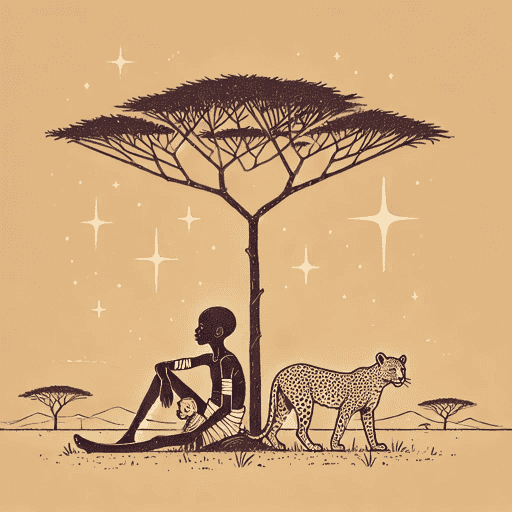
“‘The medicine man also told me that all our spirits come from stars and return to stars when we die. So, when you look up at the stars, Anthony, you may also be seeing the spirits of your ancestors and the souls of your children shining back at you.’ The boy peered up at all the glimmering stars in the vast blackness of the night sky.”
(Chapter 2, Page 12)
“[Florence] could feel the rush of love coming from her mother, started to cry with joy, and knew she would never forget the moment or how good and safe and protected she felt going home.”
(Chapter 3, Page 23)
Florence’s mother carrying her home from the hospital after her illness forms a memory for Florence that later carries her through dark times in the LRA, giving her the strength to survive and protect her own children. Her mother’s caring and protective nature emphasizes The Power of Love to Heal and Transform as a theme.
“Anthony was rarely disappointed by life. He loved to laugh, was constantly amazed by new things, and adored school, especially math and languages. His teachers said that before long, he would be elected head boy, so he had embraced that goal in the same way he’d embraced trying to be better than the day before, being a good human, and training for the yearly races.”
(Chapter 4, Page 28)
The chapters that cover Anthony’s childhood emphasize his innocence and potential, reflecting his hardworking nature and dedication to school. This characterization sharply contrasts the harshness of the LRA and the disillusionment he faces when he’s abducted. As a bildungsroman, or coming-of-age novel, All the Glimmering Stars depicts a protagonist facing an extreme conflict and maturing to overcome his difficulties.
“Another followed the order, but not before burning the images in his memory. […] He studied the stellar night sky, fixing on a cluster of three stars low on the western horizon and a single bright one to the east. He memorized their position in the sky in relationship to the direction they had traveled during the day and told himself he could find this place again.”
(Chapter 6, Page 53)
When Anthony is taken from his village and out of Uganda, the novel takes on a tone of despair and helplessness. However, as he’s led away, Anthony uses his knowledge of the land and the stars to memorize landmarks, vowing to return home one day. These words foreshadow Anthony’s eventual triumph in escaping from the LRA.
“Another felt it, too, a withering and perishing inside. His innocence. His belief in himself. His childhood. Everything George and Acoko and his teachers had taught him about growing up to be a good human. All of it felt gone in a single step.”
(Chapter 7, Page 61)
When the soldiers force Anthony to step on his friend James, it shatters his view of the world. He repeatedly emphasizes his father’s advice to be a “good human,” a prominent motif in the novel; however, facing the atrocities of the war, Anthony’s ability to navigate being a good person amid evil later becomes his core conflict when he questions whether choosing to follow evil orders rather than death makes him culpable.
“You are all murderers now. The pictures we took prove it. You can never go back. Your parents will hate you for what you have done. And if the government catches you, they will hang you for killing this boy.”
(Chapter 8, Page 63)
The soldier’s words to Anthony and the other captives convey the fear tactics and manipulation that Kony uses to control tens of thousands of people. Most of these people are young boys, who are easier to control both physically and psychologically. This moment introduces The Psychological Impact of War as a theme, because Anthony is repeatedly told that he’s now a bad person for being forced to commit evil acts.
“The next five days passed in the same mental fog that had dulled Anthony’s senses and slowed his brain during his close encounter with the bayonet. When they were on the rail, on the move, which was almost constantly, he saw nothing except the back of General Tabuley’s boots. When people called to him, it sounded like they were underwater. The food he ate had no taste. His fingers and lips felt number.”
(Chapter 9, Page 71)
This passage highlights the change that Anthony is undergoing and directly contrasts his earlier depiction as someone “rarely disappointed by life” (28). Now he has become disillusioned and defeated by the LRA’s brutality.
“Anthony felt a rush go through him. He wanted to know what it felt like to be unstoppable, invincible, ready to fight and lead. And then he realized it was a little like this sensation pulsing in him. He puffed his chest out, lifted his head, and threw his shoulders back as Kony had.”
(Chapter 9, Page 78)
The moment when Anthony first meets Kony highlights two important points. First, it reveals Kony’s power and manipulative nature as he convinces the children that he can make them “invincible.” Second, it introduces the conflict within Anthony as he struggles to succeed in the LRA while also being a good person.
“What if I have to shoot someone? The thought had not entered Anthony’s mind before. Within seconds, however, it dominated his being. He remembered his father always saying that violence was wrong, and surely there was nothing more violent than killing a man. But he had already crossed that line, hadn’t he? When he was forced to step on James’s body?”
(Chapter 13, Page 120)
Just before his first battle, Anthony realizes that he may need to kill someone. His internal thoughts emphasize his innocence in contrast to other LRA soldiers. While they take joy in fighting and pleasure in killing, he’s hesitant to kill someone even to protect his own life. He has an innocence that many of the other LRA soldiers don’t. Rather than being evil himself, he’s a product of the evil situation he’s in.
“When [Kony] came to Anthony’s side, all the fifteen-year-old could think of was that dog creature from his nightmares. Part of him wanted to recoil and turn away from the Great Teacher. Instead, he remembered himself as that wounded leopard in the narrow cave and understood he could stay beyond the dog’s reach by backing up deep into his mind.”
(Chapter 14, Page 130)
The metaphor of Anthony as a “leopard” continues throughout the novel. At times, he sees himself as dangerous and strong like a leopard. At others, like here when he’s trying to remain on Kony’s good side, he pictures himself hiding in a “narrow cave.” He still possesses that inner strength but chooses to hide it to survive.
“[Anthony] blamed it on the Great Teacher. He blamed everything on Kony and his loony ideas and spirits. Of late, that hatred had turned to bitterness like a thick chain wrapped tight around him head to toe. The weight was heaviest about his chest, where he seemed to suffer heartache on a daily basis. The weight made him angry and more aware than ever of the loneliness of the wounded leopard in his cave.”
(Chapter 16, Page 146)
The simile comparing Anthony’s anger to a “chain” trapping his body conveys his inner turmoil. He sees the evil within Kony and hates him for it yet forces himself to ignore it as it weighs him down so that he can survive. The passage again invokes the metaphor of the wounded leopard hiding in a cave to conserve strength until danger passes.
“‘My last radioman did not understand, and he got sleepy, and he made mistakes. Unforgivable ones, Opoka.’ In another time and place, Anthony might have been hugely intimidated by the comment. But after his breathing, he was very clearheaded and felt his best response was to nod humbly.”
(Chapter 17, Page 165)
Facing Kony, who threatens his life, Anthony pushes down his anger and fear primarily because of what Mabior taught him. This moment emphasizes the Mabior’s important role in Anthony’s life, as he learns to control his emotions, compartmentalize, and wait for the opportunity to escape.
“But then [Florence] remembered her mother and how Josca had carried her everywhere when she was five and helpless and had to have weighed more than this radio. She could almost hear her mother’s voice calling to her: You are my daughter, Florence. I would carry you forever. The words echoed again and again through her mind, giving her strength and hope.”
(Chapter 19, Page 183)
Florence’s thoughts emphasize the importance of her mother’s love in her life, which helps her survive her kidnapping and the LRA’s brutality. This passage helps develop The Power of Love to Heal and Transform as a theme, because the thought of returning to her mother—and her love—provide Florence with the hope she needs to survive.
“But ever since [Anthony’s] afternoon caring for the wounded old shopkeeper, he had been thinking almost daily about those evenings when he and his father had gone out to watch the stars and talk about what it meant to be a good human. He remembered how warm and filled up he felt, how seen and heard he felt, and how George seemed to understand everything about him and who he might become.”
(Chapter 20, Pages 194-195)
Just like Florence, Anthony’s ability to survive the LRA thematically reflects The Power of Love to Heal and Transform. He often thinks of his father, allowing his love and the hope of returning home to give him the motivation he needs.
“‘Oh,’ Florence said, kind of disappointed because she’d expected someone huge enough to hold four spirits in him, not this guy laughing and clapping in a hospital for the wounded. […] The closer he came, the more Florence felt the energy pulsing off the man, so strong it shifted her anger at him to fright. He seemed one of those people who are capable of any evil.”
(Chapter 23, Pages 228-229)
Florence’s first time seeing Kony conveys an important aspect of his character. Physically, he’s small, which shocks Florence. However, he has a unique ability to be both charismatic and deadly. In this way, Florence’s thoughts give insight into Kony as a person, as he’s brutally kidnaps and manipulates thousands of children over two decades.
“[S]miling to herself, [Florence] turned to a blank page and watched as her imaginary pencil began to dance on the paper, spinning and looping out hopes and dreams for herself. I will get away, she wrote. I will go home. I will be with my parents. I will go back to school. I will become a nurse.”
(Chapter 24, Page 236)
This moment illuminates the importance of Florence’s notebook, an important symbol in the novel that represents her old life. She finds solace during her time in the LRA by thinking about both her past and her future, giving herself hope to survive and fulfill her dreams.
“Florence entered the little house deeply happy for the first time since her abduction. Not only was Anthony a decent person, but she had also chosen him. She had not been forced into it, and that made all the difference in her mind.”
(Chapter 26, Page 256)
After Florence is forced into a marriage with a man she dislikes, she meets Anthony. Her first moments with Anthony convey two themes: The Power of Love to Heal and Transform and The Journey to Agency and Control. For the first time since the LRA kidnapped her, Florence makes her own decision, giving her some control. Through Anthony she finds hope for survival and a happy future.
“Then [Florence] came around the front of him, hands still on him, and looked at the wound from that side. […] ‘It has made you who you are, and I think you are beautiful and handsome, and so your shoulder is beautiful and handsome.’ She could see just how desperate he was to believe her, and felt she had to show him. Florence leaned in and kissed Anthony.”
(Chapter 26, Page 261)
Anthony’s scar, while serving as a physical reminder of what he has endured, also symbolizes the emotional and psychological wounds that he experiences in the LRA. Florence’s insistence that his scars are beautiful foreshadow her role in healing Anthony’s emotional wounds.
“At the bullets slashed the opposite side of her tree yet again, Florence fed her maternal rage with her love for her sons until she burned head to toe with full-blown bloodlust. Prior to this moment in her life, Florence had only been a witness to combat. She had never fired her gun except in training. But now the training kicked in.”
(Chapter 32, Page 315)
After Florence gives birth to Boniface, she’s forced to defend her family by using her gun for the first time. This moment is significant in Florence’s development, emphasizing the theme of The Journey to Agency and Control. She actively stands up and defends herself, resolving from this point forward to escape from Kony to protect her children.
“The young signal commander stood there, watching the LRA’s supreme commander agonize. He knew he could probably ease Kony’s pain by teaching him how to recognize the four voices of suffering, the importance of naming them, and the simple methods the old shopkeeper had shown him to quiet them enough to think clearly. But Anthony said nothing, did nothing to help the Great Teacher.”
(Chapter 36, Page 344)
Anthony’s thoughts reflect his growing maturity while emphasizing Kony’s impact on him. He no longer cares what Kony thinks of him, choosing not to help him—something that would likely garner him praise from Kony. Instead, he decides that Kony deserves to suffer and allows him to do so. Notably, however, Anthony still considers offering his help for a moment, highlighting how much control Kony continues to have despite the atrocities he perpetrates.
“LRA soldiers up and down the mountain began to cheer, ululate, and sing. Anthony could hear their voices below and above him, like some twisted and triumphant boys’ choir. Soon afterward, the surviving Ugandan and Sudanese forces gave up.”
(Chapter 39, Page 376)
This simile comparing the child soldiers to a “twisted […] boys’ choir,” emphasizes the threat that these young children pose. The fact that Anthony makes this comparison illustrates his change in the text. Before, he was part of this group, taking pride in his survival and feeling as though he belonged to the LRA. Now, their actions disturb him as he recognizes their brutality and inhumanity.
“Anthony was shocked to his core as they handcuffed him and led him away. Twenty years. I was only gone for ten. But I was commander. I did serve Kony. Anthony was put in a cell by himself. When the steel gate had been locked shut behind him, he sat on the edge of the metal bunk, put his head in his hands, and felt himself sliding into the darkest hours of his life.”
(Chapter 43, Page 419)
Anthony’s thought process when he’s imprisoned after escaping the LRA conveys the duality of his situation. Although he was forced to serve Kony and fight on threat of death, he remained with the LRA and, in his words, “served Kony,” he was coerced to do so on threat of death. As he tries to reconcile these two ideas within himself, he ultimately decides to accept punishment for what he did, highlighting his growth.
“And as our love grew, the memories of how we were deeply loved as children returned, and we found ourselves telling each other the way we were raised, what we were taught at home, in school, in church, and by all the kind people in our lives. It all came flooding back: what it was to be a good human, to believe in the goodness of another person.”
(Chapter 45, Page 440)
The novel’s final passage thematically encapsulates The Power of Love to Heal and Transform. In their darkest moments, Anthony and Florence found each other and fell in love. Their relationship helped them connect with thoughts of home, gave them hope for the future, and motivated them to continue to be good people despite the horrors they experienced.

Unlock every key quote and its meaning
Get 25 quotes with page numbers and clear analysis to help you reference, write, and discuss with confidence.
- Cite quotes accurately with exact page numbers
- Understand what each quote really means
- Strengthen your analysis in essays or discussions