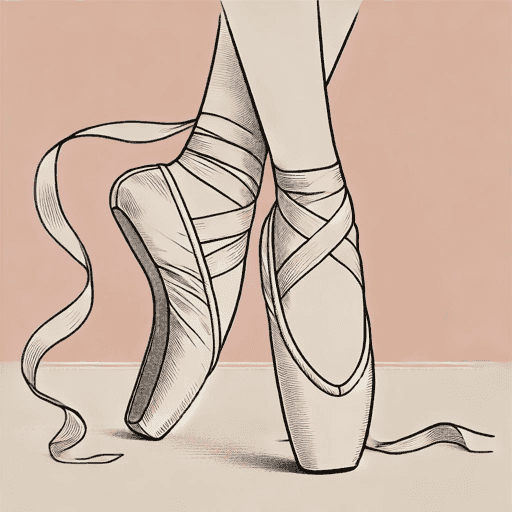
Ballet Shoes
A modern alternative to SparkNotes and CliffsNotes, SuperSummary offers high-quality Study Guides with detailed chapter summaries and analysis of major themes, characters, and more.
Summaries & Analyses
Quizzes
NEWReading Tools
Chapters 1-5Chapter Summaries & Analyses
Chapter 1 Summary: “Great-Uncle Matthew and His Fossils”
Content Warning: This section of the guide includes discussion of death.
Ballet Shoes begins by introducing the three Fossil sisters, Pauline, Petrova, and Posy, who live in a house on Cromwell Road. Their home is close enough to walk to the Victoria and Albert Museum to look at the dolls’ houses “every wet day. If the weather [is] not too wet, one [i]s expected to ‘save the penny and walk’” (3). The sisters critique the decision of their great uncle Matthew (affectionately called Gum) to buy a house at the end of such a long road. The book then tells the story of how each of the Fossil sisters came to live at the house.
Gum is an adventurer that the sisters never knew well but has a significant role in their lives. Having “collected some of the finest fossils in the world” (4), he needs a home large enough to house them and someone to look after everything while he’s on voyages. He takes in his nephew’s widow; her young daughter, Sylvia; and her nurse, Nana. By the time Sylvia is 16, her mother has passed; Sylvia and Nana must look after Gum’s home.
After losing a leg in an accident, Gum can no longer excavate fossils on land. Instead, he decides to explore the sea. While he’s on a voyage, his boat strikes an iceberg, and most of the passengers drown. The lifeboat that Gum is on picks up one survivor floating on a lifebelt: a tiny baby girl.
Instead of bringing back souvenirs from his journey, “[t]he entrancement that Gum actually [brings] home [is] Pauline” (6). Nana initially opposes taking her in, stating that the house is already too full, but she can’t help but love the baby. She warns Gum that this is the last one, however: They can’t take in any more children.
On another excursion, Gum’s leg gives him trouble, and he stays in a hospital, where he befriends a Russian man. His wife recently died, leaving him alone with a small baby girl. The man will die soon, and the nurses at the hospital debate sending the girl to the orphanage. Instead, Gum offers to take her in and gives her the name Petrova. Nana is initially upset at Gum but ultimately agrees that Petrova must stay. She tells him that he must bring home no more children, however: There simply isn’t room.
Gum doesn’t personally bring home the last baby, Posy. Instead, he delivers her “by district messenger in a basket. With her he send[s] a pair of ballet shoes and a letter” (10), informing Nana and Sylvia that the little girl is named Posy and is the daughter of a dancer; her husband recently died, and she can’t afford to raise the baby on her own, so Gum offered to adopt her. A pair of ballet shoes is the only thing the mother gave her daughter. Though shocked, Nana and Sylvia make room in the home for Posy.
About four months later, a final package arrives from Gum: three necklaces “addressed to ‘The Little Fossils’” (11), each bearing one of the sisters’ names. In the letter, Gum says that he’ll be away for about five years but has arranged with the bank to give Sylvia and Nana the money they’ll need to raise the sisters while he’s away. It’s the last they hear of Gum for a long time.
Chapter 2 Summary: “The Boarders”
The girls grow up to look quite different from each other. Pauline has a head of platinum blonde curls and big, blue eyes. Petrova is pale and thin and has dark hair, while Posy has curly, red hair. By the time two of the girls are old enough to start their education, the question of who should teach them arises. Sylvia insists that she isn’t the best teacher, so they send Pauline and Petrova to Cromwell House, a junior day school.
When they get home from their first day, Pauline runs to ask Sylvia, “Garnie, what is my real, honest surname? […] They said it was Brown, but I told them it wasn’t, because Nana always says that you are no relation” (15). Petrova reminds them that Gum called them his “little Fossils.” This reminder delights Pauline and Petrova, and they run to ask Posy, now a toddler, if she would like to have the last name too, and she agrees.
A few years later, Nana starts to worry about Sylvia after noticing that she “[has gotten] very thin lately, and that her hair [is] turning gray” (17). Posy will be six soon, and little is left of the money that Gum left for them. To save money, they must pull Pauline and Petrova out of school, and they need another source of income to keep the household afloat. Nana suggests that they take in boarders. They put an ad in the papers and move Gum’s fossils around to make room for new tenants.
First to answer the ad are Mr. and Mrs. Simpson from Malay. Petrova greets them at the door and wonders at their beautiful automobile. The next is “Miss Theo Dane. She [i]s instructress of dancing at the Children’s Academy of Dancing and Stage Training” (23). Posy is thrilled by Miss Dane’s beautiful phonograph and starts to dance along to the music it plays. Petrova and Pauline worry that their sister is showing off, but Miss Dane says that its fine and encourages them all to dance. Two older women who are retired professors, Dr. Jakes and Dr. Smith, arrive at the house, both of whom Pauline claims as her favorite boarders.
Chapter 3 Summary: “The Fossil Family Makes a Vow”
One day, while Pauline is home nursing a cold, she runs into Dr. Jakes, who is also sick. She invites Pauline to see her room, which has changed so much since she moved in that Pauline “[feels] it [is] a new room altogether” (28). Pauline is drawn to the beautiful books on Dr. Jakes’s shelf. Dr. Jakes asks Pauline what books she studied at school and if she has ever read William Shakespeare. When Pauline says that she hasn’t, Dr. Jakes has her read Puck’s speech from A Midsummer Night’s Dream. She is pleased with Pauline’s recitation and says that she may be a Shakespearean one day.
The two discuss Gum, how the Fossil sisters came to live with Sylvia and Nana, and how the sisters got their last name. Dr. Jakes tells Pauline, “The three of you might make the name of Fossil really important, really worthwhile, and if you do, it’s all your own” (31). This resonates with Pauline, and she finds her sisters to tell them. The sisters make a vow, one that they’ll renew on any of their birthdays, to make their name mean something important one day.
Later, Dr. Jakes, Dr. Smith, and Miss Dane approach Sylvia with an offer. The two teachers gently tell Sylvia that they “doubt [she’s] qualified to teach those children” (36), and Sylvia agrees. They tell her that they’ve missed teaching since they retired and want to tutor the Fossil sisters for free. Miss Dane adds that she told Madame Fidolia, the head of the performing arts school where she teaches, that she’ll train the three sisters in the hope that they’ll become professional performers one day.
Sylvia discusses the offers with Nana, and they decide to let the women help the girls. The education that they’ll receive from the professors and the training at the performing arts academy will help set up the Fossil sisters for self-sufficiency when they get older.
Chapter 4 Summary: “Madame Fidolia and the Dancing Class”
The first morning that the Fossil sisters go to the performing arts academy, chaos ensues. Pauline and Nana argue over what’s appropriate to wear, and Petrova tells Mr. Simpson that she fears she won’t be any good at dancing, asking him, “Do you suppose if you train to be a dancer when you are eight like me, that you can be something else when you grow up?” (43). He assures her that she still has plenty of time to find another career, and when she asks if girls can be chauffeurs, he says that they certainly can.
Since it’s an important occasion, Mr. Simpson drives the Fossil sisters and Nana to the Children’s Academy of Dance and Stage Training, an imposing place made of three separate houses. While waiting, they look at pictures on the wall of previous students. Posy is especially captivated by the pictures of young ballerinas who wear flowers in their hair.
Soon, the head of the school, Madame Fidolia, welcomes them. She has her dark hair in a sleek bun and wears “a long practice-dress of white tarlatan, and pink tights, and pink ballet shoes” (47). She tells the girls that all her students must greet her with a curtsy; the three girls do so, and she finds Posy’s curtsy the most poised and elegant.
She leads them to one of Miss Dane’s classes, where she watches them dance with about 20 other young girls. She then assesses them all and sorts them into different levels. Pauline and Petrova are placed in the elementary class and will attend acting classes as well. When they get home, Sylvia gives them a shilling to buy cakes for tea as a reward for their hard work that day.
Chapter 5 Summary: “The Children’s Academy of Dancing”
The girls have a busy and active schedule between their lessons with Dr. Jakes and Dr. Smith and their dancing and acting classes. At the academy, Madame Fidolia takes an interest in Posy, and during “[e]ach class that she [comes] to watch she [makes] her do some step alone” (56). Worrying that all the attention will go to her head, her sisters tease her until Nana makes them stop, telling them that Posy can’t help that Madame Fidolia singled her out. She’s soon selected as the only one in her class to study independently with Madame, which is quite an honor.
Pauline does best in acting classes. No matter what character she plays, she “make[s] them real without any dressing up, but just in the way she move[s]” (57). When the school breaks for Christmas, the older students are in rehearsals for pantomimes, which are plays that they perform during the holidays for family audiences. Once a performer turns 12, they’re eligible for a license, which allows them to perform on a London stage and get paid for their work. Pauline watches the older students with awe, hoping that one day, she can become a licensed performer herself.
Even though Nana tells her that not everyone has the same talents, Petrova feels bad that she isn’t as artistic as her sisters. She does “not want to be a good dancer, but since she [has] to dance at all [it’s] annoying to see someone younger than herself doing so much better” (59). Pauline is moving up to the next level of dance classes and worries that she won’t do as well without her sister there to help her.
The sisters’ excitement and worries about the performing arts academy are put to rest during Christmas. The boarders work to make the house beautiful for the season, while Dr. Jakes and Dr. Smith work on a secret project in their rooms. Nana sends the girls to bed on Christmas Eve.
Chapters 1-5 Analysis
The first five chapters of Ballet Shoes introduce the main characters and describe how the Fossil sisters came to live with Sylvia and Nana. In addition, these chapters establish the ballet shoes as a significant symbol and the sisters’ vow as a major motif, and the book’s main themes begin to emerge.
The backstory of the three Fossil sisters establishes their relationship with the two women who raise them: Sylvia (or Garnie, as the girls call her as a shortened form of “Guardian”) and Nana. Gum’s adoption of the three girls sets the precedent for the unconventional family that comes to live in his household. The family’s financial struggles introduce the theme of Overcoming Socioeconomic Challenges when Gum’s money is nearly gone and Nana proves her resourcefulness by offering an idea to Sylvia: “How about boarders? Such a lot of empty rooms we have. Why don’t we take some nice people in?” (18). This serves as the inciting incident for the story and reveals that one of the main obstacles for the characters is money.
Throughout the book, the author develops characters that work to help one another, especially when it comes to children. Relying on others is one way that the characters combat socioeconomic difficulties. In addition, a significant way that the adults help raise the three girls is through helping with their education, introducing the book’s thematic concern with The Role of Education in Personal Growth. Not only the sisters’ guardians but also the boarders and others help educate them, and together, these adults ensure that the sisters receive a well-rounded education that includes both studies and the performance arts and incorporates their individual interests.
Having a whole house full of people who love and nurture the girls proves to be the best thing for them. Some of the adults understand certain sisters better, sometimes more than the sisters understand each other. For example, when Posy starts dancing along to Miss Dane’s phonograph and Pauline and Petrova assume that she’s trying to show off, Miss Dane corrects them: “It’s not showing off […] Why don’t we all dance? It’s the right thing to do to music” (24). Miss Dane sees a natural gift in Posy and doesn’t want her to feel ashamed of it. It’s fitting that Posy is a natural dancer since her birth mother was one. The only thing she has from her mother is a pair of dance slippers that Gum sent along when he adopted her and sent her to the house. These ballet shoes become an important symbol representing connection, independent expression, and destiny. Nana and Sylvia see the shoes as a sign that Posy will stick with—and excel at—dancing.
Another way that education factors into personal growth is through Dr. Jakes. She and Dr. Smith kindly offer all three girls their tutoring services for free. When she and Pauline are both home sick one day, Pauline tells her about how they got their last name. Dr. Jakes admits that she’s envious, saying, “Now, if I make Jakes really worthwhile, people will say I take after my grandfather or something” (31). She encourages Pauline to make a name for herself and her sisters since they’re the only ones with this last name and no one can take credit for anything they accomplish. This inspires the sisters to make their vow to leave a mark in history, which is a motif throughout Ballet Shoes.
A few notable moments in these chapters foreshadow events later in the book. One is when Dr. Jakes introduces Pauline to Shakespeare: The first speech that she has her read is from A Midsummer Night’s Dream, which is the largest-scale production in which Pauline and Petrova eventually star. In addition, the text introduces the necklaces that were the last things Gum sent before disappearing on his voyage. These necklaces later become important when Pauline temporarily sells them to Mr. Simpson to help the family buy a dress.
Though the Fossil sisters’ individual talents and aspirations haven’t yet fully emerged, their beginnings become apparent. Pauline’s interest in recitation hints at her acting skills, Posy’s inclination to dance at every opportunity shows that she has a gift for dance, and Petrova’s love of cars over performing arts reveals her interest in machines and mechanical inclination. These emerging interests and talents introduce another significant theme: Learning to Embrace Individuality and Ambition. At the time of the book’s publication, this idea was just beginning to gain social traction for girls and women.

Get in-depth, chapter-by-chapter summaries and analysis from our literary experts.
- Grasp challenging concepts with clear, comprehensive explanations
- Revisit key plot points and ideas without rereading the book
- Share impressive insights in classes and book clubs
Featured Collections
Art
View Collection
Beauty
View Collection
Books & Literature
View Collection
British Literature
View Collection
Brothers & Sisters
View Collection
Childhood & Youth
View Collection
Class
View Collection
Class
View Collection
Community
View Collection
Education
View Collection
Family
View Collection
Fate
View Collection
Juvenile Literature
View Collection
The Future
View Collection