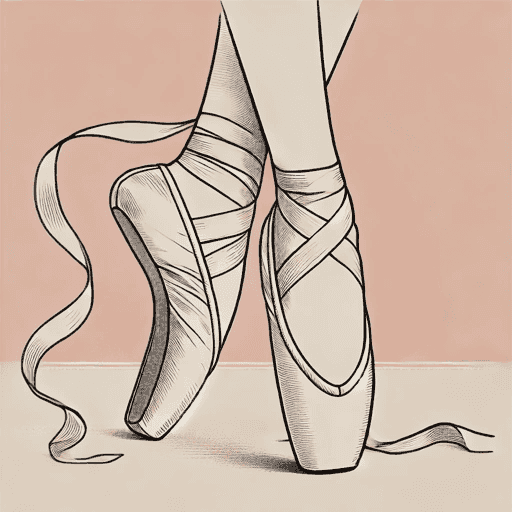
Ballet Shoes
53 pages • 1-hour read
Noel StreatfeildBallet Shoes
A modern alternative to SparkNotes and CliffsNotes, SuperSummary offers high-quality Study Guides with detailed chapter summaries and analysis of major themes, characters, and more.
Chapters 10-14Chapter Summaries & Analyses
Chapter 10 Summary: “The Audition”
Pauline buys a beautiful black velvet frock, and then Mr. Simpson takes her in his car to meet the manager. When she arrives, she meets another young actress, Winifred, who is wearing “an ugly brown velvet frock […] When Winifred’s mother [sees] Nana, she [gives] her Winifred’s coat and shoe bag and ask[s] her to be so kind as to look after her” because her husband is ill at home with five younger children (116). Nana agrees, and Winifred’s mother leaves.
Winifred tells Pauline that they’re auditioning for the role of Alice in a production of Lewis Carroll’s Alice’s Adventures in Wonderland that day. They were told to bring a ribbon to help them look like Alice. She tells Pauline how much she needs the money: “If I could get this job, Mother’d put half away for me, but even what’s left would mean the extra stuff Dad needs to get well. He’s had an operation, and doesn’t seem to get right after it” (117). Pauline almost hopes that Winifred will get the role since she needs the money more.
While the girls wait with the other actresses trying out for Alice, Pauline tries to shake off her nerves. When she’s called up, she starts with her strongest suit, acting. She performs Puck’s speech from A Midsummer Night’s Dream, then sings, and finally does a short dance to demonstrate her ability.
Winifred is next, and Pauline is certain by the end of the audition that Winifred will play Alice. Everyone is surprised when Miss Jay tells them that Pauline will play Alice instead: “Winifred is the best all-round student the Academy has ever had, but Pauline looks right for Alice” (123). Winifred bursts into tears, and Pauline feels miserable as she thinks about how Winifred could have used the money to help her sick father.
The next order of business is to get Pauline’s license, after which she can sign the contract. The law requires that at least a third of the child actor’s earnings be put away for them in the bank. After some negotiating between Pauline, Sylvia, and Nana, they reach an agreement that will relieve some of the financial burden from Sylvia and help Pauline buy back the necklaces, even though Sylvia doesn’t know that’s how Pauline will spend the money. They all go to sleep much more at ease, knowing that they’ll have more money coming in than they’ve had for some time.
Chapter 11 Summary: “Pauline Learns a Lesson”
Audiences praise Pauline’s performance as Alice, and the praise starts to go to her head. At home, she tells her sisters to fetch things for her, saying that she has become accustomed to people helping her at the theater. At the show, she tries to command Winifred, who got the role of the understudy. Nana is “shocked that anybody she [has] brought up could behave so atrociously” and tells Pauline to fetch her own items (133).
Pauline’s pride comes to a head when she’s disrespectful to the stage manager. She’s supposed to hang a cotton wrap over her clothes, and when the play first started, “Pauline was very good at remembering it, but after a bit she thought it a bore and left it hanging where Nana had left it” (134). For several days, the stage manager asks her to get the wrap, but she refuses. Finally, he comes to her room and asks her in person, but she still refuses.
Mr. French, the managing director, steps in and asks what’s going on with Pauline. Nana thinks it’s for the best that she receive a scolding and tells him everything. Mr. French then firmly tells Pauline to get the wrap, and she replies, “Get it yourselves if you want it fetched” (136). This is the last straw, and Mr. French tells Pauline that for the next performance, Winifred will play Alice, and Pauline must sit it out as the understudy.
After Pauline has a good cry about it, she starts to wonder if she was being rude. That night, she talks to Nana about it, who tries to comfort her, saying, “Pride has to come before a fall, and that’s the law of nature; you’ve got your fall, and now you’ve got to be brave and get up again” (138). Pauline later apologizes to Mr. French. He tells her that it’s all right but emphasizes the lesson: No one is so talented that they can’t be replaced.
Chapter 12 Summary: “August”
Now, Petrova is in her final year before she’s old enough for a license. She has improved at dancing; “in fact, there [is] nothing wrong with her work, except that it bore[s] her” (143), and she shows it. The one part of the week that she loves is when she goes to the garage on Sundays. Often, she and Mr. Simpson go in his car to watch planes fly or see car races at tracks. Petrova loves planes the most and starts to dream of flying one someday.
Posy, meanwhile, immerses herself in dancing, and Madame Fidolia asks Sylvia to have her at the school for half of each day. Posy is especially excited when she finally gets to “wear the little shoes her mother had given her; […] they were always too big, but [this] autumn they [fit]” (144). She’s careful to pull them out only on special occasions, but she eventually outgrows them. She tries to pretend that they don’t pinch her feet for fear of them being thrown out, but Madame Fidolia offers a solution: She asks to keep the shoes as a souvenir and makes a glass case for them so that she can hang the shoes on the wall.
Sylvia’s financial worries worsen; the girls don’t have much acting work at the moment, so the family’s main income is from the boarders. At Petrova’s birthday picnic, which Mr. and Mrs. Simpson arrange, Pauline gathers her sisters to renew their vow again but amend it, adding that they vow to help Sylvia (or Garnie, as they call her) by earning money.
Then, the girls receive news that feels so miraculous that they wonder if making the vow had anything to do with it. They receive word that “Pauline [is] to go and see them about the part of Peaseblossom, and Petrova [is] to be seen for the ballet of fairies” for an upcoming production of A Midsummer Night’s Dream (150). The girls sleep soundly that night, ready to make good on their vow.
Chapter 13 Summary: “The Clothes Problem Again”
Two girls are auditioning this time, and the weather is warm, so the Fossil sisters need dresses again. Petrova offers her birthday money to buy materials for new dresses. The project becomes a group effort for everyone at the house: “Cook made the slips, Mrs. Simpson whipped the frills, which took hours, and Sylvia made up one dress and then the other” (153). Once Pauline and Petrova put the dresses on, they’re all pleased with themselves and their hard work.
After waiting for a while at the audition, Pauline hears her name called. She’s stunned when she’s asked to walk on the stage and then leave. When she asks if the panel wants to hear her Shakespeare monologue, they say they don’t. Pauline won’t let it go easily: “It [is], she thought, very mean to bring her down, and then refuse even to hear her” (155). Suddenly, she hears a familiar laugh: It’s Madame Fidolia. She curtsies and then rushes offstage to find the panel in the audience. They tell her that almost all of the casting panel saw her as Alice and that they know she’ll make a perfect Peaseblossom.
The young girl who was supposed to audition for the role of another fairy, Mustardseed, hasn’t shown up. Pauline tells them that they should ask to see Petrova read for the part. Petrova thought that she would only have to sing and dance for her audition, so she’s surprised when she’s asked to recite a monologue as well. She performs the boy’s speech from Shakespeare’s Henry V. She does well until she suddenly forgets a line. Luckily, Pauline comes to her rescue and whispers her lines from the wings of the stage, and Petrova gets through the rest of the monologue perfectly.
Pauline and Petrova are both cast for their roles. They’re still celebrating when Winifred, disheveled, runs toward them: She was supposed to be seen for Mustardseed. She asks if she’s too late, explaining, “I was at Canvey Island, and Mother only got the letter today—they forgot to forward it” (160). Petrova awkwardly tells her that she’s too late and that she’ll be playing Mustardseed.
Winifred is clearly hurt but tells Petrova that she’s glad the role went to her if she couldn’t get it herself. Nana encourages her to try to find Mr. French and ask about being an understudy. She also offers to iron Pauline’s dress for Winifred to wear to the audition the next day so that she can try out for the fairy ballet. After Winifred leaves, Nana turns to Pauline and says that she hopes she doesn’t mind that she offered her dress, but Winifred desperately needed something besides her old, tattered dress for the audition.
Chapter 14 Summary: “A Midsummer Night’s Dream”
A Midsummer Night’s Dream turns out to be the most spectacular production that Pauline has been in yet, and she warns her sister not to start thinking that every production will be as grand. Petrova isn’t as impressed and is often bored at rehearsals; “when [she is] not wanted for the fairy scenes, or to work on one of the innumerable ballets” (168), she finds a corner and reads her book on airplanes.
One rehearsal that she and Pauline both love is the day they get to fly on stage. At the end of the play, Oberon, Titania, and the fairies are lifted into the air. The younger dancers are elegant in their harnesses, but the adults have a harder time with it. As they watch the adults struggle, they think that “[t]he whole flying rehearsal [is] more like a game than work, [and] they [laugh] so much” at the adults’ awkward, stiff, and clumsy movements (169).
Finally, the day of the performance comes, and both Fossil sisters do exceptionally well in their roles. This is the first play that Posy gets to attend. Even though Dr. Jakes prepares her by telling her the story of the play, Posy is mostly bored. However, despite her usually snobbery about the quality of dancing, she enjoys the dances.
In bed at home that night, the sisters can’t sleep. First, Pauline asks Petrova if she thinks she’ll like working on the stage. Petrova thinks about it but realizes that despite the fun she had in the flying rehearsal, she’ll have less time to study planes now that she’s working, so she doesn’t think she’ll like it. Then, Posy starts an argument with them about the move that the principal dancer did at the end. They get so loud that Nana has to come into their room and tell them to quiet down and go to sleep.
Chapters 10-14 Analysis
Each of the girls experiences significant character development in this section, but none as much as Pauline. A significant part of her arc, which is another example of Overcoming Socioeconomic Challenges, is evident in her interactions with Winifred. Winifred is another actress from the academy who is up for the role of Alice in Alice in Wonderland. When Pauline hears of Winifred’s sick father and how her mother must care for five siblings, all younger than Winifred, she thinks about life from a new perspective. Even though her family is in need of money, “nobody had ever said what a help it would be when she could earn some, and certainly she had never worried about it as poor Winifred seem[s] to do” (118). Winifred’s situation makes Pauline more grateful for what she has and makes her view Winifred as a human first and as competition second.
Another way that Pauline grows is that she learns to not be so prideful. The book’s theme of Learning to Embrace Individuality and Ambition applies not only to the nurturing of the girls’ individual dreams but also to discipline in realizing their dreams and remaining humble while achieving success. When Pauline’s diva attitude gets out of hand and Mr. French asks what’s going on, “Nana [thinks] a scolding [will] be the best thing in the world for Pauline. She [tells] him the whole story” (135). The scolding, combined with having to sit out a performance, teaches Pauline a lesson, and she regains her humility. Nana doesn’t stay cross with Pauline but instead encourages her when Pauline is clearly sorry for her actions.
Petrova, meanwhile, grows conflicted throughout these chapters. As she approaches coming of age to work professionally, she increasingly doubts that this is what she wants to do. After several excursions with Mr. Simpson, she picks up a new interest: planes. She dreams of being a pilot one day:
Although, of course, she was years too young to fly, in bed, and at her very few odd moments, she studied for a ground license; and although she had never touched a joystick, she knew that when she did, an aeroplane would obey her, just as certainly as Posy knew her feet and body would obey her (144).
However, she feels guilty for wanting to pursue something else when she can’t earn money as a pilot at 12 but can earn money as a performer. Even though Sylvia frequently asks her if she’s happy, Petrova continues to lie and say that she likes performing to everyone except Mr. Simpson. Her duty to help out the family financially supersedes her own dreams: For now, she’s willing to sideline her own dreams.
The increasingly dire financial situation leads the sisters to amend their vow. This time, they add that they’ll do whatever they can to help Sylvia earn money. All the girls feel the weight of this, but Pauline feels it most: She bears “the responsibility of being the eldest, and she, and the other children, [have] a feeling Sylvia must not be bothered, for what with the house, and the boarders, and making accounts meet, she [has] enough troubles” (146). While Pauline is becoming a more serious student of acting for her own sake, she still wishes that she could help more with the finances.
Fortunately, the girls don’t have to keep things afloat on their own. Even if money is tight, the show goes on—with help from the boarders. During the rehearsals for A Midsummer Night’s Dream, Dr. Jakes becomes much more involved with the girls’ education, thematically contributing to the book’s exploration of The Role of Education in Personal Growth. Dr. Jakes loves Shakespeare and is excited for the opportunity to help Petrova (who struggles with recitation) with her lines, to discuss the play at length with Pauline, and to explain the plot to Posy, who has never seen a play before. Her earlier prediction that Pauline would become a Shakespearean proves true: Of the three sisters, she most enjoys his plays.
The motif of clothes persists in this section of the book and again links to the thematic concern with socioeconomic struggles. Winifred’s old brown frock reminds Pauline of how things are worse for Winifred’s family than for her own, and she doesn’t object when Nana lets Winifred borrow her dress. The people in the Cromwell Road household make Pauline’s and Petrova’s audition dresses in a group effort, but “when Pauline and Petrova [are] dressed in them, all the workers, though exhausted, [say] it [has] been well worthwhile” (153). When the girls star in A Midsummer Night’s Dream, “they [are] sent to famous stage costume makers and designers” (162). This development reflects the girls’ (especially Pauline’s) upward career trajectory.

Unlock all 53 pages of this Study Guide
Get in-depth, chapter-by-chapter summaries and analysis from our literary experts.
- Grasp challenging concepts with clear, comprehensive explanations
- Revisit key plot points and ideas without rereading the book
- Share impressive insights in classes and book clubs