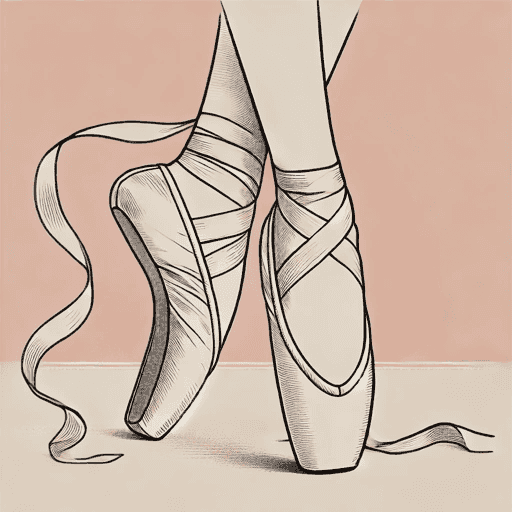
Ballet Shoes
53 pages • 1-hour read
Noel StreatfeildBallet Shoes
A modern alternative to SparkNotes and CliffsNotes, SuperSummary offers high-quality Study Guides with detailed chapter summaries and analysis of major themes, characters, and more.
Important Quotes
“Saving the penny and walking was a great feature of their lives.”
(Chapter 1, Page 3)
This quote refers to the idea that the Fossil sisters seek to save the money they would spend on the underground (public transportation) and instead walk home when the weather isn’t too bad. In addition, the phrase conveys that because the Fossil sisters aren’t wealthy, they must work harder to pursue their passions, which supports the book’s theme of Overcoming Socioeconomic Challenges.
“About four months later a box arrived at the house in the Cromwell Road, addressed to ‘The Little Fossils.’ Inside were three necklaces: a turquoise one with ‘Pauline’ on it, a tiny string of seed pearls marked ‘Petrova,’ and a row of coral for Posy.”
(Chapter 1, Pages 11-12)
The necklaces from Gum are the last piece of mail that the family receives from him for years. They become treasured items for the girls, which they eventually sell to Mr. Simpson temporarily when they need money for a dress. The note saying “The Little Fossils” is likewise significant because this is where the three sisters derive their surname.
“They smiled at Petrova, but she forgot all her manners and failed to smile back; instead she stared past them into the road, where stood the very Citroën car whose picture she had been looking at in the kitchen.”
(Chapter 2, Page 21)
Mr. and Mrs. Simpsons are boarders who take a liking to Petrova, and one of the things they bond over is the couple’s Citroën. When they see how excited Petrova is over the car, they decide to nurture her interest in machines as she grows. This thematically links to Learning to Embrace Individuality and Ambition.
“Don’t forget, it’s fun having a name with no background. Tell the other Fossils.”
(Chapter 3, Page 33)
Dr. Jakes gives Pauline the idea for the vow that she and her sisters make throughout the years. Pauline learns that, especially as a woman, having a name with no history means that no one can give her family members credit for anything great that she’ll eventually accomplish, which further develops the text’s ideas about learning to embrace individuality and ambition.
“You are the first compatriot of mine to come to my school. I will make a good dancer of you.”
(Chapter 4, Page 47)
Petrova is the first Russian student whom Madame Fidolia has had at her school. As a Russian herself, she’s excited to have someone from her country as a student and sets high expectations for the young Petrova. While Petrova’s interests lie elsewhere, this moment thematically emphasizes The Role of Education in Personal Growth.
“They would peep between the glass on the doors of the rooms where the rehearsals were taking place, and stare at the children who were already twelve and old enough to earn money.”
(Chapter 5, Page 57)
While Pauline dreams of being a stage actress, she and the others can’t earn any money until they reach the age of 12. This moment foreshadows the life that the sisters will pursue: two of them because they want to and all three because they need the money. In addition, it highlights the theme of overcoming socioeconomic challenges.
“She could not say a word to Sylvia, because she knew it would be a help when she was old enough to earn money.”
(Chapter 6, Page 68)
In a moment that continues to develop the theme of overcoming socioeconomic challenges, Petrova worries about telling Sylvia that she doesn’t like dancing because she knows that the family needs the money. Ironically, Sylvia has the same tendency to hide her true feelings and worries; in this case, she has been hiding the family’s financial struggles from the sisters.
“My children, my guests, I have asked you here this afternoon to put the same question to you. Will you help the hospital that once helped Olga?”
(Chapter 7, Page 90)
Together, the Fossil sisters vow to have their name remembered for something important. Although they don’t imagine that a career in the arts will lead to that, they’re amazed when they see their names on a train in the subway station.
“To think we should have our name stuck up on a train!”
(Chapter 7, Page 90)
Together, the Fossil sisters vow to have their name remembered for something important. Although they don’t imagine that a career in the arts will lead to that, they’re amazed when they see their names on a train in the subway station.
“Pauline, when she had finished, the tears ran down my cheeks. She was ‘L’Aiglon. She ceased to be ridiculous, her art was supreme.”
(Chapter 9, Page 104)
Part of Pauline’s character arc is learning to be humble as an actress. When she thinks she’s too good to be sitting in and watching the older dancers, Madame Moulin shares a valuable lesson that she learned when she was as prideful as Pauline. The way Madame Moulin teaches her young pupil is a way that validates her feelings of wanting to do more but encourages her to see the opportunity to learn in every instance.
“There is no doubt a new dress is a help under all circumstances.”
(Chapter 10, Page 115)
One of the book’s motifs is clothing, whether it reminds readers of how hard things are for the Fossil sisters economically or of how intense the academy can be given the multiple changes. Emphasizing the theme of overcoming socioeconomic challenges, new dresses are a rarity for the Fossils, and when the necklace money from Mr. Simpson enables Pauline to buy a dress, it signifies the beginning of a new era for them.
“There’s needing money, and needing money.”
(Chapter 10, Page 117)
The theme of overcoming socioeconomic challenges comes to the forefront when Winifred tells Pauline about her situation at home. It’s a brutal reminder that even though money is tight for her own family, other families are more in need than they are. This conversation softens Pauline toward Winifred, and she no longer sees her as just another competitor for the same role.
“Had she been rude? Had she been showing off? Inside she knew that she had, and she was ashamed, and though she was quite alone she turned red.”
(Chapter 11, Page 137)
Pauline learns a lesson about pride the hard way when she must sit out a performance and let Winifred go on as Alice instead. The punishment temporarily takes the thing she loves, acting, away from her to make her understand how her behavior affects others and learn that no one is irreplaceable.
“For a long time after they pinched her, Posy refused to own to it, because she did not want them thrown, or given, away. Madame came to her rescue, guessing how she would feel.”
(Chapter 12, Page 145)
This quote provides a glimpse into how much Madame Fidolia truly understands Posy and works to care for her. The ballet shoes symbolize Posy’s destiny as a dancer and connect her to her birth mother. When she outgrows the shoes, Madame offers to put them on display rather than discard them. This shows that though Madame can be severe and strict, she has a kind heart and seeks to honor Posy’s talent and her connection to her mother.
“An August audition for two people put a strain on the wardrobe that it certainly could not stand.”
(Chapter 13, Page 151)
One of the motifs in Ballet Shoes is clothing, and it often mirrors the sisters’ journey. The fact that Pauline and Petrova are both asked to audition at the same time, along with the season being too hot for the black velvet audition dress, leads to a flurry of chaos for the sisters and Nana. This incident marks the beginning of Petrova’s brief career on the stage.
“One day they got a special call for five o’clock, and there they learned a thing which pleased Pauline, and made Petrova take an entirely different view of rehearsals. They were to fly.”
(Chapter 14, Page 168)
Petrova’s favorite rehearsal of A Midsummer Night’s Dream is the one in which she and the other cast members get to fly across the stage. This combines the thing that she loves, flying, with the thing she feels she must do, acting. Momentarily, she wonders if she might like acting after all, but after realizing that she won’t have nearly as much time for studying planes, she decides that she still doesn’t want a life on the stage. This moment thematically foregrounds learning to embrace individuality and ambition.
“But I was thinking in bed last night; here we are, never any money, Garnie always worried, and we never have any clothes. If the money that I always have to put in the post office is spent on the house and us, we’ll have enough.”
(Chapter 15, Page 179)
As the eldest sister, Pauline especially feels the burden of helping to care for the household. When she turns 14, she decides to take matters into her own hands and use her money to help her family, even though Sylvia wants her to save it. This shows Pauline’s character growth: She maturely and firmly tells Sylvia what needs to be done. It likewise shows character growth for Sylvia in that she finally accepts help.
“I’ll trust you with a secret, Petrova, that I haven’t told anyone except Nana. I’m trying to sell the house.”
(Chapter 16, Page 192)
This moment foreshadows that the family the characters have built at the house must now go their separate ways. In addition, it increases the book’s dramatic tension: Petrova now knows a secret that both worries her and puts more pressure on the family’s increasingly dire financial situation, emphasizing the theme of overcoming socioeconomic challenges.
“Richard the III ran into July, but just before the end of the run the most exciting thing happened. Pauline was sent for a film test.”
(Chapter 16, Page 198)
This marks a turning point for Pauline in the book. She has started to enjoy critical success as a professional stage actress, but she learns that the world of film is entirely different. This serves as the inciting incident for the final part of Pauline’s character arc, thematically underscoring the role of education in personal growth as a continuous process.
“When it rained, they played a new and glorious kind of hide and seek.”
(Chapter 17, Page 206)
This moment, which occurs during the sisters’ vacation that Pauline pays for with her savings, is a rare occasion in which the Fossil sisters get to play as children. Typically, all of them are so concerned about the family’s finances or their studies and passions that they don’t have much time to play, much less play together.
“You’ve been holding out on me since the shooting began because a lot of cockeyed critics gave you a write-up as the prince in the Tower. Well, forget it. You’ve everything to learn in motion pictures.”
(Chapter 17, Page 209)
Just when Pauline thinks she knows enough about acting, she discovers a whole other kind of acting: film. This moment is a turning point for her, just as the moment with Madame Moulin was. She discovers that she can find fun and beauty in the craft of acting for the cameras, and she works harder to push through the more tedious aspects of it, again thematically highlighting the role of education in personal growth. This moment emphasizes how education isn’t framed by a part of one’s life, such as years devoted to formal studies, but a process that continues throughout one’s life and career.
“‘The film, dear,’ Nana explained. ‘You must have made a hit.’”
(Chapter 18, Page 223)
The trajectory of Pauline’s success as an actress skyrockets after the film premiere. She goes from hardly being noticed by the crowd to signing autographs over the course of a few hours, which foreshadows her eventual move to Hollywood.
“‘Manoff,’ Posy’s voice was queer and high-pitched. ‘I’ve got to learn from him, Pauline—I must.’”
(Chapter 18, Page 223)
Posy has worried about her future without Madame Fidolia’s guidance. After seeing Manoff perform in a ballet, she starts to dream about a new path that she never could have thought of before: training with him in Czechoslovakia. She resolves to seek an audience with him, emphasizing the theme of learning to embrace individuality and ambition.
“They sat with him on the stairs, because there was nowhere else they could all sit. They told him everything about how poor they had been, and the house being sold, and finally the day’s news.”
(Chapter 19, Page 232)
Even though over a decade has passed since the Fossil sisters last saw Gum, they’re instantly drawn to him. None of them ask why he was away so long; instead, they immediately welcome him into their lives. The family is complete once again just before they all go their separate ways to pursue their individual passions.
“‘I wonder,’—Petrova looked up—‘if other girls had to be one of us, which of us they’d be?’”
(Chapter 19, Page 233)
The final line of the book encapsulates the theme of learning to embrace individuality and ambition. Though the author couldn’t have known it at the time, these three sisters became such icons of literature that readers of Ballet Shoes might one day ask themselves this very question.

Unlock every key quote and its meaning
Get 25 quotes with page numbers and clear analysis to help you reference, write, and discuss with confidence.
- Cite quotes accurately with exact page numbers
- Understand what each quote really means
- Strengthen your analysis in essays or discussions