Chapterhouse: Dune
87 pages • 2-hour read
Frank HerbertChapterhouse: Dune
A modern alternative to SparkNotes and CliffsNotes, SuperSummary offers high-quality Study Guides with detailed chapter summaries and analysis of major themes, characters, and more.
Chapters 9-17Chapter Summaries & Analyses
Chapter 9 Summary
Content Warning: This section discusses graphic violence, death, sexual content, addiction, gender discrimination, and religious discrimination.
Duncan explores his no-ship prison. He is aware of the com eyes, or cameras, that they use to observe him. He is confined to the no-ship by the exterior forcefield, and certain areas have been sealed off. He can see Scytale but is unable to communicate with him. He has helped the Bene Gesserit by training men in his sexual bonding techniques so they can disrupt the Honored Matres’s pursuit. The Honored Matres think that Murbella is dead. They would be furious to learn that the Bene Gesserit were attempting to recruit her, turn her into a Reverend Mother, and steal Honored Matres secrets.
Duncan is uncomfortable with these abilities, and he is worried about Bellonda, who is also a Mentat. As he observes her, he realizes that she can never be perfect due to her loyalty to the Sisterhood. He infers through Bellonda’s questions that the Bene Gesserit greatly value Murbella as a source of information.
Duncan goes to the hold of the ship, and Odrade follows him. She asks why he’s not at his console, and he worries that this betrays his Mentat data hunger. He tells her Murbella is pregnant again. She informs him that Sheeana wants to meet with him again to talk about Leto II.
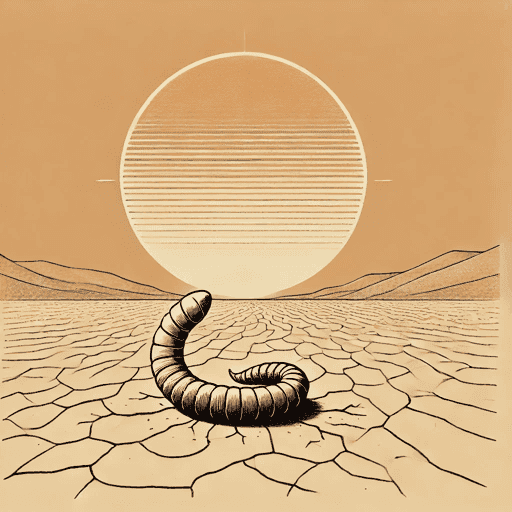
Odrade asks Duncan if he’s a Mentat and if he remembers more than one ghola lifetime. He asks why she wants to know about Leto II. She reveals that their sandworm has become sandtrout—its earliest life stage—a sign that the desert environment is becoming hospitable enough for new sandworms to eventually form and thrive. Duncan admits to his memory of other lifetimes but assures her he’s not another Kwisatz Haderach. She asks him if he remember axolotl tanks and reveals that Scytale is helping them set up such a system. Duncan is disgusted by the truth of the tanks.
He asks if there are any new worms yet. He says they need a large amount of spice as a catalyst. They expect small worms from the sandtrout any day now. He asks her to open her data systems to him with no limits and agrees to be her Mentat.
Chapter 10 Summary
Scytale is imprisoned in his own section of the no-ship. Bene Gesserit truth sayers can’t read him—he holds many secrets. He calls the Bene Gesserit the Servants of Shaitan and the Honored Matres “whores.” Scytale sees his imprisonment as a test of his faith.
Within his chest, he holds a nullentropy capsule that preserves the cells of many other people. Some are other Tleilaxu masters, but Paul Atreides and Chani are also there. The tube is his ultimate bargaining chip.
He analyzes his prison and the Bene Gesserit. He blames the Bene Gesserit for the near extinction of his order, but he is slowly feeding them basic info about the axolotl tanks. He debates Bene Gesserit burial rites, their beliefs in the great plan, and contrasts them with the Honored Matres.
Scytale learns that the Bene Gesserit are using Duncan as a Mentat and realizes that this means he has access to a ship system console. He schemes to set up a meeting with Duncan.
Chapter 11 Summary
Lucilla is brought to Dama in a cage. It is for her protection: If she uses The Voice, a Bene Gesserit ability used to control anyone who hears it, the Matres will kill her instinctively. Another cage containing a Futar is taken in. Lucilla is beginning to feel spice withdrawal. She feels that she will have to die by suicide soon, but her Reverend Mother memories tell her to survive.
She is alone with Dama, as Lucilla’s disrespect toward Dama would provoke any attendants to kill her. Lucilla notices the defenses set up by the Honored Matres. They are weak and seem like symbolic reassurances for the Honored Matres. The building was designed for navigator guild tanks.
Dama says she may let Lucilla live if she satisfies some of her curiosity, allowing Lucilla to sit on a chair across from her. Dama offers Lucilla some refreshments that have spice in them. Dama asks Lucilla questions about Bene Gesserit science so she can conquer and control them. Dama wants to know The Language of God.
They verbally spar, particularly about Leto II and the Scattering, and Lucilla is sent back into her cage. Dama leaves Lucilla in the room alone.
Chapter 12 Summary
Odrade is having dinner with the acolytes and their proctor watchers. Acolytes have a harder time hiding their emotions than full sisters, which gives Odrade a better picture of the state of her order’s morale. She reflects on the supreme effort the Sisterhood will have to undertake to survive the Honored Matres.
She feels ready to visit Sheeana in the Southern Desert, and she feels that Sheeana must be made ready to replace Tam. Sheeana must not be forewarned of the visit: Odrade musty test her to make sure that she is the one the Bene Gesserit need.
Odrade reflects on her interactions with Murbella and the gulf in their respective ideologies: the stewardship of the Bene Gesserit versus the domination of the Honored Matres. However, Murbella is starting to come around and may soon be ready for recruitment as a Reverend Mother.
In the present, an acolyte asks Odrade if she wants a map of the orchard in light of the expansion of the desert. She previously put a report on Odrade’s desk, but she didn’t recall it. Parts of the orchard must be abandoned or actively preserved.
She decides that it is time to restore the ghola Miles’s memories through Duncan’s Mentat abilities.
Chapter 13 Summary
Murbella sits in the no-ship practice room. Odrade has been on the ship less than an hour. Murbella is suffering from a fever. She is frustrated with the Bene Gesserit’s methods of teaching and compares it to the Honored Matres way of learning. She finds herself questioning whether she still considers herself an Honored Matres, though she has yet to fully commit herself to the Bene Gesserit.
Duncan arrives. She that she thinks she’s sick and then collapses. A Suk doctor comes to treat her. She diagnoses her with being overstressed and pushed beyond her limits. As she is treated, she accepts that she is a Bene Gesserit.
Chapter 14 Summary
Odrade is surveying the operation of the Bene Gesserit site. She discusses the Scattering of the Sisterhood and humanity into the world. The Bene Gesserit speculate that the infinite space humanity expands into could lead to multiple divergent evolutions. They wonder if the Honored Matres are fleeing something else. They ultimately decide that such speculation is useless.
Streggi contacts Odrade and gives her a report on Murbella: She has recovered enough to attend her classes. Bellonda brings her concerns about Duncan being a Mentat to Odrade.
Bellonda says that if Odrade won’t kill Duncan, then she must object to Odrade using him as a Mentat. Odrade says Duncan is a fantastic Mentat, but Bellonda argues they must be prepared to kill Duncan at the slightest sign that he is a Kwisatz Haderach.
Odrade reflects on how overwhelming the logistics of Scattering of the Bene Gesserit is. They discuss Miles Teg. He is 10 years old and too young to restore his memories, according to Bellonda. Nonetheless, Miles is brought in, and Odrade says she will send him to the no-ship for Duncan to restore his original memories, a painful process. Odrade never told ghola Miles that she is his original’s daughter.
Chapter 15 Summary
Scytale is walking through the no-ship. He recalls how Odrade stopped by him on her way to talk to Murbella.
They discussed different requests the Scytale has sent them. Odrade assured Scytale that she wants to keep him alive but under control. He asked what she intends for the Honored Matres: She wants to make them aware of their mortality.
He is concerned with the economics of the Scattering of the sisters and Odrade’s plans. In his view, the lines of economic connection were what kept the old empire together.
Now, he reflects on how well he understands the no-ship, something the Bene Gesserit are unaware of.
Chapter 16 Summary
Odrade is doing rounds in the halls of Central. She considers that the survival of humanity is more important than the survival of the Sisterhood; however, without their leadership, humanity is prone to mistakes. The Golden Path disempowered the Bene Gesserit, undermining their stewardship of humanity. The emperor knew that a scattered universe would offer little to unite humans aside from the knowledge of the Reverend Mothers, which some would eventually seek out. This is why he allowed them to continue existing.
She thinks about how the Honored Matres are hunting them and how the Bene Gesserit hide their communications; though encrypted and hidden, there is a trail leading to Chapterhouse, which she must keep hidden.
A Reverend Mother, Dortujla, from a punishment planet arrives. She has information for Odrade. She reveals that she and three other Reverend Mother associates have spoken to a band of Futars from the Scattering. The Futar wish to ally themselves with the Reverend Mothers in opposition to Honored Matres. The Futars also revealed the Honored Matres’s possession of The Weapon, though they had few details.
There were handlers with the Futars, and Dortujla got the impression they were face dancers—artificial human shape shifters. Dortujla believes the Futars and their handlers came from the Scattering. Allying with them might reveal the Honored Matres’s origins—a risk she considers worth taking for the Sisterhood.
The handlers and Futar were disturbed by something they would not reveal, a threat other than the Honored Matres, Dortujla suggests. It is revealed that the Honored Matres have not touched Buzzell, the prison world Dortujla came from, despite their destructive approach to other planets. It seems to be a place they want. Dortujla reveals that she’s a Mentat, something she learned from Other Memory, or the genetic memory of every female in her bloodline.
Dortujla says she must return to Buzzell; she offers to remain there and tell the Honored Matres she was banished there, as bait for a parley. Odrade tells her to say that she is willing to suggest surrender, a lie meant to bring them to the negotiating table.
Chapter 17 Summary
Lucilla is waiting in the room Dama left her in. She has been there for 17 days, which she tracks with her well-trained internal clock. She is on one meal a day with minimal spice.
A panel in the wall opens, and the Futar is slid in via its cage. Dama is on her way. Lucilla talks to the Futar, trying to win it over by saying she wishes she was its handler. She tells it she wants to kill Dama.
The Futar says Dama is poison and shows a burn mark on its lips from where it previously tried to bite her. She asks if the Futar hates Dama, but the Futar says Lucilla is not its handler, indicating that it requires a kill command from a handler.
Dama arrives, and Lucilla greets her with her familiar name, Dama, which Dama says she doesn’t have permission to use. Lucilla asks if they want to continue yesterday’s conversation, and Dama is surprised to find that she knows what time it is. Lucilla explains this ability and how Dama can potentially learn it.
Dama asks about Bene Gesserit governance. She doesn’t like it when Lucilla talks about Bene Gesserit-exclusive abilities. Lucilla steers the conversation, measuring all of Dama’s responses. Dama reveals that they were once bureaucrats that rebelled but abhor chaos. She repeatedly tries to draw parallels between her and the Bene Gesserit. Lucilla toys with Dama, driving her into a rage until Dama demands she stop speaking. Dama then kills Lucilla.
Chapters 9-17 Analysis
In this section, the Bene Gesserit keenly feels the threat of the Honored Matres. Odrade attempts to formulate countermoves to combat their impending presence, but she’s forced to consider the possibility of a world without the Sisterhood. Though she demonstrates human sentiment, she still lacks faith in humanity’s ability to guide and protect itself:
Survival of humankind took precedence over survival of the Sisterhood. […] But oh, the perils of leadership in a species so anxious to be told what to do. How little they knew of what they created by their demands. Leaders made mistakes. And those mistakes, amplified by the numbers who followed without questioning, moved inevitably toward great disasters (176).
These lines reflect Odrade’s inner conflict: She believes in the mission of the Bene Gesserit but fears that humanity’s dependence on centralized leadership could lead to catastrophic failure if that leadership falters. The paradox she embodies—guarding against tyranny while fearing chaos—positions her as a reluctant steward of civilization’s fragile balance. Odrade and the Reverend Mothers are connected with Other Memory—the memories of their female ancestors—which is a burden and a blessing as it weighs on Odrade as she prepares for conflict with the Honored Matres. This inherited memory creates a unique multigenerational consciousness—one that offers wisdom but also paralysis. Odrade must lead a Sisterhood shaped by the weight of the past into a future no one fully understands.
Their opposing group struggles to learn more about the Sisterhood. Dama envies their power, showing that her interest in them goes beyond mere violent instinct. Odrade considered if the Honored Matres were once Bene Gesserit but considers this unimportant. Still, the connection between the two groups is present, even if they are foils for one another. This contrast is apparent even in the basic appearance of the two factions. The Bene Gesserit have eyes that are entirely blue from spice, which represents their inhuman attitudes and coldness. Meanwhile, Dama and the Honored Matres’s eyes are described as flecked with orange when they grow angry, a color associated with fire or passion. Similarly, the Sisterhood often control from afar, using the Voice and emotional manipulation, while the Honored Matres use sexual imprinting. Lucilla condescends to Dama because of this ability, highlighting the difference between institutional power built over generations and the Matres’s crude, immediate tactics of control. Where the Bene Gesserit rely on discipline and long-honed tradition, the Honored Matres operate through instinct, speed, and visceral dominance—a power that burns fast but doesn’t have the same longevity. They want to learn from the Bene Gesserit in part because they want to cultivate a similar legacy based on respect more than fear.
In a universe so often shaped by patriarchal violence, the central conflict of Chapterhouse: Dune unfolds between two powerful female orders. Yet this shared dominance does not foster solidarity; instead, it sharpens their disdain for one another. The Bene Gesserit view the Honored Matres as reckless, vulgar, and destabilizing, while the Matres covet the Sisterhood’s disciplined power even as they reject their restraint. This is especially evident in Lucilla’s contempt for Dama, whose desire to learn Bene Gesserit secrets reads not as curiosity but as opportunism. When Dama demands to learn the lessons of the Sisterhood, she tells Lucilla, “Let us be reasonable. With your help we could achieve utopia,” to which Lucilla thinks, “And conquer all of your enemies and achieve orgasm every time” (128). Lucilla instantly understands that The Connection Between Domination and Cultivation is something the Honored Matres don’t understand. Dama wants new abilities to further her violent aims, which Lucilla knows is antithetical to what she perceives as a “utopia.” This moment of tension between Lucilla and Dama also highlights how ideological conflict is encoded in physical practices—sex, speech, and memory. Where the Sisterhood uses these tools to guide and preserve, the Honored Matres distort them into methods of control. Their mutual misunderstanding fuels their antagonism and reflects broader questions about the uses—and abuses—of power.
Odrade’s position as Mother Superior uniquely embodies this tension. Unlike Lucilla, whose judgment of the Honored Matres is swift and scornful, Odrade maintains a cautious curiosity—recognizing that their aggression may reflect a distorted echo of Bene Gesserit survival tactics taken to their extreme. Where Lucilla sees only degeneration, Odrade perceives a warning: Power without stewardship becomes predation. Her curiosity about the Honored Matres’s origins mirrors her fears for the Sisterhood’s future, especially as the Scattering threatens to sever not only political ties but also cultural memory and purpose.
Odrade later considers these differences. The Honored Matres’s sexual imprinting creates enslavement and a deeper conviction than the Bene Gesserit Voice. This manner of control makes Odrade curious despite its opposing nature to the habits and traditions of the Sisterhood. Overall, Odrade feels more uncertain about numerous Bene Gesserit plans. Her conversation with Scytale builds on some of her existing contemplations about the logistics of the Scattering, in which the Sisterhood will spread across the universe to ensure they’re never fully destroyed. This will break economic, political, and personal ties between many in the order and could lead to the permanent mutation of their ideology. This highlights Odrade’s earlier curiosity about who the Honored Matres were before they returned to the universe; she worries what the Sisterhood’s plan could make of them, too. Despite understanding The Importance of Change and Adaptation to Survival, she fears the uncertainty of their future. The arrival of Scytale’s insight into economic and technological foundations reinforces this concern. His focus on infrastructure and long-term strategy—as well as the presence of a capsule preserving genetic legacies—introduces a broader, species-level view of continuity. The tension between ideological preservation and biological legacy becomes increasingly urgent as the Sisterhood prepares to Scatter.
These chapters deepen the internal and external threats to the Bene Gesserit. Odrade stands at a philosophical crossroads, navigating between memory and innovation, order and chaos. Meanwhile, Duncan Idaho and Scytale represent dormant potential—both allies and possible risks. Lucilla’s arc, culminating in her death, underscores the cost of loyalty and the limits of persuasion. Her inability—or refusal—to meet Dama on shared ground reflects the Sisterhood’s most rigid instincts: to protect knowledge rather than transform it. In contrast to Odrade’s flexible leadership, Lucilla’s fate serves as a cautionary marker of what happens when adaptation fails. As tensions mount and timelines collapse into one another, the Sisterhood teeters on the edge of transformation, suggesting that survival may not depend on purity, but on the radical willingness to evolve. As tensions mount, the Sisterhood teeters on the edge of transformation, suggesting that survival may not depend on rigidity, but on the radical willingness to evolve.

Unlock all 87 pages of this Study Guide
Get in-depth, chapter-by-chapter summaries and analysis from our literary experts.
- Grasp challenging concepts with clear, comprehensive explanations
- Revisit key plot points and ideas without rereading the book
- Share impressive insights in classes and book clubs