Chapterhouse: Dune
87 pages • 2-hour read
Frank HerbertChapterhouse: Dune
A modern alternative to SparkNotes and CliffsNotes, SuperSummary offers high-quality Study Guides with detailed chapter summaries and analysis of major themes, characters, and more.
Important Quotes
“‘Trees and other plants for all of our symbiotic relationships,’ she said.
‘Symbiotic?’ It was a new word.
She explained with something she knew he already had encountered—going out with others to harvest mushrooms.
‘Fungi won’t grow except in the company of friendly roots. Each has a symbiotic relationship with a special plant. Each growing thing takes something it needs from the other.’”
(Chapter 3, Page 23)
The Bene Gesserit are demonstrated as having a close connection with nature; they take care not to take more than they can return, thus ensuring their resources aren’t depleted. This is in direct contrast to the Honored Matres, who destroy planets using The Weapon and take life on a whim. The two groups represent The Connection Between Domination and Cultivation, as both factions’ actions contribute to their prolonged survival and thus the cultivation of their culture; however, the Matres’s wanton violence doesn’t allow for balance, unlike the Sisterhood’s thoughtful approach to symbiotic relationships, which spells their doom. This passage uses an extended metaphor of symbiosis to represent the Bene Gesserit’s political philosophy. Their connection to nature is not only literal but symbolic of their approach to power—they cultivate relationships as carefully as they cultivate resources. The organic imagery of “friendly roots” and “growing thing” positions the Sisterhood as stewards of balance, contrasting with the Honored Matres’s extractive and violent tactics.
“‘Enclosed,’ she said. ‘How tempting it is to raise high walls and keep out change. Rot here in our own self-satisfied comfort.’
Her words filled him with disquiet. He felt he had heard them before…some other place with a different woman holding his hand.
‘Enclosures of any kind are a fertile breeding ground for hatred of outsiders,’ she said. ‘That produces a bitter harvest.’”
(Chapter 3, Page 27)
Odrade expresses a strong distaste for stagnation, which she sees as a natural side-effect of isolationism. The Bene Gesserit naturally value tradition and control, but Odrade is wise enough to recognize that these traits must not be prized enough to result in the Sisterhood refusing to adapt. By recognizing The Importance of Change and Adaptation to Survival, she is enabled to make thoughtful decisions as Mother Superior and develop internally as well. Odrade’s diction here—particularly words like “Enclosed” and “Rot”—carries harsh, bodily connotations. The metaphor of “high walls” evokes both physical isolation and mental rigidity. The irony lies in the idea that what seems protective (“walls”) actually accelerates decay. This moment encapsulates the novel’s tension between safety and stagnation.
“Mama Sibia, only a foster mother, had taught Odrade to love herself.
In a Bene Gesserit society where any form of love was suspect, this remained Odrade’s ultimate secret.
At root, I am happy with myself. I do not mind being alone.”
(Chapter 5, Page 33)
Despite the Bene Gesserit instinct to rebuke love and sentiment, she values her inner child and uses these repressed feelings to inform her personal development. This allows her to retain love for her foster mother Sibia, and this relationship in turn gives her a fortitude of self. Without embracing self-love or the love of others, a person may fall victim to self-doubt or uncertainty. However, Odrade can be confident and self-sustaining because of how she values love. This passage employs contrast and understatement. The phrase “only a foster mother” is an example of minimizing language typical of the Bene Gesserit, yet Odrade subverts this by attributing her foundational self-love to Mama Sibia. The paradox here is striking: In a culture that suppresses love, personal affection becomes a radical source of strength.
“Idaho questioning Murbella about Honored Matres sexual-addiction techniques. Why? His parallel abilities came from Tleilaxu conditioning impressed on his cells in the axolotl tank. Idaho’s abilities originated as an unconscious pattern akin to instincts but the result was indistinguishable from the Honored Matres effect: Ecstasy amplified until it drove out all reason and bound its victims to the source of such rewards.
Murbella went only so far in a verbal exploration of her abilities. Obvious residual fury that Idaho had addicted her with the same techniques she had been taught to use.”
(Chapter 7, Pages 61-62)
This passage alludes to how sex is used as a tool to manipulate and gain power rather than as an expression of affection or intimacy. The Bene Gesserit reject love, and the Honored Matres value domination above all else; crucially, both societies present a matriarchal structure. The original animosity toward Duncan for bonding her to him, as well as being bonded to her, shows how Murbella instinctively clings to the desire to have power over others, particularly a man. Nonetheless, their unwilling sexual bond eventually results in their developing feelings for one another, even if they end the book by separating.
“‘Mmmmmm. And she finds that events are not beyond her influence, merely beyond her senses. That is almost wise. But maturity…ahhh, Rebecca. Do we interfere with God’s plan? Is it the right of humans to set limits on the nature of God? I think Leto II understood that. This lady in you denies it.’
‘She says he was a damnable tyrant.’
‘He was but there have been wise tyrants before him and doubtless will be more after us.’
‘They call him Shaitan.’
‘He had Satan’s own powers. I share their fear of that. He was not so much prescient as he was a cement. He fixed the shape of what he saw.’”
(Chapter 8, Page 78)
This conversation between the Rabbi and Rebecca relates to the theme of Free Will and Prescience, a conflict that arises in several characters. Some occurrences are labelled as “God’s plan,” yet she questions whether a tyrant’s word on what God intended is to be believed. Leto II had prescience, but how he interpreted and acted based on his glimpses of the future are debatable. Even the Rabbi admits that Leto II likely created the future he saw rather than allowing it to come about naturally, making the relationship between free will and fate muddier.
“What fury it would arouse when they learned of Murbella. An Honored Matres being instructed in the ways of the Bene Gesserit? A clear intention to win her over, make her into a Reverend Mother and learn all Honored Matres secrets.
As usual, a war of both minds and flesh.”
(Chapter 9, Page 90)
Murbella most distinctly embodies The Importance of Change and Adaptation to Survival, as she becomes part of two opposing factions and eventually unites them under her rule. This process is instigated by Odrade, who understands how crucial adaptation is, which is why she names Murbella as her successor. Odrade recognizes that others may not react to this blending of cultures as positively as her, but she still ensures that it happens. Calling it a war of both “minds and flesh” relates to how the conflict between the two factions is not only a physical battle; it requires overcoming internal biases, desires, and traditions.
“Scytale knew himself to be a figure out of humankind’s most dangerously disturbing mythologies. Odrade would ask herself: Why did the Bene Tleilax choose this particular physical appearance when their control of genetics could have given them something more impressive?
For the very reason that it disturbs you, powindah dirt!”
(Chapter 10, Page 110)
Physical appearance plays a large part in the actions of several groups. The Bene Gesserit develop mutations in their eyes due to their Spice addictions, which many find unnerving; however, they overall present a unified, calm, and plain aesthetic that doesn’t detract from their more thoughtful and manipulative actions. Meanwhile, the Honored Matres are physically enticing, which relates to their ability to sexually bond men to them. Odrade is disturbed that Bene Tleilax would create something that dispels this need to be appealing or unthreatening to others. It also speaks to individual identity and purpose, as the Sisterhood and Honored Matres craft an aesthetic catering to their intentions with others, while the Tleilaxu in this case create something specifically meant to reject others.
“‘It’s your science we want, witch!’ She pitched her voice lower. ‘Let us be reasonable. With your help we could achieve utopia.’
And conquer all of your enemies and achieve orgasm every time.”
(Chapter 11, Page 128)
The interactions between Great Honored Matre Dama and Lucilla are often an exchange of wits and barbs, exemplifying the animosity that naturally arises from the two fundamentally different factions. Dama wants to understand how the Bene Gesserit use The Voice, among other powers, which she would use to obtain power over others. Lucilla, however, considers Dama’s proposal with disdain, as she perceives Dama’s view of “utopia” to oppose the Sisterhood’s goals for humanity. Dama wants to destroy what she dislikes and enforce sexual power over others, showing how she doesn’t understand The Connection Between Domination and Cultivation—she ignores how essential cultivation and balance are to “utopia.”
“Odrade stopped abruptly on a busy walkway and turned to her companions. ‘What would you say if I suggested that we name streets and places after departed sisters?’
‘You’re full of nonsense today!’ Bellonda accused.
‘They are not departed,’ Tamalane said.
Odrade resumed her prowling walk. She had expected that. Bell’s thoughts could almost be heard. We carry the ‘departed’ around in Other Memory!”
(Chapter 14, Page 156)
This brief exchange demonstrates the difference in values between Odrade and the broader Sisterhood. The latter rejects expressions of sentiment or love, something implicatively shown in Odrade’s desire to honor the “departed” or dead members of her order. Bellonda and Tamalane react with pragmatism, plainly reasserting that they are connected to the sisters through Other Memory, but this misses the purpose of what Odrade was suggesting. Odrade often carries feelings of love, something she hides from others but accepts within herself. Still, she struggles with this friction between her desires and the traditions of the Bene Gesserit.
“Survival of humankind took precedence over survival of the Sisterhood. Else our Grail of human maturity is meaningless.
But oh, the perils of leadership in a species so anxious to be told what to do. How little they knew of what they created by their demands. Leaders made mistakes. And those mistakes, amplified by the numbers who followed without questioning, moved inevitably toward great disasters.”
(Chapter 16, Page 176)
This emphasizes the true goals of the Bene Gesserit. Though they operate through manipulation and infiltration of political movements, they aspire to enact noble goals—something that separates them from the Honored Matres, who only desire power. Still, Odrade recognizes the risks of leaving behind humankind without the informed perspectives and wisdom of the Sisterhood. They would sacrifice themselves for humanity, but she still doesn’t trust humanity to survive without them due to what she perceives as humans’ instinct to do as told without forethought.
“Dortujla called hers a hobby. She collected old coins, did she?
‘What kind?’
‘I have two early Greek in silver and a perfect gold obol.’
‘Authentic?’
‘They’re real.’ Meaning she had done a self-scan of Other Memory to authenticate them. Fascinating. She exercised her abilities in a strengthening way, even with her hobby. Inner history and exterior coincided.”
(Chapter 16, Pages 185-186)
Because of the Bene Gesserit’s rejection of positive displays of emotion, they can have a stilted approach to humanizing traits like hobbies. They are often viewed as a form of enrichment or intellectual exploration for members of the Sisterhood rather than as an activity of mere enjoyment. Dortujla is admired for pursuing a hobby that incorporates her use of Other Memory—something deeply respected by the Sisterhood—and human history; nonetheless, the irony arises in that she is still collecting coins because she enjoys them, not because they serve a strict academic or cultural purpose.
“It was a pattern the Sisterhood had long recognized: the inevitable failure of slavery and peonage. You created a reservoir of hate. Implacable enemies. If you had no hope of exterminating all of these enemies, you dared not try. Temper your efforts by the sure awareness that oppression will make your enemies strong. The oppressed will have their day and heaven help the oppressor when that day comes. It was a two-edged blade. The oppressed always learned from and copied the oppressor. When the tables were turned, the stage was set for another round of revenge and violence—roles reversed. And reversed and reversed ad nauseam.”
(Chapter 16, Page 188)
The Bene Gesserit are more keenly aware of the patterns of history due to both their Other Memory and the Sisterhood’s direct involvement in many political events. Despite their influence, they have often witnessed the more unfortunate—and, in some ways, unavoidable—mistakes natural within human hierarchies. They condemn these social structures, which create an oppressed demographic that only produces animosity and opposition; still, they struggle to lead humanity away from the tendency toward this cultural model, implying that there is an inescapable human instinct to seek power despite the lessons of history.
“‘Hah! And I thought you would tell me something new. We know that one: “Power corrupts. Absolute power corrupts absolutely.”’
‘Wrong, Dama. Something more subtle but far more pervasive is at work. We’ve said it often enough but few hear us. Power attracts the corruptible.’”
(Chapter 17, Page 197)
Lucilla here demonstrates a message present throughout the Dune novels, which is that morally flawed people naturally gravitate toward power and should thus be inherently distrusted. This opposes the age-old phrase expressed by Dama, which claims that upstanding and just individuals can end up in positions of power but become corrupted by its totality. The Bene Gesserit avoid this circumstance by never obtaining control over humans, instead keeping to the side of other leaders, and holding each other accountable. Due to this, Dama’s clear lust for absolute power is disdainful.
“Odrade went through her sitting room to her sleeping cell where she stretched out on her cot fully clothed. One glow-globe bathed the room in pale yellow light. Her gaze went past the desert map to the Van Gogh painting in its protective frame and cover on the wall at the foot of her cot.
Cottages at Cordeville.
A better map than the one marking the growth of the desert, she thought. Remind me, Vincent, of where I came from and what I yet may do.”
(Chapter 18, Page 210)
A Van Gogh painting is presented as a peculiar relic for a member of the Sisterhood to possess—partially because of its age and partially because of what it represents to Odrade. An admiration for art and what it could signify about humankind extends beyond the natural Bene Gesserit instinct to respect the patterns of history. In fact, it alludes to Odrade’s inclination toward sentiment and affection for humans. Van Gogh is a painter renowned for his passionate and emotionally complex perception of life, and art more broadly is a concept that doesn’t tangibly aid survival, but it provides a sense of cultural bonding. The painting symbolizes memory, humanity, and resistance to utilitarianism. Positioned opposite the desert map, the painting acts as a counter-map, one that charts emotional or personal history rather than political expansion. Odrade’s invocation of “Vincent” highlights the novel’s discussion of art as a fragile but vital source of identity amidst survival-driven choices.
“Some things in the no-ship contributed to an illusion of freedom, chiefly its size and complexity. The ship was large, how large he could not determine but he had access to many floors and to corridors that ran for more than a thousand paces.
Tubes and tunnels, access piping that conveyed him in suspensor pods, dropchutes and lifts, conventional hallways and wide corridors with hatches that hissed open at a touch (or remained sealed: Forbidden!)—all of it was a place to lock in memory, becoming there his own turf, private to him in a way far different from what it was to guards.”
(Chapter 23, Page 253)
Duncan Idaho takes a proactive and calculating approach to his imprisonment by the Sisterhood. Despite being locked in a no-ship, which hides him from the potential prescience of others, he retains a sense of control in learning the ins and outs of the vessel. This relates to how he will take control of Bene Gesserit plans more broadly. Sheena, who is predicted by the Sisterhood to develop her own religion, and ghola Miles Teg, who once defended the Sisterhood with his life, will both be won over by Duncan and eventually escape with him when the Bene Gesserit and Honored Matres unify under Murbella.
“I’m jealous of Sheeana, damn her! And he knows it!
Participation Mystique! The orgy as energizer. Honored Matres sexual knowledge was having an effect on the Bene Gesserit akin to that primitive submersion in shared ecstasy. We take one step toward it and one step away.
Just knowing this thing exists! How repellent, how dangerous…and yet, how magnetic.”
(Chapter 26, Page 304)
Sheeana possesses the Honored Matres’s technique of sexual imprinting, which makes people they sleep with their slaves. The Sisterhood rejects this form of manipulation, as it is in many ways antithetical to the lifestyles and power-seeking techniques of the Bene Gesserit, yet Bellonda here unwillingly acknowledges how useful and intriguing the ability is. This shows that the sisters are not above human weakness and desire, but it also shows The Importance of Change and Adaptation to Survival, as Bellonda cannot deny—despite her disgust—how important imprinting could be to the Sisterhood’s aims.
“‘The Agnostic’s Prayer’, it had been labelled when it appeared on the wall of the Acolyte dining room inscribed on common reusable they employed for temporary notes. Purest doggerel.
Hey, God! I hope you’re there.
I want You to hear my prayer.
That graven image on my shelf:
Is it really You or just myself?
Well, anyway, here it goes.
Please keep me on my toes.
Help me past my worst mistakes,
Doing that for both our sakes,
For an example of perfection
To the Proctors in my section;
Like bread, for the leaven of it,
Or merely for the Heaven of it.
For whatever reason may incline,
Please act for Yours and Mine.”
(Chapter 33, Page 407)
This expression of uncertain faith is called “doggerel,” due to its irregular rhythm and uninspired verse, from the reader’s perspective. Nonetheless, it relates to several discussions about God and fate. The writer expresses uncertainty about a divine creator, yet they desire to have someone look out for them and create a path forward in life. The line “Is it really You or just myself?” alludes to Free Will and Prescience, as humanity struggles to understand whether events in life are manifestations of fate or the result of individual choices. The writer asks for God to protect them for whatever reason, implying that—like many characters—they may not believe in God or the destiny prescience shows, but they still desire to have a creed offering structure to their life. The forced rhymes and playful diction (“For the Heaven of it”) signal a struggle to reconcile faith with skepticism—a literary reflection of the novel’s larger thematic conflict between Free Will and Prescience.
“The Bene Gesserit were enlightened. Not dullards who attacked the bearer of bad tidings. Discount the messenger? (Who could expect anything useful from the likes of that one?) That was a pattern to be avoided at all costs. Will we silence disagreeable messengers, thinking the deep silence of death obliterates the message? The Bene Gesserit knew better than that! Death makes a prophet’s voice louder. Martyrs are truly dangerous.”
(Chapter 36, Pages 450-451)
The Bene Gesserit think highly of their own instincts, wisdom, and purpose in relation to humanity, though they can also make mistakes. Still, they abide by traditions of accepting the changes of life and tackling problems head-on; here, they accept the “bad tidings” with confidence, knowing that a human tendency toward ignoring issues or conflict can only result in more negativity. Additionally, the Sisterhood recognizes the danger in silencing those who speak the truth. Sheeana, for example, is seen by many as the revered individual who spoke to a “Divided God,” offering her a cultural power of which the Sisterhood is wary.
“He lifted the hood off his head and turned.
Odrade was shocked.
Cyborg!
The face was a metal mask with two glittering silver balls for eyes.
We enter dangerous ground.
‘They didn’t tell you?’ he asked. ‘Waste no pity. I was dead and this gave me life. It’s Clairby, Mother Superior. And when I die this time, that will buy me life as a ghola.’”
(Chapter 38, Pages 468-469)
Odrade’s disgust toward cyborgs relates to the Butlerian Jihad, a revolt by humans against computers and conscious robots a long time before the events of Chapterhouse: Dune. Previously, as technology developed, machines began effectively controlling worlds, creating a lower class of humankind. People rebelled and eventually overcame their own creations, and they then initiated religious tenets that humans should never be replaced by machines. Odrade exhibits prejudice here, as well as religious tradition, by disdaining Clairby’s transition to cyborg; however, this also shows how prejudice isn’t always accurate or productive, as dismissing Clairby for his new form would be unfair and unnecessary.
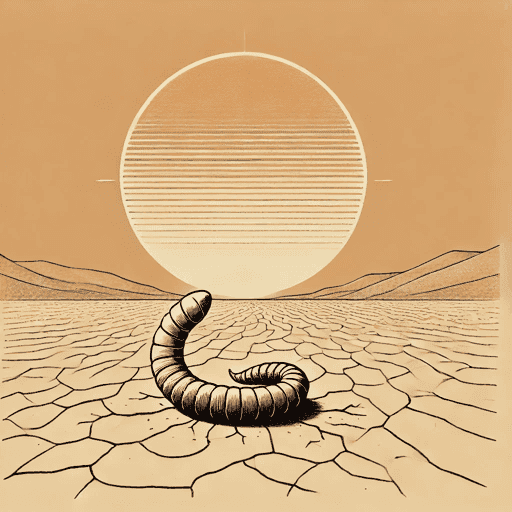
“Why did the Tyrant choose symbiotic existence in a worm?
Did those tiny worms carry his endless dream?
Sandtrout inhabited this desert. Accept them as a new skin and she might follow the Tyrant’s path.
Metamorphosis. The Divided God.
She knew the lure.
Do I dare?”
(Chapter 42, Page 520)
Sheeana has the ability to control sandworms, and here, she contemplates the transformation of Leto II into a worm during his tyrant reign. The temptation she feels to follow in his footsteps creates a moral ambiguity, as Herbert has asserted through other characters and plotlines that power attracts the corruptible; however, it also alludes to the prophecy that Sheeana will create or lead her own religion in the future, so this may simply be a reference to her fate. The passage brings up a motif of metamorphosis present throughout the Dune series, with leaders becoming something new either metaphorically or physically through the circumstances, and Bene Gesserit undergoing extreme pain and change to become Reverend Mothers. The phrase “new skin” reflects the way power in the Dune universe often requires radical, bodily change. The desert setting and invocation of the “Divided God” link Sheeana’s potential future to Leto II’s sacrificial path, blending dread with allure.
“‘With me as fulcrum, what a lever they would have to move the universe!’
‘But how could they control such a force?’
‘That is the problem. Something, so inherently unstable. Religions are never really controllable. But some sisters think they could aim a religion built around me.’
‘And if their aim is poor?’
‘They say the religions of women always flow deeper.’
‘True?’ Questioning a superior source.
Sheeana could only nod.”
(Chapter 42, Page 523)
Sheeana converses with a senior acolyte, Walli, who took over command of the Desert Watch Centre from her. Sheeana resists his questioning of her assertions, but the fact that she seeks his opinion reveals her uncertainty surrounding the Sisterhood’s intentions. Sheeana is revered by many for her ability to control sandworms and for having spoken to the Divided God. Many believe her to have been killed in the destruction of Rakis, only increasing her power through martyrdom, and this influence is something the Bene Gesserit want to use to exert their own ideologies through Sheeana. Ultimately, the concerns about power and the hesitation about the Sisterhood guide Sheeana’s decisions, as she escapes with Duncan Idaho and ghola Miles Teg at the end, abandoning the Bene Gesserit.
“There lay the threat of Honored Matres victory. Aimed by blind violence!
Blind in a hostile universe.
And there was why the Tyrant had preserved the Sisterhood.
He knew he only gave us the path without direction. A paper chase laid down by a jokester and left empty at the end.
A poet in his own right, though.”
(Chapter 42, Pages 527-528)
Sheeana expresses further disdain for the purpose of the Sisterhood. She sees them as only necessary or useful so long as humanity exists; they cannot exist without the other. This is why the reckless destruction caused by the Honored Matres frightened them so: The subjugation or eradication of other humans would render the Sisterhood obsolete, and that of the Sisterhood would leave humans aimless. In the conflict between Free Will and Prescience, Sheeana conveys outright hostility now toward the guidance of Leto II, who used his prescience to lay down a path for the Bene Gesserit and humanity that Sheeana ultimately views as aimless. She has become disillusioned with the cultural tenets and goals the Sisterhood revere.
“Fertilization. This group will carry it away with them. Hybrid vigour. We are fertilized to grow stronger. And flower. And go to seed? Best not dwell on that. Honored Matres will not see it until they are almost Reverend Mothers. Then they will look back angrily as I did. How could we have been that stupid?”
(Chapter 43, Page 541)
Murbella completes the thematic arc of The Importance of Change and Adaptation to Survival. As Odrade’s successor and the new Great Honored Matre, she is initiating immense change to the future of both factions. She worries that their unification may cause both to “go to seed,” or fail to flourish and possibly die, but she carries forth with faith that she is doing the right thing. The indication of her increased maturity as a Reverend Mother and Mother Superior is represented by her frustration with her past actions, as she can now see her behaviors with clarity in hindsight and wishes she could’ve enacted the right course for her life sooner. Murbella’s reflection employs organic metaphor—“Fertilization” and “Hybrid vigour”— to frame cultural and ideological fusion as a natural process of growth and adaptation. However, the mention of “going to seed” introduces ambiguity: Hybridization may strengthen a species or hasten its decline, reinforcing the novel’s persistent anxiety about the costs of survival.
“Reverend Mothers must be taught a new diplomacy: getting along with Honored Matres who were accustomed to getting along with no one—not even with each other. It would grow easier in time. Honored Matres slipping into Bene Gesserit ways. One day, there would be no Honored Matres; only Reverend Mothers with improved reflexes and augmented knowledge of sexuality.
Murbella felt haunted by words she had heard but not accepted until this moment. ‘The things we will do for Bene Gesserit survival have no limits.’”
(Chapter 43, Page 543)
Building on the previous quote, Murbella takes the more noble aim of Odrade in enacting change and views it with anxiety. Despite the supposedly righteous and strict standards of the order, the Bene Gesserit betray a more threatening and potentially harmful urge in protecting their existence at all costs. Blending their faction with the Honored Matres may seem like a productive goal, ensuring they adapt and flourish, but it also implies a sacrifice of tradition, thus calling their values into question. Murbella considers the quality and steadfastness of their religious tenets if they can be bent or dispelled for the means of survival.
“‘You know, don’t you, Sheeana took the Van Gogh painting from…your sleeping chamber?’
Why does that hurt?
‘I noticed it was missing.’
‘Said she was borrowing it for her room in the ship.’”
(Chapter 45, Pages 556-557)
Murbella learns that Odrade’s Van Gogh painting—which symbolized sentiment and a dedication to humanity—has been stolen by Sheeana, who escaped with Murbella’s bonded partner, Duncan, and their children. Duncan realized when Murbella become the Mother Superior that their flowering relationship could no longer exist, thus emotionally allowing him to leave her behind. Losing the Van Gogh painting represents how Murbella is becoming detached from emotion and her connections to others. Her family and friends are gone, and though it hurts, she presses down her feelings in front of others as Odrade had to do before her. The optimism, love, and dynamic with common people left with Sheeana, who readily embraces the possibility and freedom of open space with Duncan.

Unlock every key quote and its meaning
Get 25 quotes with page numbers and clear analysis to help you reference, write, and discuss with confidence.
- Cite quotes accurately with exact page numbers
- Understand what each quote really means
- Strengthen your analysis in essays or discussions