Daggermouth
Daggermouth
A modern alternative to SparkNotes and CliffsNotes, SuperSummary offers high-quality Study Guides with detailed chapter summaries and analysis of major themes, characters, and more.
Summaries & Analyses
Author Insights
Quizzes
NEWReading Tools
Symbols & Motifs
Masks and Uniforms
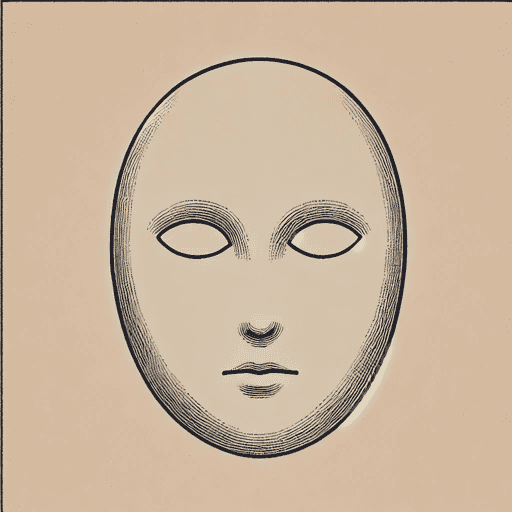
Masks and uniforms recur as a motif highlighting New Found Haven’s ability to erase the individuality of its subjects. The masking laws, Greyson notes, have become increasingly severe over the years, increasing the government’s control over the populace. The masks disguise the individuality of the Heart citizens, both marking them as elite and making that elite into a monolith. This loss of individuality symbolizes the devil’s bargain that Heart citizens face: They have far more economic privilege than those in the outer rings, but in exchange, they give up all freedom of thought and expression. This uniformity also makes the authority of the Heart more impenetrable; even if one person is lost, the masked others can take their place to reassert the totalizing control of the regime. As Jameson notes when he wears a Veyra uniform, this has both an inward and an outward effect. Someone who faces the uniform sees the impersonal image of authority and does not attempt an appeal, while the person wearing the uniform feels their individuality erode, diminishing their ability to resist. When Lira organizes a rebellion that involves women removing their masks, this act stands as an assertion of individuality in a system that attempts to erase women’s identities.
The mask system is not infallible in terms of erasing identities, however, as Shadera shows with her brutal skull mask. By bending the law’s intention to show her difference, Shadera illustrates that masks can be used as a tool of oppression as well as one of compliance.
Scars and Tattoos
Scars and tattoos act as an opposing symbol to the anonymizing masks and uniforms. Greyson notes Shadera’s scars at several points, recognizing them as marks of a life that brought endless violence; Shadera, in turn, uses Greyson’s scars as an emblem of her dawning realization that she was incorrect in assuming that his life was idyllic just because he grew up in the privileged Heart district. Additionally, revealing these scars serves as a way for the two to resist the totalitarian regime of New Found Haven without explicitly transgressing any of its many severe laws. When Shadera wears a revealing wedding gown that highlights the many cuts and bruises that Maximus and the Veyra recently inflicted upon her, she resists Maximus’s desire to cover up the violence of his regime with a picture-perfect veneer. By exposing the violence beneath the wealth, splendor, and privilege of the Heart, she rejects Maximus’s assertion that the elites of New Found Haven have status because of their merit. Instead, she reveals that even the privileged citizens of the Heart are forced to choose a side—they are either subject to the violence of New Found Haven’s government or they are complicit in it.
Tattoos also hold personal meaning in the novel. Greyson initially hides his Executioner’s tattoo, a large skull, because he fears that its size will reveal his motivation for getting it: that he feels he deserves pain in retribution for the violence he commits at his father’s behest. When Shadera wears a mask that resembles the tattoo (though she has never seen it) it suggests to the reader that the two are well-suited for one another, despite their many differences. Brooker’s small tattoo, when held against Greyson’s motivations, also offers an element of foreshadowing. Greyson’s tattoo is so large because he considers the significance of New Found Haven’s violence. Brooker’s, by contrast, is small, because he is only willing to inflict pain, not bear it himself—something that foreshadows his treachery.
Concentric Circles
The totalitarian dystopia of New Found Haven is structured in concentric rings that serve as a physical reminder of the society’s strict hierarchy, with power and privilege declining as one travels outward from a center defined by proximity to the absolute ruler, Maximus Serel. The impoverished citizens of the Boundary (the outermost circle) are perpetually on the brink of starvation, as they have been systematically denied the infrastructure necessary to produce their own food, keeping them dependent on the regime’s largesse and thus discouraging rebellion. The middle ring, the Cardinal, produces food and goods, but are allowed to keep only small amounts for themselves. Crucially, they are permitted more than the Boundary, so that the elites can uphold the myth of meritocracy in New Found Haven—that food and supplies are earned by those who contribute to society. The Heart, the central district of social elites, collects the bulk of the wealth and prosperity. The Heart’s name itself is a misnomer, however; while a heart pumps blood out to the rest of the body, working to sustain it, New Found Haven’s Heart gathers and hoards all supplies for itself, leaving the outer rings to wither and die. While the Heart’s centrality affords its citizens a great deal of material comfort and comparative stability, it comes at a moral cost. Citizens of the Heart are under constant surveillance—much more so than the impoverished residents of the distant Boundary—and any lapse in loyalty to the Serel regime, no matter how small, is instantly punished. After meeting Greyson, the president’s son, Shadera observes that despite his wealth, he is in many ways less free than she is.

Unlock the meaning behind every key symbol & motif
See how recurring imagery, objects, and ideas shape the narrative.
- Explore how the author builds meaning through symbolism
- Understand what symbols & motifs represent in the text
- Connect recurring ideas to themes, characters, and events