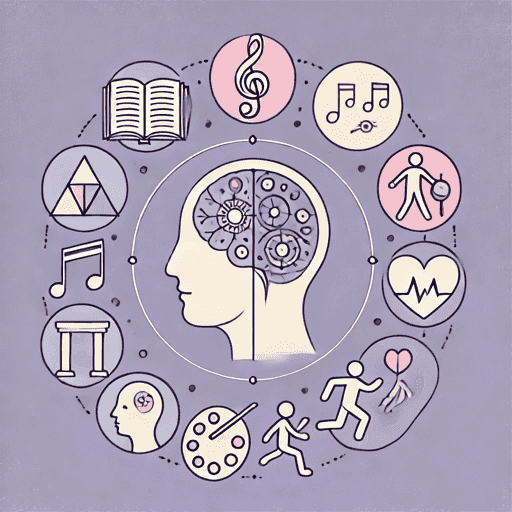
Frames of Mind: The Theory of Multiple Intelligences
Frames of Mind: The Theory of Multiple Intelligences
A modern alternative to SparkNotes and CliffsNotes, SuperSummary offers high-quality Study Guides with detailed chapter summaries and analysis of major themes, characters, and more.
Summaries & Analyses
Quizzes
NEWReading Tools
Important Quotes
“Most lay and scholarly writings about intelligence focus on a combination of linguistic and logical intelligences—the particular intellectual strengths, I often maintain, of a law professor, and the territory spanned by most intelligence tests.”
(Introduction 1, Page xii)
This quote defines Gardner’s main conflict with established understandings of intelligence and lays the groundwork for his exploration of The Model of Intelligence as Multifaceted Rather Than Singular. He states that the rigidly defined conception of intelligence promoted by Western psychological experimentation and research falls far short of capturing the true, multifaceted nature of human intelligence, which is expressed by every human in every human endeavor to some degree.
“It is fundamentally misleading to think about a single mind, a single intelligence, a single problem-solving capacity.”
(Introduction 1, Page xxiii)
This quote leads into Gardner’s fundamental break with intelligence research orthodoxy. He believes that intelligence is not a singular entity but something that comprises several different biological mechanisms in the brain, which interact with cultural prompts to produce intelligence. In his rejection of the “single mind,” he therefore stresses not only the multiplicity of intelligence (a point his repetition underscores) but also its social nature.
“Cast your mind widely about the world and think of all the roles or ‘end states’—vocational and avocational—that have been prized by cultures during various eras. Consider, for example, hunters, fishermen, farmers, shamans, religious leaders, psychiatrists, military leaders, civil leaders, athletes, artists, musicians, poets, parents, and scientists.”
(Introduction 2, Page xxviii)
This quote emphasizes Gardner’s position that intelligence is present in every human and in every culture. The vastly different skills required by the different professions, both historical and contemporary, that he lists are all expressions of intelligence, and culture plays a huge role in defining intelligence through whatever it values or needs at that time.
“For well over two thousand years, at least since the rise of the Greek city-state, a certain set of ideas has dominated discussions of the human condition in our civilization. This collection of ideas stresses the existence and the importance of mental powers—capacities that have been variously termed rationality, intelligence, or the deployment of mind. The unending search for an essence of humanity has led, with seeming ineluctability, to a focus on our species’ quest for knowledge; and those capacities that figure in knowing have been especially valued.”
(Part 1, Chapter 1, Page 5)
This quote covers the historic interest humanity has had in its own consciousness and cognition. Gardner acknowledges that his interest in the nature of intelligence is hardly new and, in fact, has ties to antiquity. This reframes Gardner’s arguments as part of an ongoing conversation rather than a mere break with consensus.
“Culture makes it possible for us to examine the development and implementation of intellectual competences from a variety of perspectives: the roles the society values, the pursuits in which individuals achieve expertise; the specification of domains in which individual prodigiousness, retardation, or learning disabilities can be found; and the kinds of transfer of skills that we may expect in educational settings.”
(Part 1, Chapter 3, Page 61)
This quote showcases Gardner’s emphasis on culture as a defining factor of intelligence, repudiating the efforts of earlier intelligence researchers to isolate the individual from culture through the use of abstract reasoning questions purporting to test intelligence. Gardner argues that culture is inextricable from intelligence, so intelligence’s relationship with culture must be acknowledged to understand both.
“Intelligences should be thought of as entities at a certain level of generality, broader than highly specific computational mechanisms (like line detection) while narrower than most general capacities, like analysis, synthesis, or sense of self (if any of these can be shown to exist apart from combinations of specific intelligences).”
(Part 1, Chapter 4, Page 72)
This quote strives to define Gardner’s novel conception of intelligence. He vacillates between understanding intelligence as a series of biological mechanisms and as cultural and individual phenomena, arguing that it must be understood as both while acknowledging that he does not currently know how to combine those two definitions satisfactorily. This caution characterizes Gardner’s tone throughout the work, reflecting the preliminary nature of his ideas and his implicit invitation for others to expand on them.
“Linguistic competence is, in fact, the intelligence—the intellectual competence—that seems most democratically shared across the human species.”
(Part 2, Chapter 5, Page 82)
This quote points out that language is one of the traits that seems to most clearly define human intelligence, which helps explain why IQ tests and experiments focus on it. Though other animals communicate, Gardner argues, only humans have the capacity to create such vivid metaphorical and symbolic spaces with language, not to mention to use language to analyze language itself, a type of meta-analysis that seems unique among animals.
“Buried far back in evolution, music and language may have arisen from a common expressive medium. But whether that speculation has any merit, it seems clear that they have taken separate courses over many thousands of years and are now harnessed to different purposes.”
(Part 2, Chapter 5, Page 103)
This quote draws a connection between linguistic and musical intelligences, which Gardner later affirms by pairing them as “object-free” intelligences (as compared to the three “object” intelligences and the two personal intelligences). Gardner emphasizes the connection between linguistic and musical intelligence by pointing out the similarities in goals of linguistic and musical tasks—namely, communication and emotive transmission—as well as creativity and cultural and personal identification. Nevertheless, Gardner insists on the distinctiveness of the two intelligences, which is an important component of his criteria.
“A composer can be readily identified by the fact that he constantly has ‘tones in his head’—that is, he is always, somewhere near the surface of his consciousness, hearing tones, rhythms, and larger musical patterns.”
(Part 2, Chapter 6, Page 107)
This quote emphasizes the different forms of sensory perception and consciousness that define different intelligences. A person with highly developed musical intelligence is constantly hearing “tones” in a way that other people may not, leading to unconscious composition in a way that feels automatic to the composer.
“Music can serve as a way of capturing feelings, knowledge about feelings, or knowledge about the forms of feeling, communicating them from the performer or the creator to the attentive listener. The neurology that permits or facilitates this association has by no means been worked out.”
(Part 2, Chapter 6, Page 131)
Gardner argues that while musical intelligence involves mathematical skill, it has completely different capacities for communication than logical-mathematical intelligence. Music has proven abilities to communicate emotion and affect the human nervous system in a way that math cannot, giving it much more immediate cultural impact and more relevance across cultures as a communication medium. Once again, this passage serves to differentiate musical intelligence from other forms of intelligence and thus to defend its existence as a discrete capacity.
“The mathematician ends up working within a world of invented objects and concepts that may have no direct parallel in everyday reality, even as the logician’s primary interests fall on the relationships among statements rather than on the relation of those statements to the world of empirical fact. It is primarily the scientist who retains the direct tie to the world of practice.”
(Part 2, Chapter 7, Page 143)
This quote shows the essential nature of the logical-mathematical intelligence: that it starts in the physical world but can quickly launch into a completely abstract one. It can therefore feel remote and intimidating to people, although Gardner argues that all humans use logical-mathematical intelligence every day to some degree. This relative abstractness differentiates logical-mathematical intelligence from the other “object” intelligences, suggesting a certain overlap with the object-free ones (linguistic and musical). These latter intelligences, however, have an emotional resonance that logical-mathematical intelligence generally lacks, rendering them more accessible to the average person.
“A person with one set of skills may be a tremendous mathematician or scientist in one era, because his skills are just what is needed, while proving relatively useless in succeeding (or prior) historical epochs.”
(Part 2, Chapter 7, Page 175)
This quote displays one of Gardner’s main theses: that intelligence is intensely culturally dependent and that efforts to define it often reveal more about the definer’s bias than about intelligence. Understanding intelligence requires acknowledgment of cultural impact, even though it introduces complexities to the question. At the same time, Gardner will ultimately suggest that no form of intelligence should be seen as “useless”; even if an intelligence does not serve an immediately obvious social purpose, acknowledging and cultivating it is vital to The Empowerment of Individuals Through the Recognition of Diverse Talents and Abilities.
“Central to spatial intelligence are the capacities to perceive the visual world accurately, to perform transformations and modifications upon one’s initial perceptions, and to be able to re-create aspects of one’s visual experience, even in the absence of relevant physical stimuli.”
(Part 2, Chapter 8, Page 182)
This quote defines the basic aspect of spatial intelligence, which is the ability to recreate visual stimuli in the “mind’s eye.” Spatial intelligence, Gardner argues, is a crucial factor in many different types of human innovation, including art, engineering, driving, navigating, and almost all forms of “survival tasks” more common in pre-industrial societies.
“As an intelligence that reaches far back into the past, spatial competence can be readily observed in all known human cultures. To be sure, specific inventions, like geometry or physics, kinetic sculpture or impressionist painting, are restricted to certain societies, but the capacity to make one’s way around an intricate environment, to engage in complex arts and crafts, and to play sports and games of various types seems to be found everywhere.”
(Part 2, Chapter 8, Page 211)
This quote exemplifies one of Gardner’s most consistent points: that intelligence is not tethered to forms of art and production valued by a particular culture, but is instead present in every form of human existence. Gardner’s examples are also typical of his broader approach in that they incorporate activities that might not be most closely associated with a given intelligence—e.g., sports as an example of spatial intelligence rather than (or in addition to) bodily-kinesthetic intelligence. This underscores his argument that each intelligence is broadly relevant to successful living.
“There has been a radical disjunction in our recent cultural tradition between the activities of reasoning, on the one hand, and the activities of the manifestly physical part of our nature, as epitomized by our bodies, on the other.”
(Part 2, Chapter 9, Page 219)
This quote displays Gardner’s habit of discussing the cultural valuing and devaluing of particular intelligences. Gardner here touches on the conventional distinction between the mind and body in Western philosophy as preparation for his defense of bodily-kinesthetic intelligence.
“Bodily intelligence completes a trio of object-related intelligences: logical-mathematical intelligence, which grows out of the patterning of objects into numerical arrays; spatial intelligence, which focuses on the individual’s ability to transform objects within his environment and to make his way amidst a world of objects in space; and bodily intelligence, which, focusing inward, is limited to the exercise of one’s own body and, facing outward, entails physical actions on the objects of the world.”
(Part 2, Chapter 9, Page 249)
This quote shows Gardner’s first tentative strategic grouping of intelligences, reiterated in the third part of the book. The logical-mathematical, spatial, and bodily-kinesthetic intelligences, Gardner argues, can be grouped by their use in navigating the physical world, while linguistic and musical intelligences are less tangible, and the personal intelligences require human interaction.
“In the course of development, these two forms of knowledge are intimately intermingled in any culture, with knowledge of one’s own person perennially dependent on upon the ability to apply lessons learned from the observation of other people, while knowledge of others draws upon the internal discriminations the individual routinely makes.”
(Part 2, Chapter 10, Page 255)
This quote presents the argument Gardner makes for presenting the personal intelligences as a pair and not in individual chapters. These two intelligences are so dependent on, and shaped by, one another, that they cannot be considered individually. Nevertheless, Gardner maintains that they are distinct enough from one another to qualify as separate forms of intelligence.
“The personal forms of intelligence reflect a set of powerful and competing constraints: the existence of one’s own person; the existence of other persons; the culture’s presentations and interpretations of selves.”
(Part 2, Chapter 10, Page 292)
This quote discusses the development of intra- and interpersonal intelligence. Gardner notes that these intelligences are uniquely shaped by an individual’s culture and internal experience, though he elsewhere observes that cultural factors inform the development and manifestation of all the intelligences to some degree.
“In its strong form, multiple intelligence theory posits a small set of human intellectual potentials, perhaps as few as seven in number, of which all individuals are capable by virtue of their membership in the human species.”
(Part 2, Chapter 11, Page 294)
This quote attempts to distill multiple intelligence theory to its most basic form. Gardner emphasizes that, although his introductions to the intelligences featured people with extraordinary abilities in each of the given domains, all human beings possess all intelligences—a point in keeping with the egalitarian ethos of the work as a whole.
“It is evident that the intelligences cannot be viewed merely as a group of raw computational capacities. The world is enwrapped in meanings, and intelligences can be implemented only to the extent that they partake of these meanings.”
(Part 2, Chapter 11, Page 313)
Though other scientists might understand intelligence as computational potential or power, combined with strong memory or analytical skills, Gardner proposes that intelligence is fundamentally intertwined with the creation of meaning in any of several realms (or in all of them). Therefore, intelligence is inextricably connected to culture, and vice versa. This contention also paves the way for Gardner’s discussion of intelligence’s relationship to symbols, or vehicles of meaning.
“The domain of symbols, as it has been constituted by scholars, is ideally suited to help span the gap between the aforementioned entities—the nervous system with its structures and functions and the culture with its roles and activities.”
(Part 2, Chapter 12, Page 316)
This quote showcases Gardner’s emphasis on symbols and symbol-bearing language as the main method of transferring intelligence from the community to the individual and vice versa. Many earlier intelligence-measuring experiments focused on either internal reasoning development and potential or social interactive development. Gardner proposes a focus on symbol usage to bridge the gap and unify the apparently disparate models of intelligence, which he represents in the text as embodied by the research of Piaget and Noam Chomsky, respectively.
“Once he becomes enwrapped in a world of notations, the child is bent on mastering new systems and using them in a precise and prescribed way. The child is now engaged in earnest in obtaining the symbol skills of his culture; and, in a sense, the fun is over.”
(Part 2, Chapter 12, Page 327)
This quote shows Gardner’s focus on childhood development and its effect on the intelligences’ relationship with the wider cultural world. Throughout the book, he returns to one of his areas of expertise, neurological development, to emphasize how typical child development involves a dynamic relationship with the symbols used to communicate intelligence. Here, he argues that the “rules” of symbolic language become more codified over the course of development; his suggestion that this represents the end of “fun” speaks to his belief that society often impinges on children’s natural inclinations and talents.
“I am concerned with the ways in which the theory of multiple intelligences might be used to inform, and perhaps alter, policies implemented by people who are responsible for education, child care, and human development.”
(Part 2, Chapter 12, Page 336)
This quote emphasizes Gardner’s stated goal: to provide a more accurate understanding of human intelligence to people who are responsible for childhood education. Though his book spends a significant portion of its pages on presenting his theory, the introduction and the third part are focused on methods of attaining this goal and handling potential obstacles, centering the theme of The Implications of Multiple Intelligences for Teaching and Learning.
“Even in nonliterate societies, one finds skills that are complex, highly elaborated, and restricted to individuals with considerable expertise—and it is these skills that are of particular significance for our inquiry.”
(Part 3, Chapter 13, Page 354)
This quote displays one of Gardner’s main points: that intelligence takes many forms and that activities not defined by literacy, academia, or mathematics should be considered intelligent as well. His definition of intelligence is purposefully broad and centered on cultural impact, meaning that forms of intelligence that are less culturally valued in Western academia require more attention and celebration.
“Social scientists need a framework that, while taking into account genetic predisposition and neurobiological factors, recognizes the formative role played by the environment.”
(Part 3, Chapter 14, Page 386)
This quote showcases Gardner’s main thesis, which emphasizes the need for a combination of analytical criteria that take into account social, individual, and cultural factors when studying human potential. This attitude has become more commonly accepted in the decades since the work’s publication but met strong critique at the time, which explains his emphasis on this model and forthright tone in presenting it.

Unlock every key quote and its meaning
Get 25 quotes with page numbers and clear analysis to help you reference, write, and discuss with confidence.
- Cite quotes accurately with exact page numbers
- Understand what each quote really means
- Strengthen your analysis in essays or discussions