Frames of Mind: The Theory of Multiple Intelligences
62 pages • 2-hour read
Howard GardnerFrames of Mind: The Theory of Multiple Intelligences
A modern alternative to SparkNotes and CliffsNotes, SuperSummary offers high-quality Study Guides with detailed chapter summaries and analysis of major themes, characters, and more.
Index of Terms
Bodily-Kinesthetic Intelligence
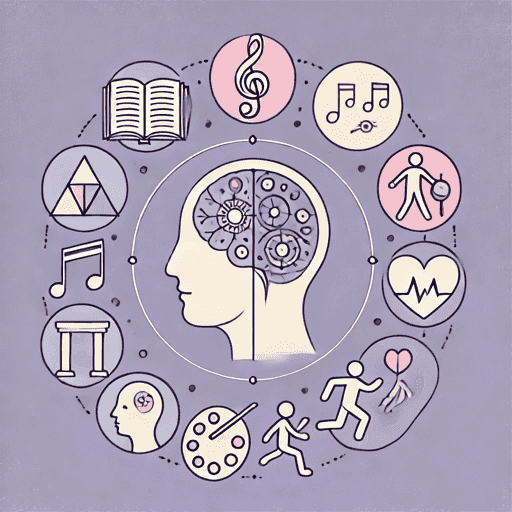
Bodily-kinesthetic intelligence refers to the skillful use of one’s body for expressive or goal-directed purposes, as in dance, athletics, surgery, or craftwork. Gardner uses the example of the mime Marcel Marceau to illustrate how movement can convey complex ideas and emotions. This intelligence is rooted in sensori-motor processes and is shown to be essential in both early child development and professional mastery, though often neglected in formal education.
Intelligence Quotient (IQ)
IQ, or intelligence quotient, was developed as a (purportedly) broad and objective measurement of individual intelligence. However, Frames of Mind critiques it as an overly narrow and culturally biased measure of human intelligence, arguing that IQ tests primarily assess linguistic and logical-mathematical abilities and thus neglect other vital forms of intelligence, such as musical, spatial, and bodily-kinesthetic.
Linguistic Intelligence
Linguistic intelligence refers to the capacity to use language effectively for expression, communication, and reasoning. Gardner explores this intelligence through examples of poets, writers, and speakers who demonstrate sensitivity to word meanings, rhetorical power, and syntactic nuance. It is one of the intelligences that contemporary secular education tends to promote.
Logical-Mathematical Intelligence
Logical-mathematical intelligence involves the ability to reason abstractly, recognize patterns, and engage in deductive thinking. Gardner traces its historical dominance in Western educational systems and aligns it with what psychologist Jean Piaget considered the highest stages of cognitive development. Although it has often been equated with general intelligence, Gardner treats it as one intelligence among many, cautioning against its undue elevation in academic settings.
Musical Intelligence
Musical intelligence encompasses the ability to perceive, discriminate between, compose, and express musical forms. Gardner discusses this intelligence in terms of pitch, rhythm, and timbre and shows how it can be found in composers, performers, and even attentive listeners. The work positions musical intelligence as distinct from but often complementary to linguistic intelligence, highlighting its early developmental emergence and its near-universal presence across cultures.
Personal Intelligences
The personal intelligences comprise intrapersonal intelligence (understanding oneself) and interpersonal intelligence (understanding others). Though less easily measured, these intelligences are essential for leadership, empathy, and self-reflection, and Gardner urges that they be taken seriously in both education and psychological theory.
Spatial Intelligence
Spatial intelligence is the capacity to visualize, manipulate, and represent spatial relationships, both real and imagined. Gardner explores its role in professions like architecture, art, engineering, and navigation, using examples such as Einstein’s thought experiments and the Puluwat navigator’s celestial mapping.

Unlock all 62 pages of this Study Guide
Get in-depth, chapter-by-chapter summaries and analysis from our literary experts.
- Grasp challenging concepts with clear, comprehensive explanations
- Revisit key plot points and ideas without rereading the book
- Share impressive insights in classes and book clubs