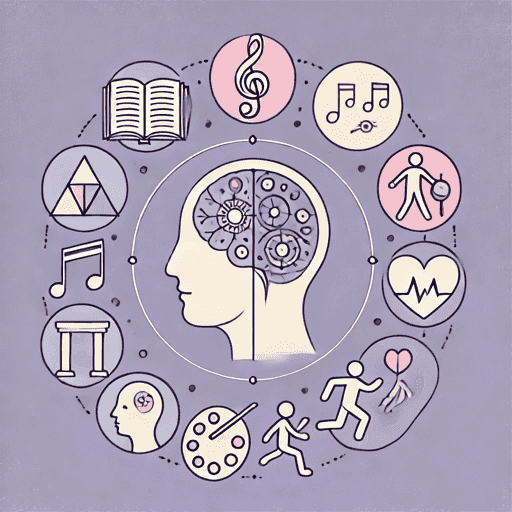
Frames of Mind: The Theory of Multiple Intelligences
62 pages • 2-hour read
Howard GardnerFrames of Mind: The Theory of Multiple Intelligences
A modern alternative to SparkNotes and CliffsNotes, SuperSummary offers high-quality Study Guides with detailed chapter summaries and analysis of major themes, characters, and more.
Introduction 1-NoteChapter Summaries & Analyses
Introduction 1 Summary: “Multiple Intelligences: The First Thirty Years”
Content Warning: This section of the guide includes discussion of racism.
The first introduction is a retrospective on the origins and cultural effects of Frames of Mind, first published in 1983. Gardner relates how the idea of multiple intelligences came to him. As a student of developmental and cognitive psychology, Gardner was struck by the absence of discussion of the arts in texts about measuring intelligence. Gardner, a skilled pianist, considered his own artistic study to be a fundamental aspect of his own intelligence. When studying the neurology of people who survived traumatic brain injuries, Gardner was again struck by their fragmented abilities: losing the ability to verbalize but not to compute, for example. He realized that different parts of the brain are responsible for different aspects of human intelligence.
These theories led Gardner to join the Project on Human Potential in 1979 in an effort to synthesize his studies of both brain damage and childhood cognitive development. He developed the theory of seven crucial areas of aptitude in the brain, all of which operate fairly independently of one another. He decided to call these aptitudes “intelligences,” knowing that doing so would place him in direct opposition to “the psychological establishment” (xi), which at the time was a huge proponent of intellectual quotient (IQ) tests as the premier measurement of intelligence. However, Gardner denies accusations that he was trying to “slay IQ” as a psychological practice, instead pointing to his original definitions and sets of criteria as his main achievement. His theory emphasizes that all humans possess all of the intelligences, but to different degrees.
The multiple intelligences (MI) theory generated buzz and catapulted the author to scholarly fame, or even infamy, since some academic psychologists heavily critiqued MI. Gardner was especially surprised at the positive responses he received from educators, who worked to integrate his theory into their teaching. Gardner warned the people who reached out to him that he was a psychologist, not an educator, and that assessing and studying intelligence is not the same as nurturing it in a classroom. Nevertheless, MI survived as a teaching concept into the 1990s while Gardner refined his theories. He added two more intelligences to his original seven and publicly refuted misconceptions surrounding his theory, including those that conflated MI with learning styles or intelligence with mastery or skill, as well as statements that certain racial or ethnic groups had intrinsic advantages in particular intelligences.
In order to accommodate educators who wished to incorporate MI into the classroom, Gardner advised them to “individualize” and “pluralize” educational approaches based on educational goals, stressing that MI is a tool for nurturing learning in the classroom setting, not an end goal itself. It involves presenting information in different ways to allow individual students to utilize their strongest intelligences to absorb information and act on it. Gardner compiled classroom resources and refutations of misuses of his theory into the GoodWork Project, which creates actionable strategies based on MI theory for educators.
Gardner ends his retrospective by thanking the many contributors and colleagues without whom his theory would not exist in its current state. He discusses the books he has written covering particular aspects of MI, like MI after brain damage or MI in gifted children. He also details areas of MI theory that he intends to explore further.
Introduction 2 Summary: “Introduction to the Tenth-Anniversary Edition, 1993”
The second introduction, written in 1993, reflects on the 10 years of change, progress, and controversy stirred by the initial publication in 1983. Gardner also introduces a new companion book, published in 1993, called Multiple Intelligences: The Theory in Practice, which reviews the principal ways in which the theory has influenced “contemporary educational discourse” (xxvii).
Gardner then covers the principal argument of Frames of Mind—namely, that traditional intelligence measurements focus on verbal, logical, and linguistic abilities and fail to address the many capacities necessary for successful human endeavor. He particularly points out the failure of IQ tests to measure all forms of human intelligence, instead focusing on reaction times and linguistic/logical ability. He covers various historical and cultural definitions of intelligence and then points out their failings in dealing with contextual differences, both social and neurological, that affect the expression of intelligence but not the existence of it. Gardner shows that the neurobiological study of intelligence and intellectual capacity has progressed, as have a more holistic view of intelligence as successful community integration and less scientific ideas of mental wellness. He states that these two forms of study, though often presented to the public as ideological opposites, “are not necessarily on a collision course” (xxxiii). Scientific and holistic studies of human potential should combine to create the best academic outcomes, according to Gardner.
He then discusses the progression of his own work, including the challenges educators face in trying to accommodate not just multiple students in each classroom and each lesson, but also the different intelligences that each child possesses. He also covers critiques of his work, including other academics’ disagreement with his definition of intelligence, with his assertion that intelligences mostly do not overlap or correlate, and with his model, which some argue more appropriately applies to learning styles. He refutes these claims and attributes them to misunderstandings of his work and to attachment to traditional ideas about intelligence. Gardner concludes by presenting some hypotheses regarding how his research might progress, including studying the intelligences’ interaction with leadership roles, creativity, and ethics.
Preface Summary: “Preface, 1983”
The Preface covers the “unusual genesis” of the book (xlvii). The van Leer Foundation, which contributed generous sums for the study of human potential at Harvard University, tasked several researchers with advancing understanding of human potential. That task led to Frames of Mind. Gardner relates his two research fields: cognitive capacity in individuals who survived brain damage and the capacity of children to use symbols, or think abstractly, particularly in the artistic fields. The support of the foundation and the Project for Human Potential allowed Gardner to combine his two fields of research into a single theoretical framework—namely, MI theory—for “conceptualizing the human cognitive capacities” (xlviii).
Note Summary: “Note on the Project on Human Potential, 1983”
This note covers the origins and function of the Project on Human Potential, a directive funded by the van Leer Foundation, an international nonprofit institution dedicated to helping disadvantaged children and youth. In 1979, the van Leer Foundation funded a group of scholars at Harvard University in “exploring the nature and realization of human potential” (li). The note details the various founding members of the project and their research projects, including the author. Frames of Mind represents the first book published with the support of the Project, and introduces the two other books published by the Project in conversation with Frames of Mind, namely Israel Scheffer’s Of Human Potential and Human Conditions: The Cultural Basis of Educational Development, by Robert A. LeVine and Merry I. White. In the publication of these volumes, as well as papers published by other members of the Project, the members have “sought to create a new multidisciplinary environment for understanding human potential” (lii).
Introduction 1-Note Analysis
At the heart of Gardner’s work lies a fundamental challenge to the more traditional conceptualization of a single, “general” intelligence (or “g factor”). This challenge unfolds in three interwoven themes: the redefinition of intelligence as multiple and independent faculties, the application of this model to educational theory and practice, and the empowerment that arises when individuals are recognized and nurtured for their unique cognitive strengths.
In keeping with the work’s emphasis on accessibility and practical application, Gardner frames his theory with front matter that emphasizes its personal roots. As detailed in the 1983 Preface and Introduction 1, Gardner was influenced both by neurological case studies—such as patients who retained some cognitive functions after traumatic brain injury—and by his own experiences as a pianist, which led him to question why modern Western societies privileged certain cognitive faculties over others. His conclusion, that different parts of the brain support different modalities of intelligence, laid the groundwork for his seminal theory of Multiple Intelligences (MI). That Gardner’s theory sprang principally from individual experience—both his own and others’—lays the groundwork for The Empowerment of Individuals Through the Recognition of Diverse Talents and Abilities to emerge as a central theme.
This personal bent intersects with a second theme: The Implications of Multiple Intelligences for Teaching and Learning. Indeed, from the outset, Gardner’s work resonated with educators more than with his peers in academia. As noted in Introduction I, Gardner received considerable attention from teachers who were eager to translate MI theory into classroom practice. Although he emphasized that MI was conceived as a psychological theory rather than a pedagogical strategy, he recognized the value of its educational applications—in particular, the imperative to “individualize and pluralize” instruction by designing curricula and teaching strategies that accommodate a range of intelligences, resulting in lessons tailored to the individual student. For instance, a lesson might integrate linguistic tasks, spatial representations, bodily-kinesthetic activities, and interpersonal collaboration, thereby engaging learners across several intelligence domains. Gardner’s collaboration with educators through the GoodWork Project demonstrates an effort to bridge theoretical psychology and classroom practice.
Central to The Model of Intelligence as Multifaceted Rather Than Singular is the claim that no form of intelligence is superior to any other. However, the fact that conventional educational systems have tended to marginalize certain intelligence types leads Gardner to focus on the potential of those whom the existing model has failed. As Gardner reflects in Introduction 2, the traditional overemphasis on linguistic and logical abilities often leads to the undervaluing of talents in the arts, physical expression, or social interaction. By redefining intelligence to include these capacities, MI theory affirms the worth of students who may not excel on standardized assessments but demonstrate remarkable abilities in other domains.
Gardner’s account of the Project on Human Potential, funded by the van Leer Foundation, underscores this democratizing impulse. The project aimed to explore and foster the full range of human capabilities, particularly among disadvantaged populations. The alignment of MI theory with this broader emphasis on inclusion reflects its foundational commitment to recognizing and cultivating the full spectrum of human potential. It is also in line with Gardner’s expansive definition of intelligence; as he states, intelligence should be conceptualized not only in terms of abstract reasoning but also in terms of community integration and ethical behavior—forms of intelligence that are both context-sensitive and socially situated.
Moreover, Gardner’s persistent refutation of misuses of his theory—including deterministic interpretations based on ethnicity or race—reinforces the egalitarian ethos at the heart of MI. Intelligence, in this framework, is not a fixed quantity that some possess in greater measure than others but a set of capacities that vary in strength across individuals and cultures. This reconceptualization invites both students and educators to adopt a more inclusive and expansive understanding of human potential.

Unlock all 62 pages of this Study Guide
Get in-depth, chapter-by-chapter summaries and analysis from our literary experts.
- Grasp challenging concepts with clear, comprehensive explanations
- Revisit key plot points and ideas without rereading the book
- Share impressive insights in classes and book clubs