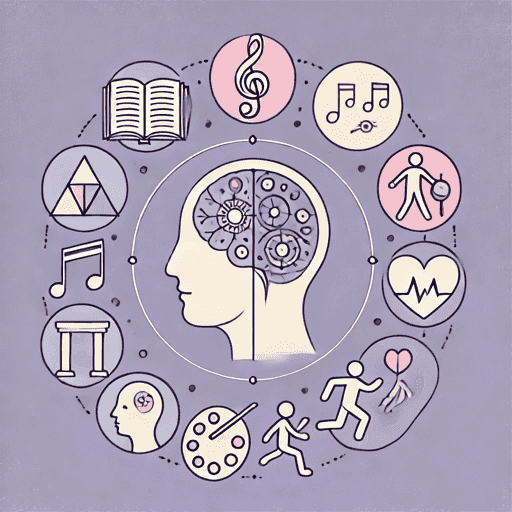
Frames of Mind: The Theory of Multiple Intelligences
62 pages • 2-hour read
Howard GardnerFrames of Mind: The Theory of Multiple Intelligences
A modern alternative to SparkNotes and CliffsNotes, SuperSummary offers high-quality Study Guides with detailed chapter summaries and analysis of major themes, characters, and more.
Key Figures
Howard Gardner (The Author)
Howard Gardner is an American developmental psychologist best known for his work in cognitive psychology and education. Born in 1943, Gardner has spent much of his academic career at Harvard University, where he has served as a professor at the Harvard Graduate School of Education and a senior director at Project Zero, an educational research group. Trained in developmental psychology, Gardner’s early work was influenced by cognitive science, neurology, and philosophy, positioning him at the intersection of multiple disciplines.
This interdisciplinary orientation became foundational to his most influential contribution: the theory of multiple intelligences. Challenging the conventional understanding of intelligence as a singular, fixed quantity, Gardner posited that human cognition is multifaceted, comprising various kinds of intelligences that are shaped by biological, cultural, and experiential factors. The Model of Intelligence as Multifaceted Rather Than Singular, first articulated in Frames of Mind, has had far-reaching effects in psychology, education, and beyond. Gardner’s blend of empirical rigor and humanistic vision synthesized complex ideas into a coherent, culturally resonant framework and, in doing so, helped transform a specialized psychological insight into a globally influential educational philosophy.
Jean Piaget
Jean Piaget, an influential Swiss developmental psychologist and epistemologist, is best known for his theory of cognitive development, which posits that children progress through a series of structured stages in their neurological development, each marked by qualitatively different modes of thinking. Central to Piaget’s theory is the idea that children are active learners who construct knowledge through direct interaction with their environment, forming increasingly complex mental structures. His work emphasized logical-mathematical reasoning as the pinnacle of cognitive maturation, with formal operational thought—marked by abstract logic and hypothesis testing—representing the “end-state” of intellectual development. Piaget’s influence on developmental psychology and education has been profound, with educators drawing on his model to shape curricula that align with children’s cognitive capacities at various stages.
Gardner’s theory of multiple intelligences aligns with Piaget’s work in several foundational ways. Both theorists view children as active agents in their own learning, constructing meaning through experience and internalizing patterns of reasoning. Gardner, like Piaget, values the developmental perspective and acknowledges that intelligences emerge and evolve through interaction with the environment. Furthermore, Gardner’s notion that children develop domain-specific competencies, such as linguistic, musical, or bodily-kinesthetic intelligence, resonates with Piaget’s idea that children form cognitive schemas through specialized engagement with the world. Both theorists also emphasize the role of symbolic representation—language, play, drawing, etc.—as a critical means of understanding and expressing thought.
However, Gardner diverges from Piaget in significant and revealing ways. While Piaget’s model privileges logical and abstract reasoning as the apex of intellectual growth, Gardner challenges the assumption that these faculties are the only markers of intelligence. In keeping with this, Gardner criticizes the universalizing tendency of Piaget’s stages, which he believes undervalues the diversity of cognitive strengths across individuals and cultures. Moreover, where Piaget’s theory centers on a single, general trajectory of intellectual development, Gardner’s MI theory proposes multiple, relatively autonomous intelligences that can develop unevenly and do not necessarily converge on a single mode of reasoning. This distinction represents a philosophical divergence: Piaget seeks to identify universal structures of thought, while Gardner foregrounds cultural, neurological, and individual variation in cognitive expression.

Unlock analysis of every key figure
Get a detailed breakdown of each key figure’s role and motivations.
- Explore in-depth profiles for every key figure
- Trace key figures’ turning points and relationships
- Connect important figures to a book’s themes and key ideas