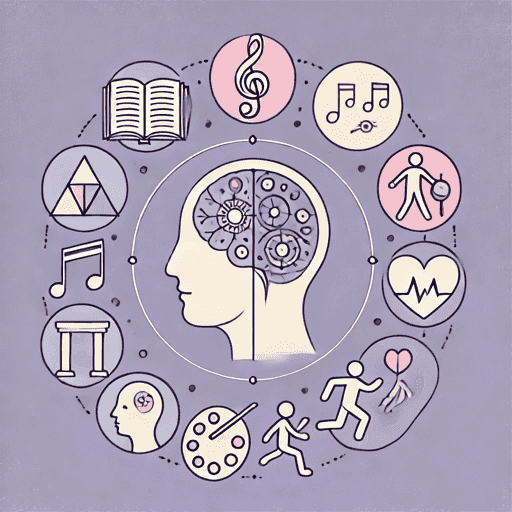
Frames of Mind: The Theory of Multiple Intelligences
62 pages • 2-hour read
Howard GardnerFrames of Mind: The Theory of Multiple Intelligences
A modern alternative to SparkNotes and CliffsNotes, SuperSummary offers high-quality Study Guides with detailed chapter summaries and analysis of major themes, characters, and more.
Part 2, Chapters 9-12Chapter Summaries & Analyses
Part 2: “The Theory”
Part 2, Chapter 9 Summary: “Bodily-Kinesthetic Intelligence”
Gardner uses the example of the celebrated mime Marcel Marceau to introduce bodily-kinesthetic intelligence. Using only his own body and gesture, Marceau could create an imaginary world populated with invisible objects that he acted upon in ways that were both familiar and exaggerated. Within a few gestures, Marceau could communicate essential aspects of a character, like their beauty, cruelty, or clumsiness, and could imply an environment through contrived reactions to it, most famously being able to act as if he were on a rapidly moving, jolting train, a beach, a busy street, or crammed into a box.
Gardner defines bodily-kinesthetic intelligence as both control of bodily motions and “the capacity to work skillfully with objects” (218). Though this intelligence involves some visualization, like in Marceau’s miming, it is grounded and embodied by nature. Dancers, swimmers, surgeons, baseball players, and instrumentalists all depend on their bodily-kinesthetic intelligence for success. In Ancient Greece, athletes competed in the earliest forms of the Olympics to express their bodily-kinesthetic intelligence. Many philosophers in that time period and beyond stressed the importance of developing this intelligence in tandem with abstract thinking. Even today, there are few fields in which a person can succeed without any sensori-motor aptitude.
Bodily-kinesthetic intelligence is one of the most easily observed intelligences in child development. Children first learn to clumsily use their own bodies and appendages as tools and then start to develop skill with instruments like forks, interactive toys, bicycles, and sports equipment like bats and balls. This kind of intelligence is also one of the most dramatically affected by brain damage. Survivors of stroke or brain trauma often experience extreme bodily-kinesthetic changes, sometimes having to learn to move limbs, crawl, and then walk in a way that mirrors an infant’s initial bodily-kinesthetic development. Neurodiverse individuals often display unusual yet prodigious mechanical skills that require skilled bodily-kinesthetic intelligence, like taking apart and rebuilding electronics or constructing complex machinery on their own.
Dance, especially, is a culturally celebrated form of bodily-kinesthetic intelligence. Practiced in some form in all cultures, dance, along with hunting, is one of the first human activities portrayed in surviving cave paintings from Paleolithic times. Like language or music, dance fulfills several cultural needs simultaneously, including social cohesion, religious expression, emotional release, economic activity, and sexual or reproductive selection. Also like singing, dancing is sometimes solo and sometimes plural in form and can be highly conformed or improvisational. In this way, bodily-kinesthetic intelligence shows itself throughout human history, interacting with different cultures in a range of ways. Other bodily-kinesthetic activities throughout history include acting, miming, and even cultural practices like sign language, knot tying, or hand signals used in sailing, hunting, and military spaces. The invention of new tools and industries, Gardner argues, can also be seen as an expression of bodily-kinesthetic intelligence because toolmaking acknowledges and seeks to ameliorate the limitations of the human physical form.
Gardner concludes by tentatively grouping logical-mathematical, spatial, and bodily-kinesthetic intelligences in a trio of “object-related intelligences” that interact with the physical world to different degrees and with different aims (249). However, the body is not simply an object: It also houses a consciousness that can and will interact with other consciousnesses in different ways, a phenomenon to be explored in the following chapter.
Part 2, Chapter 10 Summary: “The Personal Intelligences”
Gardner introduces the works of Sigmund Freud and William James, psychoanalysts at the turn of the 20th century who embodied different approaches to human psychology. Freud emphasized knowledge of the internal self, while James “stressed the importance of relationships with other individuals” (252). These two forms of psychological study encompass the two personal intelligences—intrapersonal and interpersonal—and though Freud and James focused on different aspects of human consciousness, they both believed in the importance of the individual self and its capacity to grow and change.
Intrapersonal intelligence involves understanding one’s own feelings and emotions and using them in fundamental ways to influence behavior. Interpersonal intelligence is the ability to observe and analyze other individuals’ behavior and come to conclusions that, again, influence one’s own behavior. Gardner points to skilled political and religious leaders like Mahatma Gandhi or Martin Luther King Jr. to indicate people with highly developed interpersonal intelligences.
Gardner admits that the personal intelligences are the most intensely variable along cultural lines since every human’s unique consciousness is shaped to a certain degree by their language and cultural practice while still existing individually. Additionally, interpersonal and intrapersonal intelligences are so profoundly intermingled with one another that separating them into discrete intelligences seems disingenuous, yet lumping them into the same category also seems incorrect. Despite these conceptual difficulties, Gardner feels that the personal intelligences “are of tremendous importance in many, if not all, societies in the world” and that ignoring them does a disservice to the study of intelligence (255).
During child development, infants learn to recognize faces and expressions early on, and their initial language attempts usually involve an intrapersonal expression of emotion or desire. The caregiver must in turn draw on their interpersonal intelligence to care for the infant, who cannot express their needs as successfully as an older child or adult. Later, children form attachments to characters that they identify with in fairy tales, books, or movies, interpreting aspects of themselves through these representations. Adolescence often features fraught explorations of the self as distinguished from friends or family. Later, culture shapes the individual’s understanding of the self and its relationship to the wider community, with social constructs like marriage, warfare, and work forming facets of identity. However, every culture seems to acknowledge that being human involves an outward self defined by actions and an inward self dictated by thoughts and emotions.
Though animals have been shown to experience emotions and even self-knowledge, with elephants famously able to recognize themselves in a mirror, humans are uniquely able to reflect on and analyze their own consciousness. Instances of brain damage and degenerative diseases like Alzheimer’s creating drastic personality changes have shown that personality is a neurological phenomenon that external factors affect. Chemical imbalance issues like depression or anxiety can cause a person to dramatically change their understanding of their own identity and their relationships, often based solely on a change within their own brain.
At the same time, interpersonal relationships are often crucial to the development of the self. In communities like the Maori of New Zealand, identity is seen as formed almost entirely from external forces like the opinion of the larger community and the inherited status of the family line. This is also true in some Western spaces, but philosophical thought in the midcentury modern world focused on the individual identity in ways that profoundly influenced Western understanding of the self. Nevertheless, many great thinkers, like Shakespeare or Keats, displayed a powerful facility with interpersonal knowledge that has influenced Western society as well.
Gardner concludes by reflecting on the complicated nature of these final two intelligences. He acknowledges that his description of them is vaguer than his descriptions of the last five, which he attributes to the fact that the personal intelligences are so changeable and culturally dependent. He also considers as a whole the “family of seven intelligences” (291). He groups them as logical-mathematical, spatial, and bodily-kinesthetic (object-related forms of intelligence), linguistic and musical (“object-free forms”), and the personal intelligences as, at this moment, uncategorized.
Part 2, Chapter 11 Summary: “A Critique of the Theory of Multiple Intelligences”
Gardner anticipates critique of his multiple intelligences theory because of its novel nature as well as his less-rigorous examination of their potential limitations, which he admits have been “glossed over or ignored altogether” in his introductions (293).
He starts by acknowledging that neurological research does not robustly support his idea that each type of intelligence is, to some degree, located physically in the brain and controlled by a discrete mechanism. He states that this understanding should be considered somewhat metaphorical, intended to showcase that every human being possesses every intelligence simply because they are human.
Next, he points out that the idea of multiple intelligences is not new and has in fact existed in different forms since Ancient Greece. His version is meant to counteract the tunnel-vision approach of more modern intelligence research, which focuses on logical and linguistic intelligences. It is also meant to showcase how different human competencies can qualify as intelligence alongside more traditional Western interpretations of intelligence. He also anticipates criticism based on the parts of human cognition that were apparently left out. For instance, motivation, morality, and even “common sense” are all vital parts of human competence yet don’t seem to have a place in his system. He argues that these factors represent different spheres of human consciousness than intelligence, though they interact with the intelligences in very crucial ways. Gardner also explores traits like originality and metaphorical capacity, noting that human ingenuity and the ability to link and signify ideas are strongly correlated with intelligence, yet ignored by this model. The “general synthesizing power” often referred to as wisdom (309), or the ability to make sound judgments based on a variety of factors, is also skimmed over.
Gardner excuses these omissions by clarifying his definition of intelligence, which is significantly different from other definitions. In his model, intelligence is most aptly defined as “raw intellectual capacities” present in every stage of human development and in every culture (314). This is a profoundly different definition of intelligence than those given by other psychologists or researchers, but it allows for intelligence to be considered somewhat apart from its effect on the individual and on the world. Intelligences are a group of vital human tools for making meaning in the world, but they are separate from the achievements that depend on them.
Part 2, Chapter 12 Summary: “The Socialization of Human Intelligences Through Symbols”
Gardner now places the symbol as central to his framework; they are the bridge that allows his model, “rooted in the psychology of intelligences, [to] be effectively linked with the concerns of culture” (316). He proposes that symbols create the bridge between the internal, individual nature of intelligences and their cultural effect. He defines a symbol as “any entity (material or abstract) that can denote or refer to any other entity” (316). A line in a drawing can be as much a symbol as a stone found in a backyard. Symbols convey not only information but also emotion, allowing for effective communication of internal modes of being.
Gardner covers symbol engagement in childhood development, including the basic symbols created by sound and language in infancy, as well as the stringing together of symbols as a toddler speaks, draws, and pretends or as a young child creates syntactic meaning through language and learns the basics of human existence through symbolic play. A baby can pick up a block: A four-year-old can understand that placing blocks in a certain arrangement signifies a “house” like the house they live in. This indicates the growing sophistication of symbol use in early childhood.
Gardner states that children engage in several “streams” of symbol learning at the same time. They learn the symbolic nature of language, art, dance, and logic and math simultaneously, and they use the different streams to create diverse meanings. However, Gardner also proposes that “waves” of symbolism create bursts of understanding in children. Children seem to grasp different complex aspects of symbolism out of nowhere, suddenly understanding that events require predictable sets of symbols (i.e., sleep requires a bed and a blanket, so putting a doll to sleep requires symbolizing those things). Later, they learn to approximate shapes with symbols—for instance, with a stick person representing a human being. Then, finally, they learn the importance of numerical quantity, taking care to draw enough toes and fingers on feet and hands to signify properly.
In this way, symbolization interacts with all of the intelligences and creates a feedback system between the individual’s internal experience and the culture surrounding them. Mastery of various symbol systems, like writing and mathematical language, becomes a focus of education, entrenching skilled symbol use as an accepted end-state of the intelligences.
Gardner outlines the positions of other fields of intelligence research on symbols and how their use predicts intelligence. Though he acknowledges the value of their contributions, he believes that Piaget and others engaged in flawed thinking that centered the individual’s capacity for thought without considering the profound effect of culture on intelligence. Gardner posits that a true and useful definition of intelligence would take into account inherent intellectual advantages, the relatively uniform stages of childhood development, and the ways in which individuals “are shaped and transformed by the particular practices and values of culture” (342). This is the goal of Gardner’s work, and he acknowledges that it is flawed and evolving as a theory. However, he emphasizes that understanding intelligence as multifaceted, hard to grasp, and continually evolving in its functions is crucial to creating models that accurately reflect human intelligence and its interaction with cultural symbols.
Part 2, Chapters 9-12 Analysis
In Chapters 9 through 12, Gardner completes The Model of Intelligence as Multifaceted Rather Than Singular by introducing bodily-kinesthetic and personal intelligences. Because Western thought often conceptualizes the mind and body as distinct from one another, Gardner’s presentation of bodily-kinesthetic intelligence represents a particular challenge to the status quo. Through examples such as that of celebrated mime Marcel Marceau, Gardner illustrates how the body can serve as a medium for complex expression, problem-solving, and symbolic communication. The range of examples—dancers, surgeons, athletes, etc.—illustrates the diverse shapes a given form of intelligence can take while also implicitly calling on readers to check their preconceptions; intelligence is commonly understood as necessary to becoming a surgeon in a way that it is not to becoming an athlete, yet Gardner suggests a parallel between these professions. The inclusion of bodily-kinesthetic thus emphasizes Gardner’s project of The Empowerment of Individuals Through the Recognition of Diverse Talents and Abilities. Recognizing dancing, athletics, and craftsmanship as forms of intelligence challenges elitist and exclusionary standards, allowing for more inclusive definitions of ability.
Gardner’s discussion of the personal intelligences—intrapersonal and interpersonal—breaks the mold that the preceding chapters have established. For one, he addresses two distinct forms of intelligence in the same chapter: Interpersonal intelligence governs relationships and ethical action, while intrapersonal intelligence shapes self-regulation and identity. Nevertheless, as Gardner concedes, the two are often difficult to disentangle, and his structural choices in discussing them reflect that. This in turn speaks to the second difference: Gardner’s greater difficulty providing concrete definitions of inter- and intrapersonal intelligence. Gardner acknowledges this and implies that these problems of conceptualization stem from some of the same factors that have led many to dismiss these intelligences in conventional models: namely, their subjectivity, variability, and ubiquity.
Yet Gardner insists not only that these faculties develop along a neurological path that mirrors that of other intelligences but also that they are essential to human life and cultural development. Indeed, his claims about the value of recognizing multiple intelligences are particularly forceful in this area: Cultures may weigh other intelligences differently, but virtually all cultures, Gardner argues, implicitly or explicitly reward high personal intelligence. Intrapersonal intelligence enables individuals to make meaning of their experiences, regulate emotions, and pursue personal growth. Interpersonal intelligence facilitates effective communication, leadership, and collaboration—skills critical to social cohesion and individual fulfillment. By valuing these intelligences, Gardner implies, societies can foster a broader range of human capacities. Chapter 12 extends this empowerment to the cultural level. Through symbol systems—whether in language, dance, mathematics, or religious ritual—individuals connect their internal experiences to communal values and traditions.
Chapter 11 functions largely as a conclusion to Gardner’s core claim about the multiplicity of intelligence, acknowledging critiques—such as the lack of precise neurological evidence or his decision to exclude traits like morality or motivation—while defending his broader goal of conceptualizing intelligence as a “set of raw intellectual capacities” (314), present across all cultures and individuals. However, it also paves the way for Chapter 12’s discussion of symbols. Notably, Gardner responds to the argument that his claims are not backed by neurological research by suggesting that his theory should be understood as a “metaphor”—a kind of symbolic thinking. As Gardner goes on to associate symbolic thinking with all forms of intelligence, this serves as a tacit rebuke of his critics.
Though The Implications of Multiple Intelligences for Teaching and Learning is not an explicit focus of Part 2, these final chapters continue to lay the groundwork for Part 3’s deeper discussion of this theme. In Chapter 9, for instance, Gardner observes that bodily-kinesthetic intelligence is one of the first to develop in children, as they learn to crawl, walk, and manipulate objects. That traditional classrooms often undervalue this form of learning implies a need for change to meet children where their strengths lie. Similarly, Chapter 12 illustrates how children engage in multiple “streams” of symbolic learning—from language and art to logic and social play—and discusses how these streams reflect the interplay between individual cognition and cultural context. Gardner’s insight that mastery of symbol systems is integral to education points to the need for pluralistic curricula that incorporate not just reading and mathematics but also storytelling, visual arts, dance, and emotional education. Gardner’s discussion of the personal intelligences also offers crucial implications for teaching. For instance, recognizing that adolescents often undergo a period of intrapersonal exploration and interpersonal flux suggests that emotional intelligence should be cultivated in schools, not sidelined. Lastly, Gardner’s insistence that intelligences are shaped and transformed by cultural practices and values suggests that educational systems should honor and reflect cultural diversity rather than impose a uniform standard.

Unlock all 62 pages of this Study Guide
Get in-depth, chapter-by-chapter summaries and analysis from our literary experts.
- Grasp challenging concepts with clear, comprehensive explanations
- Revisit key plot points and ideas without rereading the book
- Share impressive insights in classes and book clubs