Frames of Mind: The Theory of Multiple Intelligences
62 pages • 2-hour read
Howard GardnerFrames of Mind: The Theory of Multiple Intelligences
A modern alternative to SparkNotes and CliffsNotes, SuperSummary offers high-quality Study Guides with detailed chapter summaries and analysis of major themes, characters, and more.
Themes
The Model of Intelligence as Multifaceted Rather Than Singular
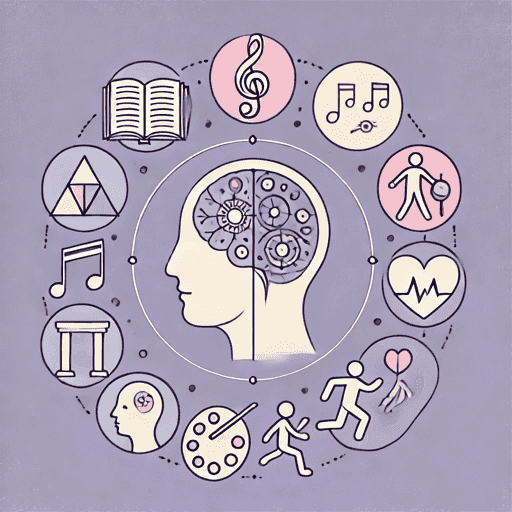
Gardner’s central claim in Frames of Mind is that intelligence is multifaceted rather than singular. This challenges the modern Western view, upheld by IQ testing and early cognitive psychology, that intelligence can be measured as a single, general mental capacity. Gardner’s theory of Multiple Intelligences (MI) redefines intelligence as a plural and diverse set of capacities, each with its own developmental trajectory, neurological basis, and cultural value. His work thus dismantles the idea of a one-size-fits-all measure of intellectual competence and replaces it with a model that encompasses a wider spectrum of human potential.
Gardner introduces this argument early in the book by juxtaposing three culturally distinct examples of cognitive excellence: a Puluwat navigator, an Islamic Koranic scholar, and a Parisian computer composer. Each of these individuals exhibits profound intelligence in their respective domains—navigational, linguistic-mnemonic, and musical-logical—but none of them would necessarily perform well on a standardized IQ test. The Puluwat child, trained to navigate through hundreds of islands using only stars, ocean currents, and memory, demonstrates spatial and bodily-kinesthetic intelligence. The Islamic scholar, who memorizes vast portions of the Koran in classical Arabic, exemplifies linguistic and intrapersonal intelligence. The Parisian teen composing electronic music using a computer blends musical and logical-mathematical intelligence.
As Gardner progresses through his chapters, he devotes focused analysis to each of the intelligences he identifies: linguistic, musical, logical-mathematical, spatial, bodily-kinesthetic, interpersonal, and intrapersonal. For example, musical intelligence is shown to develop early and often independently of linguistic ability, as seen in child prodigies and supported by neurological dissociation between the two faculties. Personal intelligences, both interpersonal and intrapersonal, are for Gardner the hardest to define, yet he insists that these emotional and social dimensions of cognition often left out of traditional models are often vital to individual and societal success. Gardner also stresses the diversity that exists within each intelligence, the expression of which is shaped by both individual and cultural factors. His discussion of bodily-kinesthetic intelligence, for example, emphasizes the intellectual depth involved in mastering physical movement and gesture, whether that movement manifests in the precise handiwork of a surgeon or the full-body expressiveness of a dancer.
Gardner’s framework, which he supports with cross-cultural, biological, and psychological research, proposes that intelligence is not a unified trait but a range of potentials and abilities. This model opens the door to more inclusive educational practices and broader recognition of diverse talents, ultimately arguing for a more diverse (and, according to Gardner, accurate) understanding of what it means to be intelligent.
The Implications of Multiple Intelligences for Teaching and Learning
Multiple Intelligences Theory, as presented in Frames of Mind, has profound implications for teaching and learning. Rejecting the view that intelligence is a single, measurable faculty, Gardner offers a pluralistic model that demands a rethinking of educational practices. In his framework, intelligence is not a monolith but a collection of distinct capacities, each of which requires different modes of instruction, assessment, and support.
In Chapter 13, Gardner demonstrates how different historical educational systems cultivate different intelligences. He revisits the Puluwat navigator, the Islamic scholar, and the Parisian computer composer, aligning each with a specific mode of instruction: pre-industrial apprenticeship, religious-literary schooling, and modern secular education, respectively. The first is an immersive and tactile form of learning that tends to prioritize bodily-kinesthetic engagement (though the particular skills learned vary substantially according to time and culture). Religious-literary schooling leans heavily on memorization and linguistic skill, exemplifying a highly structured, literacy-focused education. Finally, modern secular education incorporates technological tools and symbolic systems, encouraging logical-mathematical development (though linguistic intelligence often features prominently as well). Besides highlighting that different environments and pedagogical approaches activate different intelligences, this overview illustrates that no single existing system effectively nurtures all forms of cognitive potential.
Gardner applies these insights in Chapter 14, where he explores educational models like the Suzuki method for music training. This program teaches children as young as three by integrating listening, imitation, repetition, and gradual performance—methods that activate musical, bodily-kinesthetic, and interpersonal intelligences. Still, while Gardner considers the Suzuki method effective at incorporating multiple modes of learning, he cautions that such narrow and intense focus on a single method may hinder the development of other intelligences. He therefore recommends balanced and flexible educational environments, where students can explore multiple domains without being prematurely tracked or labeled. Though Gardner stresses that his own ideas are preliminary, the picture that emerges is one in which education, particularly in early childhood, would be bottom-up rather than top-down, asking teachers and other caregivers to observe children learning semi-independently. Such observation could then be used to generate individual intellectual profiles, which would allow educators to tailor instruction to students’ strengths and needs as they grow.
Ultimately, Gardner’s theory promotes a learner-centered educational paradigm that values diverse talents, adapts to varied cognitive styles, and encourages holistic development. It urges educators to abandon uniform approaches and embrace a more equitable and dynamic model of teaching and learning.
The Empowerment of Individuals Through the Recognition of Diverse Talents and Abilities
By challenging the dominance of traditional intelligence metrics—particularly IQ tests—Gardner opens the door to a more inclusive and affirming understanding of human potential. His theory of multiple intelligences (MI) emphasizes that individuals possess a range of intellectual capacities that conventional educational and psychological systems often do not recognize. By contrast, Gardner suggests that validating individuals for their unique strengths fosters greater confidence, engagement, and opportunity.
Gardner’s early examples illustrate how empowerment occurs when individuals are nurtured within cultural and educational systems that value their specific abilities. The Puluwat navigator, trained through observation and physical interaction with the ocean, demonstrates exceptional spatial and bodily-kinesthetic intelligence. Similarly, the Islamic scholar, who memorizes the Koran and masters classical Arabic, is valued for his linguistic and mnemonic skills—abilities that are cultivated through a rigorous religious-literary education. The Parisian computer composer, meanwhile, benefits from access to modern technology that supports her musical and logical-mathematical intelligences.
Though these children happen to live in environments that recognize and develop their distinct gifts, Gardner suggests that any form of education that prioritizes some forms of intelligence over others is ultimately flawed. Indeed, while Gardner stresses the value of considering what different cultural models of education have to offer, he cautions that empowering individuals must involve nurturing the whole person, not merely pushing them toward culturally preferred outcomes. As an example, Gardner cites postwar Japan, praising much about the Suzuki method but warning that overemphasis on academic success can lead to psychological stress and emotional underdevelopment.
Gardner therefore proposes using intellectual profiles to help children and educators better understand where a child’s strengths lie, thus promoting personalized education and reducing stigma. When society acknowledges bodily, interpersonal, or artistic intelligence alongside academic skills, students who might otherwise feel marginalized are given a platform to thrive. Gardner works toward this goal both explicitly and implicitly, advocating for education reform but also providing examples of well-known individuals who thrived once they found their niche; his remark that Albert Einstein experienced delayed linguistic development tacitly encourages readers not to measure their intelligence—or that of others—solely by conventional standards. Ultimately, Gardner argues that empowering individuals means respecting the diversity of minds and creating systems that honor and elevate all forms of intelligence.

Unlock every key theme and why it matters
Get in-depth breakdowns of the book’s main ideas and how they connect and evolve.
- Explore how themes develop throughout the text
- Connect themes to characters, events, and symbols
- Support essays and discussions with thematic evidence