How We Learn to Be Brave: Decisive Moments in Life and Faith
54 pages • 1-hour read
Mariann Edgar BuddeHow We Learn to Be Brave: Decisive Moments in Life and Faith
A modern alternative to SparkNotes and CliffsNotes, SuperSummary offers high-quality Study Guides with detailed chapter summaries and analysis of major themes, characters, and more.
Important Quotes
Content Warning: This section of the guide includes discussion of death.
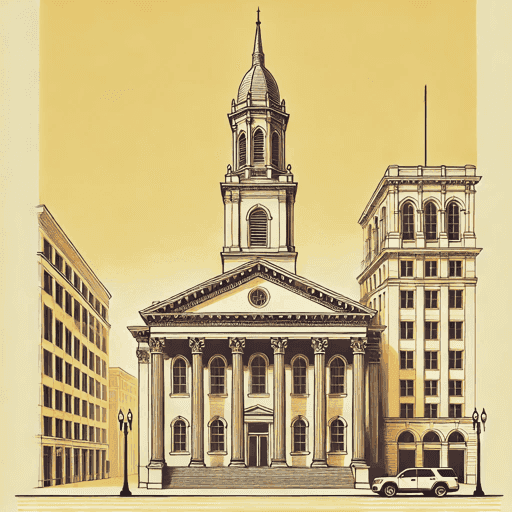
“Arriving at the entrance to the ‘Church of the Presidents,’ attended by every chief magistrate since James Madison, the president pivoted to face the bank of television cameras, holding an upside-down Holy Bible. ‘This is a great country,’ he said. After a few more photos were taken, the president turned and left, speaking to no one.”
(Preface, Page xii)
Budde paints the scene of Trump’s misuse of St. John’s Church, specifically highlighting his upside-down hold on the Bible. She does not comment explicitly on this gesture, instead allowing the inverted image to symbolize Trump’s use of the Bible for unchristian, political aims.
“We are, as they say, all in, shapers of our destiny, and cocreators with God. For as the word itself suggests, in a decisive moment, we decide.”
(Introduction, Page xviii)
In her introduction to decisive moments, Budde connects the idea of decision to the idea of creation. Human beings possess free will, and she illustrates how people join together with God in shaping their destinies collaboratively.
“Ultimately, what I want to communicate in these pages is that heroic possibilities lie within each of us; that the inexplicable, unmerited experience of God’s power working through us is real; and that we matter in the realization of all that is good and noble and true. We can learn to be brave.”
(Introduction, Page xx)
Budde explicitly states her goal in writing How We Learn to Be Brave. She wants to help her readers unlock the courage present within them and realize how God is working through them in their lives.
“It was the rigidity of their belief system that I struggled with, and their certainty that God’s unconditional love was only extended to those who accepted Jesus as their personal savior in the precise way they did. There was no room for deviation of experience or difference in understanding. Nor was there any place to acknowledge the ongoing struggles of human sin and brokenness that persisted after being saved. There certainly wasn’t room for doubt.”
(Chapter 1, Page 7)
Budde highlights her issues with the evangelical church of her teenage years in Colorado. Doubt is a key concept in her evaluation of faith because faith is the courageous choice to look beyond doubt and place hope and belief in something uncertain. Her old church left no room for uncertainty and therefore no room for meaningful cultivation of faith and bravery.
“It would require a lifetime of faithful steps, of answering one call and then another and then another, until by grace one reaches the kind of integration and opportunity summed up by the words, I have been preparing my entire life for this.”
(Chapter 1, Page 15)
Budde engages with the idea of vocation—of heeding a series of calls (whether to go, stay, start, step up, etc.) in order to reach an ultimate destiny. Her destiny was to become bishop, but it was not a singular moment or decision that led to that outcome.
“I’ve had to learn, time and again, that faithfulness isn’t always about taking big leaps, but also walking with small steps, and that it’s possible to make a lasting difference in the world by tending to one small corner of it.”
(Chapter 2, Page 23)
Budde offers an expansive definition of faith. Like the journey toward bravery that is made up of small moments of preparation, faith also requires similar steps to cultivate.
“Through challenge and sacrifice, we grow in our capacity to forgive, to accept, and to prize the uniqueness of another human being. Over time, we realize the privilege and responsibility of playing a supporting role in another person’s life story.”
(Chapter 2, Page 36)
Budde outwardly extends the significance of the call to stay into relationships with others. Staying creates stability and the skills of forgiveness and acceptance, which are two key aspects of creating healthy and lasting relationships.
“The fact that few others realize the significance of the call to start underscores its initially private nature and how long it can be before those first stirrings are seen in light of where they ultimately lead.”
(Chapter 3, Page 45)
Throughout the entirety of How We Learn to Be Brave, Budde highlights not the outcome of any of the calls she describes but the journey and process of such calls. The journey itself is at least as important as its outcome.
“It’s tempting to view the decisions and events of those years through the lens of inevitability, all leading to where I am now, but as I lived them, the path was anything but certain. I could only see far enough to take the next step, and the next, and then the next.”
(Chapter 3, Page 55)
Courage and faith both require individual steps, steps that Budde explains are not inevitable. The cultivation of courage and faith is an intentional process filled with choice, not something that people are easily pulled toward.
“The only thing within her control was how she would respond. She chose love.”
(Chapter 4, Page 73)
Throughout the text, Budde often switches her sentence structures, leading with longer sentences that build to a point before following with a punchy, shorter sentence rife with emotion. This passage is an example of such a construction, where she illustrates that even as her sister Christine’s husband died, Christine chose to embrace the experience with love.
“At the same time, there is a mystery embedded in pain that all major faith traditions point to, and those who have experienced it testify to its transformative power. They do not judge others who do not share their experience, but they want us to know that it’s possible to find meaning in adversity, even the circumstances we would have given anything to avoid.”
(Chapter 4, Page 83)
Budde engages in theological discussion of the nature and significance of pain, noting that many faiths ascribe meaning to suffering. She highlights that this meaning is a mystery, which is a key aspect of the mystical sides of religion.
“In the realm of justice, and indeed all of life, stepping up to the plate isn’t something we do once, but time and again, when it feels as if the world is watching and, more important, when it’s not.”
(Chapter 5, Page 109)
Budde’s introductory example of a decisive moment was decidedly public, as she rebuked the president of the United States. However, throughout the rest of the book, Budde highlights examples from herself and others of decisive moments that were private—when people stepped up to the plate when no one else was watching—illustrating the significance of people’s private journeys toward bravery.
“For reasons beyond our understanding, God consistently chooses to work through our imperfect, inadequate offerings.”
(Chapter 5, Page 117)
Imperfection is a key piece of being human, and Budde explains that God accepts people’s imperfections. Instead of working toward perfection, Budde encourages her readers to focus on diving deeper into faith and making courageous choices.
“For when brave souls come together in common purpose, led by those who helped them believe that their contribution matters, the world changes for the better.”
(Chapter 5, Page 129)
Budde illustrates Bishop Curry’s goal in the construction of his homily for the royal wedding. He encouraged his audience to join together in love to make the world a better place, and Budde adds to this idea by clarifying the place of courage in such a communion.
“Although circumstances vary, the inevitable emotional letdown that follows a decisive moment can throw us off course and cause us to question the validity or lasting power of what we had thought to be a transformative experience.”
(Chapter 6, Page 136)
Much of Chapter 6 is vulnerable for Budde, as she admits her own failures and experiences with letdown. In adding her personal examples, she illustrates that this letdown is not unusual or something to feel ashamed of. She joins with her readers in this universal experience.
“We need to be honest with ourselves and others when we make a mistake or are brought to our knees. It’s a way of living and leading with an undefended heart, truly open to others, and with a spine strong enough to withstand the experience, learn from it, and carry on.”
(Chapter 6, Page 146)
“An undefended heart” is another way to describe vulnerability, which Budde encourages her readers to bravely exhibit. When failures inevitably happen, vulnerability is key in understanding how to grow from the experience.
“For some, the conscious life of faith begins with such a moment, often referred to as a conversion experience. It can be a wake-up call of epic proportions, feeling oneself unconditionally loved, rescued from disaster, forgiven for past mistakes, and enabled to start over. For others, their spiritual consciousness has a far less dramatic beginning, with no one defining experience but instead a gradual sense of being led or inspired to live within a certain faith tradition or to open themselves to the mystery of the divine.”
(Chapter 6, Page 151)
Budde illustrates that not all faith journeys begin with a thunderclap conversion like that of the apostle Paul: Some are slower and more subtle journeys toward the development of a spiritual consciousness. She makes room for a variety of experiences with faith, which is essential to crafting a spiritual text with a wide appeal.
“Yet much of the spiritual life—as life in general—is lived not on the mountain, but in the valley, when the sense of God’s presence is far less dramatic, if we sense God’s presence at all. The challenge then is to trust that whatever vision or grace that was given to us was real, even when its emotional intensity fades, along with our confidence.”
(Chapter 6, Page 152)
Budde again adds realistic expectations to people’s faith journeys. Just as there is not always a defining conversion experience in a person’s path to faith, God’s presence is not always obvious. Faith requires trust in something unseen.
“You could say that I got through college on perseverance alone, if you define perseverance simply as effort, which I know now to be too narrow a definition.”
(Chapter 7, Page 163)
In Chapter 7, Budde redefines perseverance, something that she herself struggled with in her youth. She goes on to open the definition of perseverance to include not just continued effort but also the development of the skills necessary to continue the act of perseverance.
“I wonder if God needs us to persevere in prayer simply because most of what we pray for will take a long time to realize. We pray for healing for ourselves and those we love, knowing that in most cases the process is slow. We pray for peace within our families or in the human family, and we know that peace isn’t readily attained and often comes at a dreadfully high price. We pray for justice, knowing that it is always hard-won and takes generations to accomplish.”
(Chapter 7, Page 176)
Budde links prayer and perseverance as things that both require dedication and slow progress. Her reference to generations seeking justice connects to her historical analysis of the civil rights movement, which lasted decades in its journey toward racial justice, continuing to this day.
“Intellectually, we may know that our most decisive moments are preceded by countless small decisions, invisible to others. Yet it’s easy to lose sight of that truth as we slog through those stretches of preparation, trial and error, skill-building, and character formation. Perseverance is what keeps us going in the days without drama.”
(Chapter 7, Page 177)
The journey toward destiny, a journey of countless decisive moments, is often less exciting than people anticipate. Budde encourages her readers to dig deep into the aspects of the journey that are less dramatic and to continue to persevere through the process of preparing for the decisive moments.
“Jesus’ cross was one he took up daily, and so must we. Our acts of daily faithfulness and perseverance are part of a larger arc of courage and resilience through which the power and the grace of God are at work. The stories we tell and the moments we remember may be about the decisive moments, but what matters most is how those moments inform the living of each hour.”
(Chapter 7, Page 178)
Budde harkens back to the discussion of atonement theory from Chapter 4, in which she guides her readers toward appreciating Jesus’ sacrifice by living Jesus’ teachings. Cultivating faith, courage, and perseverance is essential to a meaningful life.
“To persevere in faithfulness is our greatest gift to this world. The most influential moments in our lives and in human history depend far more than we realize on our faithfulness in small things.”
(Chapter 7, Page 179)
Budde highlights the importance of the journey toward faith and the small steps taken in a faithful life. She again emphasizes the importance of the small moments on the way to the decisive moments that are life and history shaping, which is a key point that she attempts to instill in her readers.
“What I keep coming back to, as a source of hope and strength, are the historical accounts of men and women who faced the challenges of their times with grit and grace, the timeless stories of our spiritual and literary traditions that embody courage for us all, the people in my life whose courage and sacrificial love I admire, and the moments I have felt summoned to do what felt impossible at the time. Sometimes I succeeded; often I failed. But what seems to matter most in those moments is that we show up, step up, and make our offering despite its limitations and our own.”
(Epilogue, Page 182)
Budde emphasizes the importance of Bravery as a Historical Throughline as she harkens back to the examples from the Bible and the civil rights movement. She also reiterates her own personal examples of triumphs and losses, illustrating that despite people’s imperfections, it is crucial to stay on the journey toward faith and bravery.
“May you and I dare to believe that we are where we are meant to be when that moment comes, doing the work that is ours to do, fully present to our lives. For it is in this work that we learn to be brave.”
(Epilogue, Page 184)
Budde concludes the text with these two sentences, referencing the title of the book and ending with a sort of benediction that is similar to the ending of a traditional homily. She leaves her readers with her key message: Learning to be brave is a process that requires work, and the work is worthwhile.

Unlock every key quote and its meaning
Get 25 quotes with page numbers and clear analysis to help you reference, write, and discuss with confidence.
- Cite quotes accurately with exact page numbers
- Understand what each quote really means
- Strengthen your analysis in essays or discussions