How We Learn to Be Brave: Decisive Moments in Life and Faith
54 pages • 1-hour read
Mariann Edgar BuddeHow We Learn to Be Brave: Decisive Moments in Life and Faith
A modern alternative to SparkNotes and CliffsNotes, SuperSummary offers high-quality Study Guides with detailed chapter summaries and analysis of major themes, characters, and more.
Preface-Chapter 1Chapter Summaries & Analyses
Preface Summary: “Lafayette Square—June 1, 2020”
Content Warning: This section of the guide includes discussion of death, racism, and addiction.
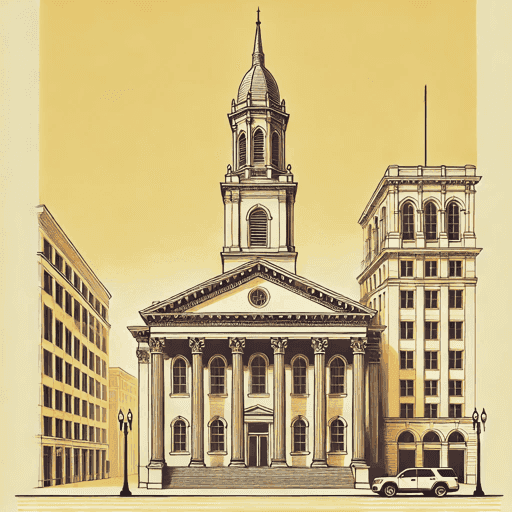
Mariann Edgar Budde describes the consequential day of June 1, 2020, when President Donald Trump held a photo-op in front of St. John’s Church, the so-called “Church of the Presidents,” which has been attended by all sitting United States presidents. The church sustained minor fire damage during a march organized to protest the police killing of George Floyd. After a press conference at the White House, in which Trump threatened to use military force against the American citizens who banded together to protest the murder of Floyd by police, Trump posed with a Bible in front of the church while reporters took photos.
Budde, as Episcopal bishop of Washington, DC, was appalled by Trump’s use of the church as a political tool to further his own agenda of political repression, and she spoke to CNN and other prominent news stations and publications to remind the American public that Trump “d[id] not speak for St. John’s” and that his use of the church and the Bible itself as a justification for immoral violence was “antithetical to the teachings of Jesus” (xi). In the days that followed, Budde continued to repeat this message, and for a brief period, her words carried far across the United States, though she acknowledges that the significance was not about her or St. John’s specifically; the significance stemmed from the fact that this was a “decisive moment” for the United States (xii).
Introduction Summary
Budde describes the central idea of How We Learn to Be Brave, which centers on her exploration of decisive moments that call for courage—moments when people find themselves wanting to rise to the occasion and be brave. Budde addresses her readers directly, stating her desire for them to realize that they “have all the raw material [they] need to live with courage and purpose in [their] decisive moments, and all the moments that precede and follow them” (xv).
Budde defines decisive moments as “marking events” that offer an adrenaline rush but are preceded by “seasons of preparation” (xv). She argues that preparation for these decisive moments makes it possible to step up when they happen. Budde has experienced a number of decisive moments throughout her life, but perhaps none as significant as June 1, 2020. Budde states that she didn’t speak out to be brave but to take her place alongside others who were being brave. She lauds the protestors for seeking justice for George Floyd and the other victims of racist police violence, and she views her decision to speak out against Trump not as a moment of personal bravery but as a contribution to the collective bravery of the American citizens standing up to racist and immoral violence.
Another decisive moment that Budde encountered in the wake of that June day was standing in Black Lives Matter square outside St. John’s, listening to Bishop William J. Barber of the Poor People’s Campaign, a coalition dedicated to building community-based efforts among low-income citizens of all races and backgrounds. He spoke about the necessity of collective action from everyone and emphasized that everyone has a role to play in bringing about change in the United States. These words brought relief to Budde, who knew that she had a large role to play in the search for justice and became even more motivated to live her life in pursuit of this justice.
Budde clarifies that while some decisive moments are public, many of these moments are personal or even private, but all decisive moments shape people’s lives and guide them toward becoming the people whom God calls them to be. Decisive moments require conscious choice and agency and the recognition of the consequences of each path. Decisive moments, Budde argues, “make believers out of everyone” (xviii), as the greater power working through people during decisive moments is real, no matter what name the power is given. Bravery often requires acceptance, as there is courage in accepting the life that one has been given. Budde outlines the various chapters of the text and what each chapter will explain about decisive moments, how they shape individual experience and spiritual development, and how they can teach the readers to be brave.
Chapter 1 Summary: “Deciding to Go”
Budde frames the chapter around the concept of the hero’s journey, a traditional narrative structure in which the protagonist ventures out into the unknown to pursue a goal—usually one of some importance to the community. It’s a universal narrative throughout history, and when people hear others’ courageous journeys, they become inspired to undertake their own. The “summons to go,” as Budde calls it (1), is a definitive moment in people’s lives, calling them to leave one place for another and balance the risks and costs of leaving with the benefits of fulfilling an unknown destiny. This journey toward destiny begins before the act of leaving itself, with either “an inner stirring, a precipitating event, or an invitation that takes us by surprise” (1). There is often resistance, either within people themselves or from the people or world around them, but as Budde writes, “We often don’t know we have wings until we’re forced to fly” (1).
Budde meditates on her own “summons to go,” which led to her decision to leave Colorado as a teenager. When she was a junior in high school, her father confided in her that he planned to leave her stepmother with no warning. He assumed that Budde would accompany him, but she recognized that his struggles with mental illness and addiction would not make him a suitable parent, and she could not stay with her emotionally withholding stepmother, though she felt guilty for leaving her younger half-brother behind. Budde decided to return to her mother in New Jersey. Budde and her older sister, Christine, were raised by their mother in New Jersey until their father sought custody of Christine. Afraid to be left behind without Christine, Budde exaggerated stories of her life to the family court judge in a bid to please her father. The judge then placed Christine and Budde with their father, breaking their mother’s heart.
Budde sought the normalcy of a nuclear family, something that she felt she lacked with her single mother, who worked frequently. However, her father’s and stepmother’s lives were not what they seemed, as her father made poor financial decisions and Christine’s life became tumultuous before she left home for good. By her sophomore year, Budde formed her own family with friends from school, who guided her to the Christian youth organization Young Life, which added depth to her relationship with God while allowing her to form relationships with others around her.
Despite her close friendships, Budde returned to her mother after finishing her fall semester and performing in the school play. She tearfully left her boyfriend behind at the airport and boarded the plane back to her mother, who had never given up on Budde. Her mother had called her weekly in the beginning of Budde’s time in Colorado, and as her mother grew in self-confidence, her relationship with Budde grew and blossomed. Along with the support of her mother, Budde was supported by the pastor at the Episcopal church of her childhood. Budde found the rigid beliefs of the leaders in her Colorado faith community repressive. If she had stayed in Colorado, she would have eventually found conflict with her faith.
In New Jersey, Budde found a more expansive understanding of God. She acknowledges that leaving Colorado had some adverse effects: Her relationship with her half-brother never fully recovered. She remembers the sensations of leaving as clearly as if it were yesterday, and it remains a touchstone of her understanding of decisive moments.
In the summer of 2020, Budde attended a virtual interfaith panel hosted by Rabbi Bruce Lustig of Washington Hebrew Congregation to discuss Bruce Feiler’s book Life Is in the Transitions: Mastering Change at Any Age. Feiler’s thesis is that life transitions are not linear or predictable and that moments of transition that occur at extreme magnitudes are called “lifequakes,” which occur only a few times throughout one’s life. During a lifequake, one can easily realize that life is changing, but the permanence of the change can be difficult to grasp.
During the panel, Feiler asked the attendees to speak about a lifequake of their own. Budde shared about her departure from Colorado. Though she felt reluctant to share something that she worried the others would find juvenile, both Imam Mohamed Magid and Rabbi Lustig also shared about transformative experiences in their adolescence and young adulthood. Feiler noted that despite their religious differences, all of them shared stories of family and vocation, illustrating that breakthroughs in both life and faith come from letting go of the familiar and moving toward unknown destinies.
The three religions (Christianity, Islam, and Judaism) that Budde and the others represented are known as the Abrahamic religions, as all three claim Abraham, an ancient nomadic leader, as their spiritual ancestor. Abraham heard a voice telling him to leave and settle in a new place. Abraham first appears in Chapter 12 of Genesis, after Adam and Eve, Noah’s ark, and Cain and Abel. God called Abraham and his wife, Sarah, to travel to a new land with the promise of family and important familial lineage, something so outlandish to the elderly couple that Sarah laughed when Abraham told her that they had to go. Abraham did not ask for proof or evidence, and the description of Abraham’s decision is depicted in a matter-of-fact way in Genesis. Still, they placed their trust in God and went, something that Feiler indicated was not a sign of Abraham believing in God but believing God. Though their journey, like Budde’s out of Colorado, had its pitfalls, with Abraham and Sarah making mistakes and causing harm, this does not diminish the importance of their journey. The lack of Abraham and Sarah’s feelings in Genesis illustrates that people’s feelings about their decisive moments are not what is most important; the decision to heed the call is what matters most.
Budde pivots back to the hero’s journey, illustrating that while the first hero’s journey typically takes place in adolescence, the hero’s journey calls more than once throughout a person’s life. She offers the example of another Episcopal priest whom she met early in her vocation. He seemed settled in his life as the director of a camp and retreat center, but he was changing roles to become a counselor at a residential center for adolescent felons. He told Budde that he felt as if he had prepared his entire life for the job, illustrating that the call to go can come at any time and that following the call means drawing on a lifetime of faithful steps and decisions.
Budde provides another example: Black American pastor Howard Thurman, who was invited in 1943 to move to San Francisco, California, to co-lead an interracial Christian community. A sought-after pastor by both white and Black Christian communities even during the segregated Jim Crow era, Thurman became frustrated with the white Christian community’s unwillingness to confront racism. In San Francisco, Thurman built a community that he saw as the culmination of a dream he had conceived in 1936 while traveling in India, where spirituality suffused ordinary life and united people across class and racial lines. Thurman had to leave his teaching post at Howard University, a prestigious HBCU (historically Black college or university). Though the faith community did not have the national ramifications that Thurman had hoped for, the call was still worthwhile. Later, Thurman was again called to teach at Boston University, where he became the mentor to a young Martin Luther King, Jr.
Budde reminds her readers that, whether it comes for the first or the hundredth time, the call to go is significant and reminds people that their lives matter. Whether going in excitement or fear, the cost confirms the importance of the call, and the clarity to go is a gift. When the heroic call to go comes, Budde asserts, all people will recognize it and know what to do.
Preface-Chapter 1 Analysis
The opening chapters of How We Learn to Be Brave establish a number of key themes that Budde continues to explore throughout the entirety of the text. Courage is at the center of Budde’s book, and she frames the cultivation of bravery through the lens of decisive moments. She emphasizes the importance of decisive moments, noting that every decisive moment requires one to draw on a lifetime of prior experience: “Moments like these are preceded by seasons of preparation, practice, and intention, of making countless daily decisions that determine our capacity to be brave when called upon or when we’re summoned not of our own choosing” (xvi). Courage is necessary for decisive moments because the build-up to these moments helps people develop the bravery that is a requirement of decisive moments, like heeding what Budde calls the “summons to go.”
The concept of the summons or call to go forms one part of a tripartite framing device that Budde uses to structure the book. In this structure, there are three kinds of calls, each of which requires its own kind of courage: the call to go, the call to stay, and the call to start. In discussing the summons to go, Budde draws on the concept of the hero’s journey, a narrative structure identified by folklore scholar Joseph Campbell as one of the foundational structures of storytelling across many cultures and throughout history. In the hero’s quest, the protagonist receives a “call to adventure”—e.g., Gandalf’s visit to the shire in The Fellowship of the Ring or the arrival of the messenger owl in Harry Potter and the Sorcerer’s Stone—prompting them to leave the safe, familiar world behind and embark into the unknown. In pointing out the ongoing relevance of this ancient narrative structure, Budde underlines the theme of Bravery as a Historical Throughline: Across cultures and from antiquity to the present, people have valued stories about finding the courage to heed the call to go.
Budde uses historical, biblical, and personal examples of bravery to guide her readers toward a better understanding of how to become courageous. She offers an example of cultivating courage alongside her fellow Abrahamic faith leaders at a conference, an action she describes clearly: “Together we also gave witness to a lesson embedded in the stories of our common scriptural tradition, that breakthroughs in life and faith can occur when we relinquish what is familiar and go toward the unknown” (11). Budde illustrates that the Abrahamic faiths have lessons of courage embedded in their sacred texts, which are examples to turn to in times of difficulty or challenge.
Budde highlights a specific example from the Old Testament: Abraham and Sarah, who were told by God to travel to an unknown land to start a family, even though they were elderly and had never been able to have children. They listened to God and went, despite the seeming impossibility of God’s promise. They took a leap of faith, which God rewarded, and their lives took on new meaning. In this self-help book, Budde explicitly frames them as a model for her readers:
Their story can be a spiritual template for us, to help us trust those rare experiences of clarity when they come. The fact that the text doesn’t tell us what Abraham and Sarah felt is a helpful reminder that in our decisive moments, our feelings—or anyone else’s—are surprisingly irrelevant (13).
In Budde’s reading, the relative absence of interiority in the biblical story highlights the importance of action over emotion. When the call comes, it doesn’t matter whether one is afraid; all that matters is whether one heeds the call. Abraham and Sarah did not hesitate or express concern or anxiety over God’s command to them; they simply went. The straightforwardness of this choice represents what Budde calls a moment of clarity. Clarity is a concept that she explores in the context of decisive moments, as clarity usually comes before a person enters a decisive moment, even if fleetingly. Clarity, like bravery, helps decisive moments add meaning to people’s lives.
For Budde, an Episcopal bishop, this clarity comes through the grace of God. In surrendering to the call to go, one undergoes “a profoundly spiritual experience, one in which we feel a part of something larger than ourselves and guided, somehow, by a larger Spirit at work in the world and in us” (xviii). Budde emphasizes “decisive moments” throughout the book in part because, in her religious worldview, these are the moments in which God is most palpably present in individual lives. For the same reason, folklore across numerous cultures has long regarded crossroads as places imbued with spiritual power: Symbolically, the crossroads represents a “decisive moment,” a point at which one must choose. The clarity that Abraham and Sarah experienced stemmed in part from the guidance of a larger spirit that Budde believes to be God. God guides people through their decisive moments, even when those moments seem daunting.
Budde’s role as a spiritual leader plays an important part in her construction of the text, especially as she explores ideas related to The Impact of Leadership in Cultivating Courage. Though she is now a prominent bishop, her walk to faith was not simple. When she moved to Colorado as a young teenager, she joined an evangelical church, and she recalls finding the church’s conservative, authoritarian leadership troubling, which she did not fully realize until returning to the Episcopal Church. Of this return, she writes, “It was the first time it dawned on me that a relationship with God isn’t defined by ‘correct’ beliefs but rather a willingness to trust and step out in faith” (8). The leadership of her Colorado church risked pushing her away from her faith with its emphasis on rigidly defined rules of belief and behavior. Budde found the courage to pursue God even after this disappointment because she found a community, church, and church leadership that prioritized faith over doctrine and dogma. She carried this experience with her, and when it was time for her to be brave and speak up against the injustice carried out on the steps of one of her churches, she didn’t hesitate because she knew that the “significance was not about St. John’s Church, or about [her], but what thousands needed to hear in a decisive moment for [the United States]” (xiii). Because of the positive examples of Episcopal leadership that she saw in her youth, Budde knew how to model bravery through faith, which she did when the decisive moment for both herself and the nation came her way.

Unlock all 54 pages of this Study Guide
Get in-depth, chapter-by-chapter summaries and analysis from our literary experts.
- Grasp challenging concepts with clear, comprehensive explanations
- Revisit key plot points and ideas without rereading the book
- Share impressive insights in classes and book clubs