Kensuke's Kingdom
43 pages • 1-hour read
Michael MorpurgoKensuke's Kingdom
A modern alternative to SparkNotes and CliffsNotes, SuperSummary offers high-quality Study Guides with detailed chapter summaries and analysis of major themes, characters, and more.
Chapters 7-11Chapter Summaries & Analyses
Content Warning: This section of the guide includes discussion of mental health concerns, suicidal ideation, animal cruelty and death, illness, and death.
Chapter 7 Summary: “All That Silence Said”
When Michael awakens, he is in Kensuke’s cave. He is still immobilized and in pain from the jellyfish’s toxins. For many days, Kensuke tends to the boy, feeding him, bathing him, and singing to soothe him. Stella also stays close to Michael during his convalescence. Gradually, Michael becomes able to move his neck, allowing him to see more of Kensuke’s spacious cave, which contains a kitchen, a sitting room, a studio, a bedroom, and a small cooking fire. Kensuke spends much of his time painting seashells with images of dolphins, birds, gibbons, butterflies, and orangutans. One day, he gives Michael a seashell painted with a tree in blossom. Although the boy still wants to see his parents, he no longer misses them as much as he did when he was alone.
After Michael recovers, he regains his ability to speak, but he senses that Kensuke would prefer to preserve their companionable silence. Kensuke teaches the boy how to spearfish and find fruit and honey in the forest. The orangutans follow the man and love his singing voice, and they begin to express friendly curiosity toward Michael. The boy is deeply curious about Kensuke, but he stops asking questions because Kensuke doesn’t want to talk about his past.
Kensuke makes Michael a kimono that matches the one he wears and begins teaching him how to paint on seashells. One day, as they paint side by side, Kensuke asks Michael to teach him English. After months of English lessons, Kensuke asks Michael to tell him the story of his life, and the boy tells him all about his childhood home, the Peggy Sue’s voyage, and the night he fell overboard. They discover a shared love of soccer. The next day, Kensuke guides Michael to the beach where the boy first washed ashore. The man uncovers a concealed outrigger and Michael’s soccer ball.
Chapter 8 Summary: “Everyone Dead in Nagasaki”
Kensuke shares in Michael’s joy at being reunited with his beloved soccer ball. Along with Stella, they go out in the outrigger to look for large fish. After they cast their lines, Kensuke tells Michael his life story. He was born in Nagasaki, Japan, and studied at Guy’s Hospital in London where he worked as an obstetrician. During World War II, he was drafted as a doctor on a warship. American planes bombed his ship, killing everyone on board except for him. On the ship’s radio, Kensuke heard that the United States bombed Nagasaki, where his wife, Kimi, and his son, Michiya, lived. Japan had surrendered. The news devastated him—as he tells Michael: “I so sad, I want to die” (71). The ship drifted ashore on the island, and the orangutans’ kindness and the island’s peacefulness restored his will to live.
Shortly after Kensuke moved everything useful from the warship into a cave, a storm sank the ship. American soldiers came to the island. Kensuke hid but was close enough to hear them bragging about how everyone in Nagasaki was dead. Many years passed without anyone else coming to the island, and Kensuke befriended the orangutans and learned how to live off the land by observing them. About a year before Michael washed ashore, a group of poachers came to the island and slaughtered many gibbons while Kensuke and the orangutans hid.
On the night that Michael fell overboard, Kensuke’s fishing boat was blown off course, and he felt too weak and afraid to reach the island. He was astonished when he heard Michael’s singing, and both the boy and his dog were nearly drowned when he pulled them into his boat. Due to his deeply rooted anger against humanity, Kensuke didn’t want to be near Michael at first. He knew that the sea was full of dangerous jellyfish after the storm, and he feared that the boy would die after he was stung. Kensuke ends his story by saying that Michael is his family now, and the boy sincerely agrees. However, part of him still longs to find his parents.
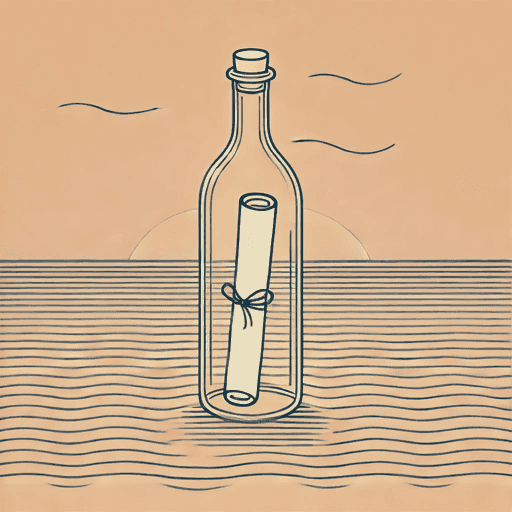
The next morning, a Coke bottle washes ashore, and Michael secretly places a message inside: “Dear Mom and Dad, I am alive. I am well. I live on an island. I do not know where. Come and find me. Love, Michael” (75). After he hurls the bottle into the sea, he feels so guilty that he can’t eat that evening. The following day, Stella brings the bottle to Kensuke, who realizes what it contains.
Chapter 9 Summary: “The Night of the Turtles”
After Kensuke discovers that Michael attempted to send a message in a bottle, he withdraws into himself. Wracked with guilt, the boy keeps to himself for several days. One night, Kensuke’s favorite orangutan, Tomodachi, comes to the cave in search of her baby, who has run away. This prompts Kensuke to open up to Michael. After reflecting upon the situation, he now understands that Michael and his parents must always think of each other all the time like he still thinks of his son. Although he loves Michael like family, he no longer expects him to stay with him forever: “You have long life waiting for you. You cannot live whole life on this island with old man who die one day” (79). Kensuke proposes that they play soccer and build an enormous signal fire the next day. Michael is grateful for his forgiveness and understanding and gladly accepts.
The next day, they build a massive pile of wood and kindling and spend hours playing soccer with Stella. Days pass, and Kensuke tells Michael more about his life before the island. Although the boy hopes a ship will rescue him, he doesn’t want to leave Kensuke behind, so he encourages him to consider returning to Japan. Although Michael knows little about Japan, he assures the man that the country is at peace and produces much of the world’s technology.
One night, Kensuke awakens Michael and leads him to the beach, where hundreds of baby turtles are hatching. All night and into the morning, the two humans protect the baby turtles as they journey to the sea. Kensuke explains that he does this every year so that birds will not devour the infants. Seeing the little turtles’ bravery gives Kensuke courage: “Like turtles I go. I go with you. I go home to Japan. Maybe I find Kimi. Maybe I find Michiya. I find truth. I go with you, Micasan” (85).
Chapter 10 Summary: “Killer Men Come”
For days, heavy rains batter the island, confining Michael and Kensuke inside the cave, where they spend hours painting side by side. Kensuke paints his house in Nagasaki and his wife and son, but he no longer remembers their faces. Kensuke heaps praise on the boy’s portrait of Tomodachi and helps him improve his technique.
One morning, after the rains relent, Stella angrily barks at a Chinese junk. Kensuke recognizes the vessel as the one that carried the men who killed the gibbons. He sings to gather the orangutans to safety, but Tomodachi’s baby doesn’t follow him. For hours, the two humans, the orangutans, and Stella hide in the cave. Kensuke sings softly to soothe the anxious animals as the sounds of gunfire echo around the island. When the junk sails away and Kensuke and Michael search the forest, they find two slain mother gibbons. Kensuke’s despair and bewilderment are tempered by joy when they find Tomodachi’s baby safe and sound. Kensuke and Michael camouflage the entrance of the cave in case the poachers return.
One day, Michael and Kensuke spy the white sails of a yacht and light the beacon. With wonder, the boy recognizes the approaching vessel as the Peggy Sue. Kensuke goes to sit in front of his cave and holds the soccer ball. He explains that he’s decided to stay on the island because, even if his family members are still alive, they belong to another world now. He also wants to protect the orangutans from the poachers: “This is Kensuke’s Kingdom. Emperor must stay in his kingdom, look after his people” (94). Michael weeps but understands his friend’s decision.
Kensuke asks Michael to make him three promises—that he will paint every day, that they will never forget each other, and that he will tell no one about Kensuke for 10 years so that no one will come to disturb his peace. Michael agrees. Kensuke gives him the soccer ball, and they say their goodbyes. Reluctantly, Stella follows Michael to the shore.
The Peggy Sue reaches the island, and Michael’s parents embrace him, shedding joyful tears. Michael learns that his parents spent nearly a year searching for him and that his mother is the only person who never gave up hope that he was alive.
Chapter 11 Summary: “Postscript”
Four years after Michael publishes the story of his life, he receives a letter from Kensuke’s son, Michiya Ogawa. Kimi, who died three years ago, and Michiya both believed that Kensuke died in the war. They survived the destruction of Nagasaki because they were in the countryside visiting relatives when the bomb fell. Because he was so young when his father disappeared, Michiya has no memories of Kensuke. Michael accepts Michiya’s invitation to go to Japan and meet him and observes that he “laughs just like his father did” (96).
Chapters 7-11 Analysis
The novel’s final section focuses on Michael and Kensuke’s deepening connection, illustrating The Essential Need for Friendship and Companionship. The characters’ relationship undergoes an enormous shift while Kensuke nurses Michael back to health after he’s stung by the jellyfish. Michael acknowledges that his “erstwhile enemy, [his] captor, had become [his] savior. [….] The day [his] fingers first moved was the very first time [he] ever saw [Kensuke] smile” (59). Kensuke heals Michael emotionally as well as physically to the point where he “no longer misse[s]” his parents as much as he did before (62).
The characters’ efforts to bridge their language barrier allow them to share their backstories, advancing their personal growth. Their improved communication also helps Michael restore Kensuke’s interest in the outside world. Under Michael’s influence, Kensuke admits: “Maybe one day before I die I go back to my home. One day I go back to Japan. Maybe” (83). Although the man ultimately decides to remain on the island, it remains significant that his friendship with the boy restores his hope for humanity. Another advantage of their shared language is that the characters can overtly express the depths of their love for one another. Kensuke tells Michael: “You are like son to me now. […] We happy. We stay together. You my family now, Micasan. Yes?” Michael responds, “Yes,’ I said. I meant it and felt it, too” (74). Although Michael wounds their bond when he tries to send the message in a bottle, Kensuke cares about Michael enough to help him achieve a life beyond the island. Although Michael’s reunion with his parents gives the novel a happy ending, this resolution is bittersweet because the two dear friends must part forever.
Kensuke’s history and learned skills exemplify both Survival and Resilience. He demonstrates emotional and mental strength by starting a new life on the island after losing everything. He’s “a considerable craftsman” who makes his clothes, paintbrushes, rush matting, furniture, fishing spears, and other objects (65). He shares both his skills and his perspective with Michael, saying: “No war here, no bad people. I say to myself, Kensuke, you very lucky person to be alive. Maybe you stay here” (72). Kensuke’s words evidence his adaptability as well as his fears, laying the groundwork for both the man and the boy to help each other grow. Kensuke helps Michael to become a more capable survivor and a more emotionally resilient individual, and Michael helps Kensuke begin to heal from the trauma of his past and move from a place of personal isolation to one of connection and companionship.
Kensuke’s powerful bond with the orangutans emphasizes The Importance of Ethical Relationships With Nature. He adapts to life on the island by observing and imitating the apes. As Michael observes: “He learned he said mostly by watching what the orangutans ate, and what they did not eat. He learned to climb as they did. He learned to understand their language, to heed their warning signals” (73). The orangutans’ acceptance helps Kensuke survive after the horrors of war, facilitating mutual respect, understanding, and affection between them. Michael notes that “[the orangutans] would often come to Kensuke when they were upset or frightened, just to be near him” (78). The closeness between Kensuke and the primates informs his ethical determination to protect them in contrast to the poachers who kill mother gibbons and take their babies. In the novel’s resolution, the orangutans motivate Kensuke’s decision to live out the rest of his days on the island rather than return to human society: “I have family here, orangutan family” (93). Kensuke’s protective, familial bond with the orangutans offers an example of the powerful connections that arise from building ethical relationships with nature.
In this final section, Morpurgo invokes the symbolism of the soccer ball to reinforce the good fortune inherent in Michael and Kensuke’s friendship, since each has grown and benefited from knowing the other. Kensuke returns the ball to the boy in Chapter 7, foreshadowing the revelation that he rescued Michael and Stella from the sea when they fell off the Peggy Sue. In Chapter 9, Kensuke and Michael’s soccer game echoes Michael’s joyful childhood memories with Eddie: “What a time we had. Neither of us wanted it to end. With a crowd of bemused orangutans looking on, with Stella interfering and chasing after every goal scored, we were at it till darkness drove us at last back up the hill” (81). Kensuke gives Michael the soccer ball when they say their final goodbyes, positioning the object as a memento of their friendship as well as a symbol of good fortune.

Unlock all 43 pages of this Study Guide
Get in-depth, chapter-by-chapter summaries and analysis from our literary experts.
- Grasp challenging concepts with clear, comprehensive explanations
- Revisit key plot points and ideas without rereading the book
- Share impressive insights in classes and book clubs