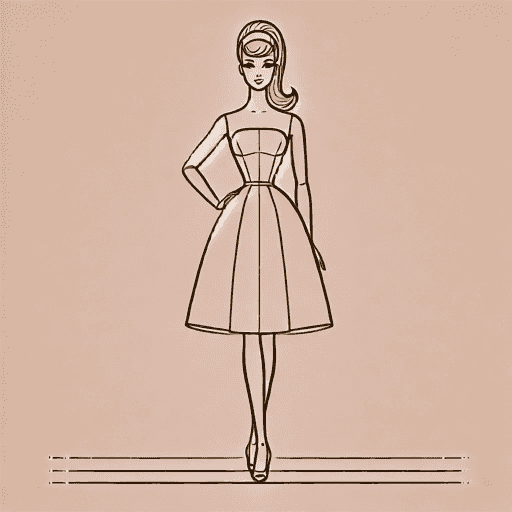
Let's Call Her Barbie
64 pages • 2-hour read
Renée RosenLet's Call Her Barbie
A modern alternative to SparkNotes and CliffsNotes, SuperSummary offers high-quality Study Guides with detailed chapter summaries and analysis of major themes, characters, and more.
Background
Content Warning: This section of the guide contains discussions of mental illness, disordered eating, and gender discrimination.
Sociocultural Context: Post-War Gender Roles and the Creation of an American Icon
In the decade following World War II, American society was characterized by rapid suburbanization and the baby boom, which saw over 3.4 million births in 1946 alone. (Easterlin, Richard A. et al., “American Population Since 1940.” The American Economy in Transition, University of Chicago Press, 1980.) The post-war era was also characterized by social conservatism and a return to traditional norms, in which women were primarily expected to be homemakers and mothers (“Postwar Gender Roles and Women in American Politics” Office of the Historian, The US House of Representatives, 2026.) In following Ruth Handler’s career, Rosen dramatizes the cultural tension embodied by the minority of women who held careers in male-dominated fields, exploring the structural sexism they faced, such as Ruth’s marginalized experience in New York when Mattel floats on the New York Stock Exchange (NYSE).
The toy industry responded to and reinforced these gendered social norms, producing a sex-segregated market saturated with baby dolls for girls, designed to teach them mothering and homemaking. This convention is reflected in Let’s Call Her Barbie, when Ruth Handler argues that traditional toys limit girls’ imaginative possibilities: “what do we give little girls? Baby dolls. […] They get to play mommy” (7). The novel shows how this restrictive social environment created a vacuum for a popular toy symbolizing female independence and professional ambition. The novel dramatizes the immense sociocultural friction this vision caused, as Handler’s male colleagues initially dismissed the adult doll as a “hooker” (6). The discrepancy revealed by Mattel’s focus groups between young girls’ enthusiasm and their mothers’ fears explores real social anxieties about policing female autonomy and sexuality. Let’s Call Her Barbie thus presents Barbie as an American icon born of a female-led progressive vision.
Cultural Context: Barbie's Complicated Legacy
For decades, Barbie has been a cultural icon, continuing to sell extremely well; it is the world’s best-selling doll of all time, with over a billion sold. (Rienke, Kira. “The History of Barbie: The World’s Most Popular Doll.” Barnaby’s Magazine, 15 Jul. 2022.) Over the years, the doll has been released in numerous versions and designs, including Barbies with diverse body types, skin tones, and hairstyles, aiming to reflect changing attitudes and to increase representation and relevance. Despite this, Barbie continues to be both celebrated and criticized and can be seen as a cultural bellwether for social trends and controversies of the type now known as “culture wars.”
As part of Ruth Handler’s original vision to encourage girls to consider a breath of opportunities and choices, Barbie has been designed as over 200 career options, from astronaut to presidential candidate, which Mattel argues normalizes the idea of women in leadership and professional roles, promoting equality of opportunity, and allowing girls to explore different identities and narratives (“Barbie: Our commitment.” Mattel, 2025). Conversely, studies have suggested that Barbie may have unintended negative consequences. Research has indicated that playing with Barbie dolls can lead girls to see fewer career options for themselves compared to boys, arguing that traditional boys’ toys promote more active, varied and imaginative play than dolls as a genre. (Spring Science and Business Media. “Barbie could dampen a young girls’ dreams, study suggests.” ScienceDaily, 6 Mar. 2014) The brand is also criticized in some quarters by its focus on dressing and redressing, as centering on external appearance, and the doll's highly idealized physical form which, it is argued, promote unhealthy body image ideals, which can lead to lower self-esteem and body dissatisfaction among young girls. (Dill-Shackleford, Karen. “Barbie evokes suffering in girls, scorn in teens and finally gets reshaped.” Oxford University Press Blog, 19 Feb. 2016.) The 2023 Barbie movie sparked further conversations about the doll’s role as a cultural symbol of feminism, patriarchy, and female empowerment. Barbie's cultural impact remains a topic of debate and, while she has been a symbol of fun, aspiration and possibility for many, her influence on girls' self-perception and career ambitions is a nuanced issue that continues to evolve.

Unlock all 64 pages of this Study Guide
Get in-depth, chapter-by-chapter summaries and analysis from our literary experts.
- Grasp challenging concepts with clear, comprehensive explanations
- Revisit key plot points and ideas without rereading the book
- Share impressive insights in classes and book clubs