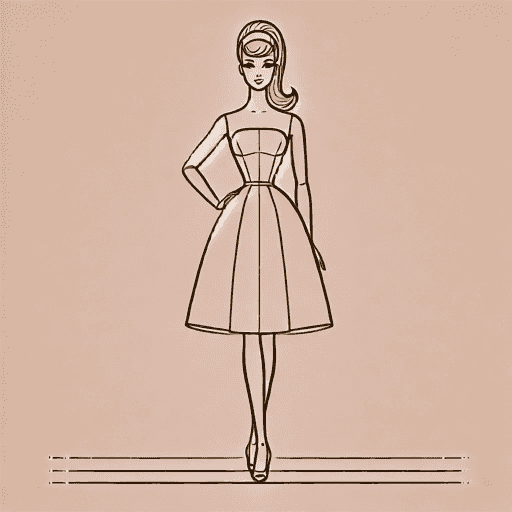
Let's Call Her Barbie
64 pages • 2-hour read
Renée RosenLet's Call Her Barbie
A modern alternative to SparkNotes and CliffsNotes, SuperSummary offers high-quality Study Guides with detailed chapter summaries and analysis of major themes, characters, and more.
Important Quotes
Content Warning: This section of the guide contains discussions of mental illness, disordered eating, illness, sexual harassment, gender discrimination, and religious discrimination.
“‘If you hand a little girl a baby doll, she’s going to make believe she’s a mommy. But if you hand her something like this’—she holds up Bild Lilli—‘she can pretend she’s a young independent woman.’”
(Part 1, Chapter 1, Page 7)
In her initial pitch, Ruth employs a rhetorical contrast to articulate her innovative vision for the toy market and establish the theme of Influencing Female Identity Through Play and Toys. By juxtaposing the domestic limitations of playing “mommy” with the imaginative freedom offered by an adult doll, she reframes the sexualized adult product as a tool for young female empowerment, introducing the symbol of the Bild Lilli doll.
“Don’t you see? The clothes are like razor blades. […] Trust me, the real money is not in the doll. It’s going to be in her wardrobe.”
(Part 1, Chapter 2, Page 22)
Ruth’s “razor and blades” simile reveals her business acumen, a core element of her characterization and the theme of Female Vision and Success in a Male-Dominated Industry. This statement demonstrates that her vision is strategically commercial, foreseeing a model where the doll serves as a platform for continuous consumerism. By identifying the wardrobe as the primary profit driver, she establishes the economic foundation that will transform a simple toy into a global brand, but also articulates an aspect of it that will create controversy and criticism.
“But I know what happens when two people collaborate on a project. There’s a bond that no one else can penetrate. […] It’s like a private club that no one else can join.”
(Part 1, Chapter 5, Page 44)
Speaking to Ruth about her partnership with Jack, Elliot uses the simile of a “private club” to articulate the personal cost of intense creative collaboration, highlighting the theme of The Personal Costs of Professional Commitment. The word “penetrate” suggests that his feelings of exclusion and envy are underpinned by sexual jealousy or insecurity. Although Elliot is generally very supportive of Ruth’s career, this quote shows that his expectations on her presence as a wife can still place her under pressure.
“[Y]ou both have some pretty important people in your lives named Barbara. You could call it the Barbara doll. Or the Babs doll. Or hey, even better—what about Barbie?”
(Part 1, Chapter 6, Page 51)
This passage is the narrative’s turning point for the doll’s branding, resolving a creative roadblock for Ruth and Jack. The suggestion to name the doll “Barbie” merges the commercial product with the creators’ personal lives, establishing a direct link that foreshadows future familial and identity conflict. This moment of collaborative inspiration solidifies the doll’s identity and marks Elliot’s official entry into the project, altering the core team’s dynamic.
“Like the mother of a newborn, she checks the doll, examining her closely. She has ten fingers, ten toes.”
(Part 1, Chapter 7, Page 56)
Receiving the first prototype, Ruth’s inspection is described with a simile that equates her creation of the doll with childbirth, highlighting the depth of her emotional investment and blurring the lines between a manufactured product and a living being in a way which echoes Ruth’s own use of animate language for the doll. The specific detail of counting “ten fingers, ten toes” reinforces this maternal connection, suggesting the doll has become a surrogate for the family she is neglecting, a key aspect of the theme the personal costs of professional commitment.
“Be useful, be helpful and they’ll keep you around.”
(Part 1, Chapter 10, Page 81)
This sentence, presented as an internal maxim, reveals the core psychological motivation behind Ruth’s ambition. The thought stems from the childhood trauma of being given away by her mother, framing her work ethic as a deep-seated survival mechanism. This phrase functions as a thesis for her character and a justification of her choices, demonstrating how a fear of being disposable fuels her need to prove her value.
“Ruth wants—well, she wants Barbara to be more like Barbie. My goodness. This is an epiphany, a branch of lightning already beginning to vanish as quickly as it’s appeared.”
(Part 1, Chapter 10, Page 89)
Following an argument with her daughter, Ruth experiences a moment of self-awareness, recognizing the doll has become an idealized surrogate for the child she feels she is failing. The metaphor of a “branch of lightning” emphasizes the pain and danger of this realization, which exposes a fault line in Ruth’s perception of her daughter. This passage is central to the theme of the personal costs of professional commitment, showing how Ruth’s professional ambitions reflect her personal and maternal frustrations.
“All we have to do is convince the mothers that Barbie will help their daughters catch a husband.”
(Part 1, Chapter 12, Page 110)
Spoken by marketing psychologist Ernest Dichter, this line marks a cynical turn in strategy after market research reveals mothers’ disapproval of the doll. It directly addresses the theme of influencing female identity through play and toys, demonstrating how Barbie’s original meaning is deliberately manipulated to align with conservative social values for commercial gain. This strategy creates friction for Ruth, as the doll she conceived to inspire independence is ultimately marketed as a tool teaching girls to conform to traditional expectations.
“‘I’m sorry, Ruth,’ he says, shaking his head. ‘I can’t see this on our shelves. It’s not for little girls. That doll has a woman’s figure. If you don’t mind me saying, it strikes me as indecent.’”
(Part 1, Chapter 17, Page 140)
The head buyer for Sears delivers this verdict at the New York Toy Fair, articulating a widespread source of resistance to Barbie. His judgment that the doll is “indecent” because of her “woman’s figure” highlights the breasts motif as the physical embodiment of a social taboo. The quote illustrates the theme of female vision and success in a male-dominated industry, as Ruth’s vision is dismissed as inappropriate by the male gatekeepers of the toy world, setting up her vindication and success when Barbie sells.
“Didn’t you hear the phones out there? They haven’t stopped ringing all day. Ruthie, my love, we can’t fill the Barbie orders as fast as they’re coming in.”
(Part 1, Chapter 19, Page 156)
This dialogue from Elliot marks a turning point and reversal of fortune after the Toy Fair. The success, conveyed through the auditory imagery of ceaselessly ringing phones, serves as validation for Ruth’s decision to air television commercials. This moment proves the efficacy of her strategy to market directly to children, circumventing the objections of parents and industry buyers. Elliot’s affectionate diction of “Ruthie, my love,” cements his role as the supporter of his wife’s professional success.
“‘The guy’s gotta have a schmekel,’ says Ruth. […] ‘Look,’ he says, ‘obviously we need to address the groin area. But why can’t we do it the same way we did for Barbie? We can allude to it.’ ‘Fine,’ says Ruth. ‘Allude. I’m not asking for a set of balls here.’”
(Part 2, Chapter 21, Pages 171-172)
In a discussion about the Ken doll prototype, this exchange mirrors the earlier conflict over Barbie’s anatomy, reinforcing how the dolls’ bodies challenge cultural taboos. The decision to “allude” to genitalia reveals the balance Mattel must strike between representation and mid-century propriety, underscoring the manufactured nature of the dolls’ bodies. Ruth’s blunt dialogue contrasts with the quieter, euphemistic discomfort of her male colleagues, highlighting her confrontational style.
“Until Barbie, Ruth had forgotten what a goddamn big deal breasts are—for little girls, big girls, for mothers, for men. They are the ultimate symbol of femininity, a source of female power and even sustenance for a newborn.”
(Part 2, Chapter 23, Page 182)
This internal monologue occurs after Ruth discovers a lump in her breast, directly connecting the breasts motif to her personal health crisis. The passage makes the doll’s most controversial feature explicit as a representation of womanhood, power, and vulnerability. This reflection explores how Barbie’s manufactured femininity intersects with real-world female identity and mortality, a central concern of the theme the personal costs of professional commitment.
“‘This wall’—he knocked against the stone, creating a hollow reverberation—‘it’s not real.’ […] ‘I’m working with a Hollywood set designer. All the archways and turrets, even the drawbridge, are made out of prop materials. They look real but they’re not, and they’re saving me a ton of dough.’”
(Part 2, Chapter 24, Page 191)
Here, Jack reveals the artificiality of his mansion, establishing the Castle as a symbol of his internal state. The “hollow reverberation” and use of “prop materials” function as a metaphor for Jack’s own life. This moment characterizes Jack as a man who engineers his personal life with the same artifice he applies to toy design, blurring the line between creative genius and personal deception.
“It’s not until she gets bangs, lightens her hair yet again and starts wearing it pulled back in a high ponytail that it dawns on everyone, including Jack, that Ginger is trying to look like Barbie.”
(Part 2, Chapter 30, Page 227)
This third-person narration reveals the culmination of Ginger’s physical transformation. The passage employs dramatic irony, as the reader has likely recognized Ginger’s goal before the characters express this. This sentence marks a turning point in the theme of influencing female identity through play and toys, demonstrating the destructive potential of the Barbie ideal when a real woman attempts to embody its artificial standards.
“I don’t want little girls to think conventionally and see themselves as just wives and mothers. That’s what baby dolls are for. Not Barbie.”
(Part 2, Chapter 32, Page 234)
Responding to pressure to create a maternal storyline for Barbie, Ruth delivers a statement of purpose that encapsulates her core vision. This quote frames the doll as an alternative to the domestic play patterns offered by traditional “baby dolls,” providing a concise thesis for the theme of influencing female identity through play and toys, defining Barbie’s brand identity as emphatically not a wife and a mother. This sets up the novel’s compilation of Ruth’s continued rejection of these possible identities as Barbie is almost exhaustively reiterated.
“She’s not the problem. You’re blaming Barbie because it’s easier than taking on the real culprits—society, the government, the men in our lives.”
(Part 3, Chapter 36, Page 256)
Speaking at a feminist consciousness-raising session, Barbie designer Stevie defends the doll against accusations that it is a “dangerous role model.” This quote encapsulates one of the novel’s central tensions, positioning Barbie as a scapegoat for larger, systemic issues of misogyny. Through Stevie’s dialogue, the text explores the doll’s complex legacy, suggesting it is not the object itself but the societal context it occupies that is the source of female oppression.
“The idea of ownership has never factored in before. Yes, she owns Mattel, but who owns Barbie?”
(Part 3, Chapter 37, Page 259)
This moment of internal monologue occurs after Ruth reads a New York Times article crediting Jack Ryan as Barbie’s sole creator. Her rhetorical question marks a significant psychological shift for Ruth, reframing her creation from a collaborative success to a persona and reputational legacy that must be defended. This shift in perspective transforms her professional partnership with Jack into a rivalry, triggering their increasing conflict over recognition and intellectual property.
“But when the caption comes up on the TV screen, what they—and everyone else—see instead is Creator of the Barbie Doll. Ruth may have forgiven Jack twice before for claiming he invented Barbie, but announcing it on national TV is too much. She’ll be damned if she’s going to let him erase her from the equation.”
(Part 3, Chapter 40, Page 273)
This passage marks the irreparable fracture in Ruth and Jack’s relationship after he appears on the television show What’s My Line? The phrase “erase her from the equation” reveals her perception of the conflict as an existential threat against her identity and historical contribution. By making his claim on a national stage, Jack transforms a private tension into a public insult, an act Ruth perceives as the ultimate betrayal.
“God, how can something so terrible for her make her feel so much better? It’s just one cigarette. One cigarette doesn’t mean she’s going back to smoking.”
(Part 3, Chapter 41, Page 279)
After discovering Mattel has been overpaying Jack in royalties, Ruth breaks her hiatus from smoking. The act symbolizes her loss of control as stress drives her back to a self-destructive habit, intersecting with the theme of the personal costs of professional commitment. Her rationalization parallels the small compromises that have led to her company’s precarious situation, representing a retreat from discipline in the face of stress.
“‘I’ll give you three.’ Rosenberg starts counting off on his stubby fingers: ‘First, you’re a woman. Second, you’re Jewish—’ […] ‘Third,’ he says, […] ‘you don’t have the right temperament. You talk like a drunken sailor.’”
(Part 3, Chapter 44, Page 294)
Executive Seymour Rosenberg uses this blunt, tripartite justification to remove Ruth from delivering the annual stockholder’s report. The dialogue reveals Rosenberg’s role as the novel’s hidden antagonist, personifying the prejudice that Ruth faces even within her own company. The passage demonstrates the irony that the traits that enabled Ruth to build her empire are now being used to strip her of power and claim her success.
“He’s said so himself: If Barbie were real, she’d be the perfect woman. Ginger’s trying her best. People say she looks like Barbie, but Jack only tells her she’s getting too thin. But she knows for a fact that Jack likes thin women, and if she could just break 110—the number on Barbie’s scale, a number she’s given magical powers to—then maybe he would look at her the way he looks at other women […] but never her.”
(Part 4, Chapter 45, Page 301)
In this moment of third-person limited narration from Ginger’s perspective, the text explores the dangerous consequences of the theme of influencing female identity through play and toys. The analysis of Ginger’s thoughts reveals how the idealized, manufactured femininity of the doll has become a destructive, real-world goal. The specific detail of “110—the number on Barbie’s scale” provides concrete evidence of how the doll’s accessories create and enforce arbitrary and unrealistic beauty standards.
“I know I wasn’t a great mother when you kids were growing up, but I did the best I could. […] You’re much better at this than I ever was. I don’t know how you turned out to be so good at motherhood, because you certainly didn’t get it from me.”
(Part 4, Chapter 46, Page 308)
During her recovery from a mastectomy, Ruth has a moment of vulnerable connection with her daughter, Barbara. This quote is a direct confession of the consequences explored in the theme of the personal costs of professional commitment, as Ruth acknowledges that her professional ambition came at the cost of her maternal role. The dialogue reveals her deep-seated insecurities about motherhood, linking her perceived failures to her own mother’s abandonment and highlighting the generational impact of her choices.
“Who is she now, sitting back in meetings, letting everyone else run the show? She’s lost her edge along with her breast. She never would have backed down in a boardroom before. No one would even think to call her Ruthless anymore.”
(Part 4, Chapter 48, Page 320)
Following a confrontation with Seymour Rosenberg, Ruth reflects on her diminished power within the company she built. This internal monologue connects Ruth’s physical loss directly to her professional identity, employing the recurring breasts symbol to explore her sense of lost femininity and corporate authority. The wordplay on her nickname, “Ruthless”’ underscores her transformation from a formidable executive to a marginalized figure, illustrating the fragility of female power in a patriarchal environment. It also acts as an ironic double pun, as the name “Ruth” means regret, loss or grief, which encapsulates her feelings at this moment.
“The problem isn’t Barbie’s feet. It isn’t Barbie at all. It’s society. […] Like it or not, guys, women are fed up. They’re lashing out because they’re sick and tired of—”
(Part 4, Chapter 51, Page 346)
In a meeting to address Barbie’s declining sales amid feminist protests, Stevie attempts to explain the cultural context to her male colleagues. Stevie’s dialogue functions as a commentary on the doll’s role as a cultural lightning rod, arguing that Barbie is a symbol onto which broader frustrations about gender inequality are projected. As a young woman in a man’s world, Stevie can see the argument from both sides, making her a natural mediator. This moment articulates a central tension of the novel: whether Barbie is a tool of oppression or a flawed model of progressive ideals in a divided society.
“This isn’t the company that hired you. This isn’t the Mattel I created. And for that, I’m sorry. […] You’re smart and you’re talented. Do what you need to do. Look out for yourself. Don’t go down with the ship.”
(Part 4, Chapter 57, Pages 379-380)
In her final conversation with Stevie, a demoralized Ruth acknowledges the corruption of her original vision for Mattel. Ruth’s apology and advice represent the transfer of a generational torch from a pioneering female leader to her successor. The metaphor “Don’t go down with the ship” signifies Ruth’s recognition that the institution she built has become unsalvageable, and her encouragement for Stevie to “Look out for yourself” is a final, maternal message that prioritizes the individual woman’s future over the failing company.

Unlock every key quote and its meaning
Get 25 quotes with page numbers and clear analysis to help you reference, write, and discuss with confidence.
- Cite quotes accurately with exact page numbers
- Understand what each quote really means
- Strengthen your analysis in essays or discussions