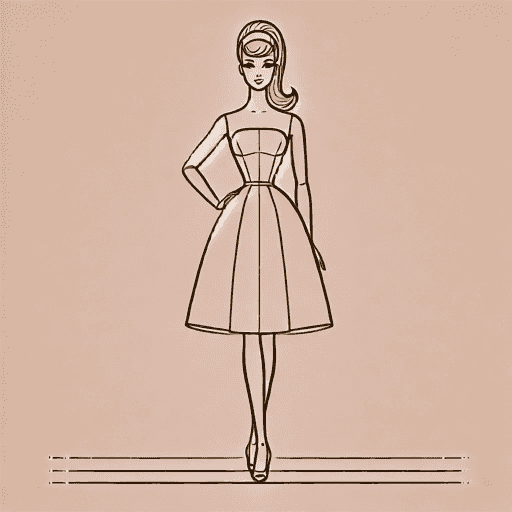
Let's Call Her Barbie
64 pages • 2-hour read
Renée RosenLet's Call Her Barbie
A modern alternative to SparkNotes and CliffsNotes, SuperSummary offers high-quality Study Guides with detailed chapter summaries and analysis of major themes, characters, and more.
Part 3Chapter Summaries & Analyses
Content Warning: This section of the guide contains discussions of mental illness, disordered eating, substance use, illness and death, cursing, sexual content, antigay bias, rape, pregnancy termination, gender discrimination, racism, and religious discrimination.
Part 3: “Buckle Up”
Part 3, Chapter 36 Summary: “Anatomically Impossible”
In 1968, Stevie accompanies Vivian to her first feminist consciousness-raising session at a Silver Lake bungalow. About 15 women share intimate stories about terminating pregnancies, rape, workplace discrimination, and domestic entrapment. Stevie connects with the group and shares her fears of repeating her own mother’s mistakes.
The conversation shifts to Barbie. One woman declares the doll embodies everything the movement opposes. Another criticizes Barbie’s “anatomically impossible” body. The group brings up the controversial diet book included with Barbie’s “Slumber Party” ensemble, which said “Don’t Eat” on the back. Stevie recalls her role in creating that product and feels defensive about the doll and her colleagues. Stevie gets angry at the group, arguing that Barbie is a plastic toy and accusing them of misdirecting anger at a doll instead of confronting society, government, and men. Her outburst redirects the discussion toward addressing actual chauvinism.
Part 3, Chapter 37 Summary: “The Happiness Maker Is Back”
Ruth, Elliot, and Jack prepare to present at a Goldman Sachs conference in New York. Jack arrives early hoping to meet Sheila, an old girlfriend, but she brings a New York Times reporter. Jack humbly credits Ruth and the Mattel team for Barbie’s success and promotes the new Christie doll, a Black doll which aims to reflect typical Black physical characteristics. This project followed the failure of the earlier Francie doll, which had simply used darker plastic in Barbie’s white-normative molds.
The next day, Ruth discovers a headline proclaiming Jack as “the brains behind Barbie” (259). The article credits him as the doll’s “sole creator,” even stating Barbie is named after his wife. Ruth feels her legitimacy has been stolen. She confronts Jack in his hotel room, but he claims the reporter twisted his words. Ruth storms out.
Unable to read the article due to his dyslexia, Jack feels stupid and ashamed. He skips the conference reception and goes to the hotel lounge, where he meets Shelley, a young woman upset after seeing her ex with someone new. Jack takes her to dinner and back to his room, focusing entirely on her pleasure. Satisfying her restores his sense of power and control.
Part 3, Chapter 38 Summary: “The Difference Between the Men and the Boys”
In 1969, UCLA students transform Jack’s Castle mansion into a medieval setting for a Tom Jones party. Guests arrive in costume, including Stevie, Patsy, and celebrities, including “starlet” Zsa Zsa Gabor. Jack seats Zsa Zsa on a throne and they exchange interested glances. Jack announces there is no silverware, forcing everyone to eat greasy lamb with their hands. After dinner, Jack drives everyone in a 1935 fire truck down Sunset Boulevard to the Pandora’s Box nightclub. A Life reporter takes notes and photographs throughout. At closing time, only Jack, Zsa Zsa, and the reporter remain. During the ride back, the reporter asks Jack if he invented the Barbie doll.
Part 3, Chapter 39 Summary: “Executives and Pishers”
Three months later, Ruth and Elliot attend their standing poker game friends who became rich after investing in Mattel shares. The friends press Ruth on Jack’s reported claims that he invented Barbie, despite Ruth and Elliot’s attempts to change the subject. Although Ruth is angry with Jack, she finds it difficult to stay mad because Jack is extraordinarily talented: He did create Twist ‘n Turn Barbie, Talking Barbie, Living Barbie, and co-developed Hot Wheels with Elliot. The conversation turns to Mattel’s stock, now at $48.50 per share and the friends toast Ruth, Elliot, and Mattel’s success.
Part 3, Chapter 40 Summary: “What’s My Line?”
Jack appears as a contestant on What’s My Line?, with Mattel funding the trip. At Studio 50, a producer confirms his occupation will be listed as Toymaker for Mattel, but Jack impulsively asks for a change. The Mattel staff watches the broadcast from Los Angeles: When host John Daly introduces Jack, the on-screen caption reads “Creator of the Barbie Doll” (274). Ruth is enraged, seeing this as the third public betrayal.
When Jack returns, Ruth furiously confronts him. He defends the move as good publicity and claims he is one of Barbie’s creators. Their relationship becomes openly hostile, damaging company morale.
Stevie worries about Jack’s deteriorating state, including his drinking. He cannot remember attending his own party and woke with two unknown women in his bed. He breaks down sobbing in Stevie’s arms, asking if she still finds him sexy. She avoids answering, noticing his exhaustion, bloating, and badly-dyed hair.
Part 3, Chapter 41 Summary: “Look, Just Look”
Ruth has been smoke-free for three and a half months thanks to hypnosis. After a Look magazine reporter mentions Jack’s royalty payments, Ruth retrieves Jack’s 1955 contract and discovers he receives 1.5% royalties on any product he develops, whether patented or not. She calculates he has earned over $1 million annually in recent years (equivalent to approximately $10 million today).
Furious, Ruth drives to a store, buys cigarettes, and smokes one in her Rolls-Royce. She returns to Mattel and shows Elliot the totals. He is stunned but argues they have a contract and Jack is worth the cost. Ruth insists they cannot continue paying him that much. They consult Seymour Rosenberg, who proposes phasing Jack out by hiring other engineers to redesign his products, working around his patents to eliminate future royalties. Elliot is reluctant, fearing Jack will leave or sue. Ruth frames it as a necessary business decision and convinces Elliot to proceed. As they finish, Elliot notices Ruth smells of smoke.
Part 3, Chapter 42 Summary: “The Two Jacks”
Stevie and Jack discuss the negative changes at Mattel since Rosenberg’s arrival, who has taken over Jack’s staff meetings and stifles creativity. The next day, Rosenberg introduces Jack Barcus, announcing a second design group to compete with Jack Ryan’s team.
Jack feels ambushed and storms into Elliot’s office, where Ruth is present. They explain the company is expanding and needs more manpower. Jack feels betrayed and storms out. Elliot takes antacid and blames Rosenberg for mishandling the situation. Ruth feels dread.
Part 3, Chapter 43 Summary: “Who’s Pulling the Strings?”
Despite the plan to phase him out, Jack secures major patents for Living Barbie’s joints, Twist ‘n Turn Barbie’s movable waist, and Talking Barbie’s voice box. Jack Barcus repeatedly presents inferior ideas like Blinking Barbie and Flexing Barbie, which Ruth dismisses. Jack Ryan undermines Barcus by taking his team to an expensive lunch, leaving them too drunk to work.
Ruth tells Rosenberg the plan is backfiring: Jack’s sabotage costs Mattel productivity, and Living Barbie’s success increases his royalties. Jack experiences insomnia and paranoia, convinced Rosenberg has poisoned Ruth against him. When his therapist reminds Jack of his repeated public claims to have invented Barbie, his paranoia escalates to fears of being poisoned or his car being sabotaged. He copes by swimming and smoking marijuana with students.
After three sleepless nights, Jack is called to a meeting and informed that Sears reports Talking Barbie dolls are overheating and melting due to the cheaper plastic he chose. Humiliated, Jack arranges an Esquire interview at his mansion, and again claims he invented Barbie.
Part 3, Chapter 44 Summary: “A Change of Plans”
The day before Mattel’s annual stockholder meeting, Ruth learns her daughter Barbara is divorcing. Ruth prepares her speech highlighting the company’s growth to over $100 million in sales. Rosenberg summons Ruth and Elliot to lunch and announces Ruth will not attend the New York meeting. Rosenberg will deliver the year-end review instead, having already discussed it with the board behind their backs.
Rosenberg tells Ruth she cannot be the face of Mattel because Wall Street is uncomfortable with her. He gives three reasons: She is a woman, she is Jewish, and she has the wrong temperament. Ruth explodes and storms out. Elliot follows and explains she cannot fire Rosenberg because Wall Street’s confidence in Mattel depends on him. The board, not them, now makes these decisions.
Back at Mattel, Ruth walks through the newly expanded offices, feeling disoriented among unfamiliar faces. She experiences chest tightness, sweating, and nausea as she realizes she has lost control of the company she built.
Part 3 Analysis
These chapters detail the fracturing of the creative partnership between Ruth Handler and Jack Ryan, examining how the battle for control over Barbie’s public narrative precipitates a loss of control within Mattel itself. The theme of Influencing Female Identity Through Play and Toys is increasingly explored through the contested story of its origin. Jack’s repeated and escalating public claims of being Barbie’s sole creator represent an—apparently subconscious—campaign to seize ownership of the icon’s legacy, driven by his need for external validation. Only his final interview with Esquire, in which he dismisses his employers by “referring to Ruth and Elliot only as ‘the Couple’” (292), is a deliberate act of revisionist history, precipitated by the final breakdown of the old allies’ relationship. The novels presents this conflict as more than a workplace dispute, using it to illustrate how the reputational baggage around a cultural product can become as crucial and carefully constructed as the object itself. The struggle for recognition is a struggle for power, revealing that the “creator” of an icon can wield immense cultural capital, a reality Jack pursues to the point of self-destruction. The novel reveals Ruth’s growing fury at this injustice to be partly driven by her experience of erasure as a woman when she threatens to “cut the balls off” Jack (274), a statement which places their conflict in gendered terms, seeking to reassert her authority through metaphorical emasculation.
The increasingly hostile dynamic between Ruth and Jack positions them as tragic accidental antagonists. By showing them each driven by contrasting personal insecurities, the novel presents both in a sympathetic light, increasing the pathos of their relationship’s decline. Jack’s extravagant persona and credit-seeking behavior are presented as primarily responses to his dyslexia and mental illness. The scene of confrontation between Ruth and Jack in Chapter 37, in which he is unable to read the newspaper misreporting his words, act to link his disability directly to the question of Barbie’s ownership, and to emphasize his hidden vulnerability. Throughout this section, Jack’s damaged sense of self-worth requires increasingly risky reinforcement through wild behavior, alcohol, sexual conquests, and public accolades. Ruth is at first characterized by forgiveness, finding it hard to remain angry with Jack. However, his appearance on What’s My Line? proves to be an unforgivable offense, shifting their codependent professional relationship into open warfare. This schism marks a critical juncture in the theme of The Personal Costs of Professional Commitment, as the creative energy that once built an empire is redirected toward mutual destruction.
From this personal conflict, the narrative broadens to a systemic critique of corporate misogyny, articulating the theme of Female Vision and Success in a Male-Dominated Industry. Seymour Rosenberg emerges as the embodiment of the antagonistic institutional—and patriarchal—forces aligned against Ruth. Whereas Jack’s challenge to Ruth’s authority are framed in understandable, personal terms, revealed by Jack’s intimate inner monologue, Rosenberg’s actions appear to be motivated by a greed for power. He methodically dismantles Ruth’s power, culminating in the decision to remove her from the annual stockholder’s meeting. The reasons he provides—that Wall Street is uncomfortable with her because she is a woman, Jewish, and possesses the “wrong temperament”—are a blunt articulation of the sexist and antisemitic barriers that she has worked to overcome in her career. Ruth’s subsequent realization that she has lost control, having “sold out Mattel to Wall Street” (296), signifies the victory of a patriarchal corporate structure over her feminist, entrepreneurial vision, signifying the book’s crisis point. Although Ruth is presented as a victim of this system, her recognition that she has “sold out Mattel” echoes the narrative’s suggestion that she also sold out herself, when she mistakenly welcomed Rosenberg to punish Jack. In this way, Ruth’s character arc follows the hubristic pattern of the tragic hero, an ironically masculine model which chimes with the novel’s patterning of gendered roles.
The novel uses the internal politics of Mattel to explore the broader cultural debates of the late 1960s. The consciousness-raising session, where feminists decry Barbie as an “anatomical impossibility” (255) and a tool of patriarchal oppression, contrasts with discussions inside the company, including the necessities of commercial design. Stevie’s impassioned defense—that their anger is misdirected at a plastic toy instead of the real structures of power—prefigures the collapse of Ruth’s position as a female leader, another example of Stevie’s fictional malleability within the narrative. The subsequent chapters illustrate the very chauvinism she alludes to, as Ruth is systematically marginalized by her male colleagues. This section also engages with the racial controversy around Barbie in the 1960s, when public outcry surrounded Mattel’s disastrous launch of the Francie doll, which was intended to create a Black friend for Barbie, but which merely used darker plastic in the Barbie mold based on idealized white characteristics. The novel highlights how, in contrast to the progressive female-led Barbie team at Mattel and mixed debate over gendered roles and aims, racial segregation and lack of workplace inclusion led Mattel to create a highly-offensive doll which reflected and perpetuated the marginalization of Black people in America.

Unlock all 64 pages of this Study Guide
Get in-depth, chapter-by-chapter summaries and analysis from our literary experts.
- Grasp challenging concepts with clear, comprehensive explanations
- Revisit key plot points and ideas without rereading the book
- Share impressive insights in classes and book clubs