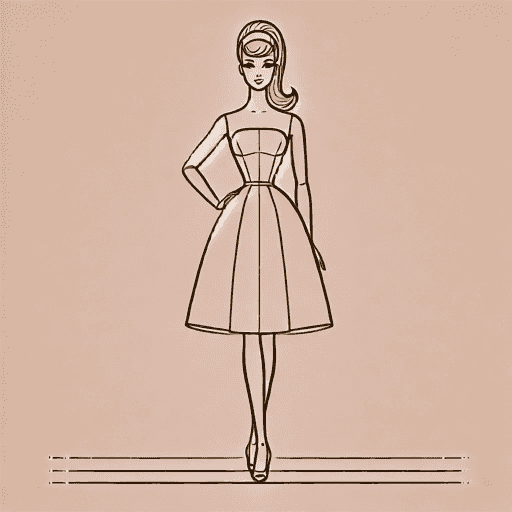
Let's Call Her Barbie
64 pages • 2-hour read
Renée RosenLet's Call Her Barbie
A modern alternative to SparkNotes and CliffsNotes, SuperSummary offers high-quality Study Guides with detailed chapter summaries and analysis of major themes, characters, and more.
Summary and Study Guide
Overview
Renée Rosen’s 2025 novel Let’s Call Her Barbie is a work of historical fiction that dramatizes the creation of the world’s most iconic doll. Rosen is a USA Today bestselling author known for biographical novels about influential American women, including Fifth Avenue Glamour Girl (2023), which chronicles the life of Estée Lauder. Let’s Call Her Barbie follows Mattel co-founder Ruth Handler as she attempts to revolutionize the 1950s toy market by creating a doll with an adult figure, designed to inspire girls to imagine futures beyond motherhood. Met with resistance from her all-male colleagues, Ruth forges a contentious but brilliant partnership with engineer Jack Ryan to bring her vision to life. In development long before the release of the 2023 Barbie movie but gaining publicity as a result of it, the novel reflects Rosen’s interest in the lives of historical female trailblazers and their relevance to present-day culture.
Spanning several decades, the narrative explores the personal and professional struggles behind the creation and success of Barbie. The novel examines themes of Female Vision and Success in a Male-Dominated Industry, as Ruth battles sexism and corporate politics to maintain control of her creation. It also delves into The Personal Costs of Professional Commitment, revealing the immense toll the project takes on the creators’ family relationships and mental health. Finally, the novel investigates the theme of Influencing Female Identity Through Play and Toys, detailing how the Mattel team consciously crafted not just a toy, but an idealized lifestyle that would shape the dreams and identities of a generation.
This guide refers to the 2025 Berkley edition.
Content Warning: The source text and this guide contain depictions of mental illness, disordered eating, death by suicide, substance use, illness and death, cursing, sexual content, pregnancy loss or termination, rape, sexual violence and harassment, gender discrimination, bullying, antigay bias, racism and religious discrimination.
Language Note: This guide uses the term “Black” to refer to people who are described as “Negro” in the source text. Rosen uses this term in passages portraying the direct speech or thoughts of characters, to accurately reflect the diction used at the time of the novel’s historical setting
Summary
In 1956, Mattel co-founder Ruth Handler returns to Los Angeles from a trip to Switzerland with a German doll named Bild Lilli. She presents the doll to her husband and business partner, Elliot, and the company’s all-male research and development team, led by engineer Jack Ryan, vice president of research and development. The men dismiss the doll, with its adult figure and breasts, as a “hooker” and inappropriate for children. Ruth argues that a grown-up doll would inspire girls to imagine futures beyond motherhood, but Jack rejects the idea, citing high production costs. Undeterred, Ruth challenges Jack to take the doll with him on an upcoming business trip to Japan to find a manufacturer.
Jack finds a Japanese manufacturer, Kokusai Boeki Kaisha (KBK), willing to produce the doll. Ruth hires fashion designer Charlotte Johnson to create a sophisticated toy wardrobe, explaining an up-sell business model, where the real profit will come from selling outfits separately. This core team of Ruth, Jack, and Charlotte begin the intensive design process. Jack, who is dyslexic, relies on his secretary, Ginger, to read documents aloud to him, without explaining why. He attends a meeting with his psychiatrist to discuss his marriage and difficulties staying faithful to his wife, Barbara. Ruth’s long hours at the office strain her relationship with her teenaged children, Ken and Barbara, and she reflects on how her difficult relationship with her own mother shaped her relentless work ethic.
The project faces numerous setbacks between 1957 and 1959. The first prototypes from KBK do not fit the brief, featuring Japanese facial features, non-compliant plastic, and nipples, which Jack tries to file off. At home, Elliot confronts Ruth about her commitment to work and expresses jealousy over her close partnership with Jack. The team worried about a forthcoming rival Miss Revlon Doll and are relieved to discover it is traditional baby-style doll. Elliot suggests naming their doll “Barbie” as a tribute to his daughter, Barbara, and Jack’s wife, who shares the same name. He officially joins the project. In 1958, a perfect prototype arrives, but Mattel’s general counsel, Henry Pursell, warns them that they have failed to secure a licensing agreement with Bild Lilli’s creator.
To handle the growing workload, Ruth hires Stevie Klein, a talented former student of Charlotte’s who is working as a waitress. Initially skeptical, Stevie accepts the job, seeing it as a steppingstone to a career in “real” fashion. She struggles with the challenges of designing in one-sixth scale. Her first encounter with Jack is tense but her perception of him changes after her coworker, Patsy, reveals she once had an affair with him. Ruth’s relationship with her daughter deteriorates; when Ruth accidentally calls Barbara “Barbie,” she realizes she views the doll as an idealized version of her daughter. Production is threatened when Jack announces the Japanese factory will shut down for the rice harvest, until Elliot negotiates a solution involving overtime shifts. Ruth hires marketing psychologist Ernest Dichter to conduct focus groups to test the doll’s appeal. The studies reveal that, while young girls are captivated by Barbie, their mothers are appalled by her mature figure. Dichter advises marketing the doll to mothers as a tool that will teach their daughters the grooming and style needed to attract a husband. Based on this strategy, Stevie designs a wedding dress for the doll’s launch. The shoot for the television commercial is nearly a disaster when studio lights overheat the dolls, until Ruth puts them on ice between takes.
Despite these efforts, the New York Toy Fair launch in March 1959 is a failure. Buyers universally reject Barbie as indecent. Devastated but defiant, Ruth overrules Elliot’s decision to cancel the expensive TV ad campaign, insisting they run it as a last resort. Following the disastrous launch, morale at Mattel plummets, and Jack sinks into a deep depression. At first, the Barbie television commercial, which airs during The Mickey Mouse Club, appears to have no impact. Ruth struggles with a sense of professional failure while hosting her daughter, Barbara’s, wedding. When she returns to the office after the wedding, Ruth is met with a celebration: The phones are ringing nonstop with orders. The advertisement, which targeted children directly, has created a consumer frenzy. Barbie becomes an overnight sensation.
From 1960 to 1963, Mattel’s success grows rapidly. Jack becomes wealthy from his royalty agreement and purchases a Tudor mansion in Bel Air he calls “the Castle.” Stevie receives a significant raise. Inspired by a fan letter, Ruth proposes a boyfriend for Barbie, the Ken doll, named after her son. Barbara is horrified by the idea of a doll version of herself “dating” a doll version of her brother. In 1961, Louis Marx and Company, the new licensee for Bild Lilli, sues Mattel for copyright infringement, and Mattel countersues. While working late one night, Stevie and Jack begin a sexual affair. The Ken doll is a commercial success, but the real Ken is bullied at school because of it, exacerbating his unhappiness at feeling unable to come out as a gay man. In 1963, Mattel becomes a public company and Ruth experiences structural sexism as the female head of a New York Stock Exchange (NYSE) business.
Stevie and Jack’s affair ends, though they remain close friends. In 1968, Stevie attends a consciousness-raising meeting where feminists attack Barbie’s “anatomically impossible” body, and she finds herself defending the doll. Mattel releases the Christie doll, a thoughtfully-designed Black doll with unique molds, learning lessons from a poorly-executed attempt to create a Black doll named Francie. Jack gives an interview to The New York Times in which he credits himself as Barbie’s sole creator, creating a deep rift with Ruth.
In 1969, Jack’s hedonistic lifestyle is profiled in Life magazine, where he again takes credit for inventing Barbie. When, in 1970, Jack appears on the television show What’s My Line? and his occupation is listed as “Creator of the Barbie Doll” his professional relationship with Ruth becomes openly hostile (274). That same year, Ruth is diagnosed with breast cancer and undergoes an emergency mastectomy. During her recovery, she bonds with Barbara but is hurt when Ken reveals his children do not play with Barbies. In 1971, after a reporter questions her about Jack’s royalties, Ruth discovers that a vaguely worded clause in his contract has resulted in Mattel overpaying him by millions of dollars. Around the same time, Stevie begins a relationship with Simon Richards, a lawyer in Mattel’s legal department.
Ruth feels weakened and marginalized at work after her surgery and restructures Jack’s contract on its renewal, drastically cutting his royalties. Enraged, Jack signs this new agreement. He has sex with his secretary, Ginger, something that he has promised himself—and his wife—he would not do. Ginger has been using diet pills and undergoing cosmetic procedures in an effort to look like Barbie.
In 1973, Mattel’s financial situation worsens after a factory fire and a dockworkers’ strike. Vice President Rosenberg devises a fraudulent scheme based on an illegal “bill and hold” strategy where cancelable orders are booked as final revenue. Patsy from the accounting department acts as a whistleblower, revealing the fraud to Simon. Ruth is forced to step down as president, demoting her to co-chair where she is excluded from key meetings. Ginger dies of a heart attack caused by her extreme dieting. Jack sues Mattel for $25 million in lost royalties. Ruth fires him. In 1975, the new male leadership introduces “Growing Up Skipper,” a doll that grows breasts when its arm is twisted. Horrified and disillusioned, Stevie resigns from Mattel and is offered a job by her former classmate, the now-famous designer Bob Mackie.
In 1975, while being fitted for a new prosthetic breast, Ruth collaborates with her prosthetist, Peyton Massey, on a more realistic and comfortable design. This experience inspires her to start a new company, Nearly Me, to mass-produce prosthetic breasts for mastectomy survivors. Ruth pitches her new product line to Neiman Marcus in 1976.
A final section summarizes the characters’ later lives. Ruth and Seymour Rosenberg are convicted of financial fraud but Ruth finds immense success with Nearly Me. Jack settles his lawsuit with Mattel but later ends his own life. Elliot retires shortly after Ruth leaves Mattel.

Unlock all 64 pages of this Study Guide
Get in-depth, chapter-by-chapter summaries and analysis from our literary experts.
- Grasp challenging concepts with clear, comprehensive explanations
- Revisit key plot points and ideas without rereading the book
- Share impressive insights in classes and book clubs