The Director
55 pages • 1-hour read
Daniel Kehlmann, Transl. Ross BenjaminThe Director
A modern alternative to SparkNotes and CliffsNotes, SuperSummary offers high-quality Study Guides with detailed chapter summaries and analysis of major themes, characters, and more.
Important Quotes
Content Warning: This section of the guide includes discussion of graphic violence, religious discrimination, mental illness, emotional abuse, illness, racism, and death.
“And now the monitor, even though it’s showing me, is showing something else at the same time, and to avoid seeing it, I close my eyes, but that doesn’t help, and I still see them: black-and-white people in a concert hall.”
(Part 1, Chapter 1, Page 14)
During Franz Wilzek’s television interview, the monitor becomes a symbolic mirror confronting the narrator with a fragmented self that triggers an involuntary memory. This moment illustrates the futility of Self-Deception in Memory and Perception, as Wilzek’s conscious denial of The Molander Case’s existence is shattered by a repressed image from its creation. The author uses this sensory conflict—the simultaneous sight of his present self and a past vision—to demonstrate how memory can break through psychological defenses.
“A Modern Hero was a fundamentally bad script, said Pabst. None of it made sense! The hero was stupid, the girl was stupid, the story was complicated but still stupid! It was all senseless! Please, they had to believe him!”
(Part 1, Chapter 2, Page 24)
This quote captures the chasm between G. W. Pabst’s European artistic sensibilities and the commercial demands of the Hollywood studio system. His desperate, almost childlike repetition of “stupid” and the plea “they had to believe him” highlight his powerlessness and frustration. Kehlmann establishes this artistic suffocation as a key motivation for Pabst’s later, catastrophic decisions, showing how the denial of his ambition in America makes him vulnerable to the promise of creative freedom elsewhere.
“You would be welcomed with open arms. You could do whatever you want. Make any film.”
(Part 1, Chapter 4, Page 47)
Nazi agent Kuno Krämer’s proposition frames collaboration with the Reich as an offer of absolute artistic freedom, targeting Pabst’s greatest vulnerability: his bruised ego and craving for the recognition he knows he deserves. The quote directly introduces the theme of The Moral Compromises of Artistic Ambition by presenting Pabst with an escape from the creative frustrations he has experienced in Hollywood. The seductive promise to “make any film” is the central temptation that will drive Pabst toward complicity with the regime.
“I need work, but it certainly won’t come from you. I’ve learned how Hollywood works. Your picture was a flop. […] And if the next one flops, it’s over. The American dream, baby.”
(Part 1, Chapter 5, Page 56)
Louise Brooks’s blunt assessment strips away all sentimentality, delivering the final verdict on Pabst’s failed American career. In contrast to Garbo’s polite refusal, her direct language and use of the cynical American colloquialism “baby” underscore the unforgiving, transactional nature of the Hollywood system. This moment serves as the final catalyst for Pabst’s departure, extinguishing any remaining hope he had of succeeding in exile and pushing him back toward Europe.
“Director was, all in all, a strange profession. One was an artist, but created nothing, instead directing those who created something, arranging the work of others who, viewed in the cold light of day, were more capable than oneself […] And again and again one secretly wondered when all the people working on a film together would realize that they could do it without a director too, if only they agreed.”
(Part 1, Chapter 6, Pages 64-65)
This passage of interior monologue reveals Pabst’s intellectual self-awareness and a core professional insecurity about the nature of his own art form. His characterization of directing as a dependent, almost parasitic craft that requires immense resources and the labor of others illustrates Pabst’s deep fear of irrelevance and the urge to create as much as possible before his own insignificance is discovered. This sense of anxiety rationalizes his consuming need to secure funding and control, a vulnerability that makes the Nazi promise of unlimited support so appealing.
“‘It was very difficult over there,’ said Pabst. ‘I got the worst script. I couldn’t choose the actors. During the filming a man from the studio was always interfering. […] And then the film came out and was, of course, a flop, and then it was supposed to be my fault, because there you’re only as good as your last film, and they wouldn’t have let me make another. But I might be allowed to assist, they said. You must understand, I can’t go back to being an assistant director, in all modesty. I’m simply not quite ready to forget who I am.’”
(Part 1, Chapter 7, Page 80)
Pabst’s exiled friends and acquaintances in France are shocked to learn that Pabst and his family have forsaken the United States to return to Europe despite the imminence of war. Here, Pabst tries to justify his decision. However, his focus on his professional struggles in Hollywood illustrates his inability to see past his artistic ambition. From the beginning, Pabst cares about nothing but making films, he doesn’t hesitate to put himself or his family in harm’s way to achieve his professional goals.
“‘We can’t let them Jew their way out of it,’ says the policeman. He looks at Jakob kindly. ‘Anyone whose papers are not in order goes back.’”
(Part 2, Chapter 8, Page 92)
This quote, delivered from the perspective of the child Jakob, juxtaposes the policeman’s “kindly” demeanor with the casual, bureaucratic antisemitism of his words. The author uses this contrast to illustrate the normalization of the regime’s ideology, where dehumanizing language and persecution are presented as routine procedures. The verb phrase “to Jew their way out” exemplifies the perversion of language used to codify prejudice and justify state-sanctioned cruelty.
“‘Coming back from abroad and making a fuss,’ said Jerzabek. ‘Coming back and playing the great lord as if nothing has happened. But a lot has happened, and you don’t take that tone with Local Group Leader Jerzabek, or you’ll quickly find yourself somewhere else.’”
(Part 2, Chapter 9, Page 104)
Jerzabek’s dialogue marks the complete inversion of the social hierarchy at Dreiturm Castle, directly confronting Pabst’s former status with his own newfound authority as a Nazi official. The speech serves as a blunt articulation of the new political reality, where previous social standing is nullified by party affiliation. This moment encapsulates the theme of The Blurred Line Between Survival and Complicity, as Jerzabek embodies the opportunism that thrives under a totalitarian regime, turning his former subservience into a tool of intimidation.
“He did it because he realized that it’s dangerous to be unpopular in class. But you become popular by playing pranks.”
(Part 2, Chapter 10, Page 121)
This passage provides direct insight into Jakob’s rationale for his escalating transgressions as he adjusts to life in the Reich. The statement reveals his calculated adaptation to the social logic of his new environment, where popularity and, by extension, safety are achieved through assertions of dominance. Jakob’s methodical approach to social survival highlights his moral development within a system that rewards cruelty and conformity.
“At that moment a door opened to Pabst’s left, in the middle of the white wall, and the Minister entered. He raised his hand, said ‘Heil Hitler’ and walked with brisk steps […] toward the desk where Pabst and he himself were sitting.”
(Part 2, Chapter 12, Page 145)
Kehlmann employs surreal imagery to represent the psychological terror and disorientation of Pabst’s meeting with Joseph Goebbels. This physically impossible event, where the minister enters a room he already occupies, serves as a narrative manifestation of the encounter’s illogical and manipulative nature. This craft element blurs the line between reality and nightmare, reflecting Pabst’s loss of agency and the disorienting power of the totalitarian state.
“Another word that should not be said, especially not by me, is: penance. You are here because you want to crawl to the cross. You are here to plead for peace and forgiveness. And of your own accord.”
(Part 2, Chapter 12, Page 147)
The minister’s monologue reveals the core of his psychological strategy to reframe Pabst’s forced summons as a voluntary act of contrition. By demanding a performance of “penance,” he coerces Pabst into accepting culpability and actively participating in his own subjugation. This manipulation absolves the regime of its coercion and is central to the novel’s exploration of the moral compromises of artistic ambition.
“‘A circle like this is based on agreement,’ said Else Buchholz. ‘On harmony. Where that is not the case…Dear Gritt, with all due respect, maybe we’ll carry on without you for a while.’”
(Part 2, Chapter 13, Page 165)
Set during a seemingly apolitical literary discussion, this dialogue demonstrates how totalitarian control permeates even private social spheres. The polite but firm expulsion of a member of the literary circle for minor social transgressions, framed as a disruption of “harmony,” illustrates the broader political demand for ideological conformity. The scene demonstrates the intense social pressure to assimilate and the swift, brutal consequences for even perceived dissent.
“There’s nothing we can do. We didn’t make it happen. We can’t keep it from happening. It has nothing to do with us.”
(Part 2, Chapter 15, Page 187)
Spoken by Franz Wilzek after Pabst discovers that the extras for Leni Riefenstahl’s film are Sinti and Roma prisoners from the Maxglan concentration camp, the use of short, declarative sentences and repetition creates a mantra of denial and moral absolution. This moment marks a critical ethical turning point, encapsulating complicity’s psychological dimensions by framing inaction and passivity as a form of non-involvement, despite direct participation in the prisoners’ exploitation for art.
“‘This man is from the ministry!’ Heuser points at Kuno Krämer. ‘You can’t just…You have to talk to him first!’ ‘Oh, really?’ asks Karsunke. They both look at Krämer. He sits motionless, staring at the tabletop. ‘Which ministry?’ Krämer clears his throat, then says softly, ‘Propaganda.’”
(Part 2, Chapter 16, Page 211)
This exchange during the Gestapo’s arrest of screenwriter Kurt Heuser illustrates the regime’s brutal power dynamics. Krämer’s inability to intervene, despite his position in the Propaganda Ministry, reveals a hierarchy where the apparatus of terror supersedes cultural authority. The stage-like description of Krämer’s posture—“motionless, staring at the tabletop”—and his soft-spoken reply contrast sharply with his previous position of authority in Pabst’s eyes. The scene conveys his impotence and fear, highlighting how collaborators like him might possess influence but have no real power against the state’s violence.
“‘We no longer want to be famous or rich. We believe in sacrifice,’ says Jakob. […] ‘We want to be there for the whole, we want to fight, and if it comes to it, then we also want to die for something greater than ourselves. For the Reich and for our Führer.’”
(Part 2, Chapter 16, Page 214)
Jakob’s speech to his father reveals the success of his Nazi indoctrination. The rhetoric of collectivism (“the whole”) and martyrdom (“die for something greater”) demonstrates a complete substitution of individual identity with ideological fervor. This moment creates a profound schism between father and son as Jakob explicitly criticizes his father’s path, suggesting the frivolity of Pabst’s pursuit of fame and recognition and contrasting Pabst’s increasingly compromised individualism with his own fanatical self-abnegation.
“‘You’re right,’ he finally said. ‘But only half right. Because all this will pass. But art remains.’
‘Even if that’s the case. Even if it remains, the… art. Doesn’t it remain soiled? Doesn’t it remain bloody and dirty?’”
(Part 2, Chapter 16, Page 215)
Here, Trude challenges Pabst’s primary justification for his moral concessions and raises one of the text’s central questions: whether art can be truly separated from the conditions of its creation. Pabst sees art as the ultimate pursuit of the human psyche and its creation as important enough to justify any means. Despite the horrors of the Nazi regime, he believes that history will appreciate his work for its own sake, untarnished and eternal. Trude disagrees, implying that the “soiled” work will forever be a reminder of the dark circumstances of its creation.
“There was nothing joyful about it, neither mirth nor freedom: forward and back, to the right and to the left they jumped, their bodies twitching and writhing, seemingly unleashed, yet in perfect unison and with desperate faces. No one deviated in the slightest.”
(Part 2, Chapter 17, Page 234)
The English writer’s description of the Saint Vitus’s dance sequence in Pabst’s film Paracelsus functions as an allegorical critique of the Nazi state. The imagery of convulsive yet synchronized movement captures the paradox of mob mentality under totalitarianism: An appearance of wild abandon that is, in fact, an expression of absolute, enforced conformity. This passage showcases Pabst’s dark artistry, demonstrating his ability to embed subversive commentary within a state-sanctioned film.
“All this madness, Franz, this diabolical madness, gives us the chance to make a great film. Without us, everything would be the same, no one would be saved, no one would be better off. And the film wouldn’t exist.”
(Part 2, Chapter 18, Page 270)
Pabst’s rationalization for using concentration camp prisoners as extras in The Molander Case marks the nadir of his moral descent. Not only does he justify this moral transgression, but he also frames it as a way to improve his work and even give meaning to the otherwise senseless horror surrounding them. He argues that there is nothing they can do to stop or undo the violence of the regime, but they can at least turn it into a great piece of art. By prioritizing his art over human life, he fully embodies the moral compromises of artistic ambition, reducing an atrocity to a necessary, if regrettable, step in the creative process.
“He understood only that the two army rucksacks, which looked exactly the same and exactly like all other army rucksacks, had been switched […] Because this rucksack here, standing silent and heavy and hideously stupid in front of him, contained horseshoes.”
(Part 2, Chapter 18, Page 294)
This moment of discovery utilizes situational irony to render Pabst’s immense moral sacrifices utterly futile. The detailed, mundane description of the rucksacks and the personification of the one containing horseshoes as “hideously stupid” underscore the absurd, banal nature of the catastrophe. The loss of The Molander Case, the masterpiece for which he compromised everything, is a random accident, suggesting a universe indifferent to his artistic ambition and ethical failings.
“‘Weak actors,’ said Pabst. ‘A nice little film. It’s not important.’ […] He fell silent for a moment, so the rain and the voices from below could be heard. Then he added: ‘Or something, it doesn’t really matter.’”
(Part 3, Chapter 19, Page 302)
In this postwar production meeting, Pabst’s terse, dismissive dialogue reveals his complete artistic and spiritual exhaustion. His apathy toward the current film underscores the depth of his obsession with the lost Molander Case. Pabst’s listless pronouncements signify a man hollowed out by his past choices, illustrating a core argument of the work’s exploration of the moral compromises of artistic ambition: that his collaboration with atrocity ultimately destroyed the very creative impulse he sought to preserve.
“‘I’ve hurt you so much,’ he said. ‘I loved another woman, and I brought you and Jakob back into hell.’
‘One can be forgiven, but the other…Do you remember? The letter he wrote at night when he was sixteen and couldn’t sleep from excitement because the whole class would be joining the party the next day? That can’t be forgiven.’”
(Part 3, Chapter 19, Page 314)
Trapped in the symbolic darkness of a cave, Pabst and Trude confront the consequences of his decisions. Trude’s response shifts the focus from Pabst’s personal betrayals to the unforgivable corruption of their son, a direct result of him being raised within the Nazi regime. This exchange clarifies the novel’s moral schema, suggesting that enabling the indoctrination of a child is a transgression that cannot be absolved by any amount of creative success, directly addressing the theme of the blurred line between survival and complicity.
“‘That Mr. Pabst went back, that’s one thing. A strange, confusing thing. But—’ […] ‘He shouldn’t have done that. Just look at you. They broke you.’”
(Part 3, Chapter 20, Page 319)
Speaking to Pabst’s adult son, Jakob, Louise Brooks echoes Trude’s accusation that Pabst’s central moral failure was the harm he allowed to come to his family in pursuit of his artistic ambition. Her sharp, unsentimental tone cuts through any ambiguity or self-justification, framing Pabst’s decision to return to the Reich as an act that destroyed his son. The simple, declarative statement “They broke you” makes Jakob the living embodiment of his father’s catastrophic choice.
“‘I used to paint a lot. But then…’ Jakob raises his hands. His disfigured, damaged hands, his painful hands: the skin blackened on the right one, the pinkie and ring finger no longer able to bend, the left missing the tip of the thumb, the index finger always curved and unable to straighten.”
(Part 3, Chapter 20, Page 322)
This passage uses the visual imagery of Jakob’s scarred hands to symbolize the destruction of his potential and innocence. His mutilated hands, which can no longer create art, serve as a physical manifestation of his profound psychological scarring from the war. Jakob’s body here represents the irrevocable damage caused by his father’s decision to return to the Reich.
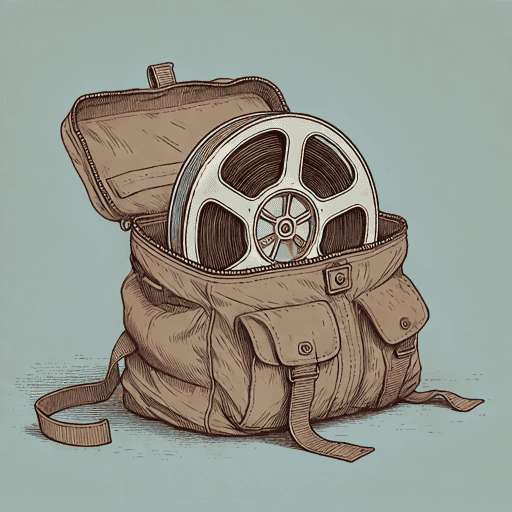
“I tug it into the light, then work at the two buckles. They resist, the leather is stiff, but then they open. I feel metal. Seven film cans.”
(Part 3, Chapter 21, Page 327)
Franz Wilzek’s rediscovery of the lost film is described with simple, tactile details that ground the novel’s central mystery, the loss of The Molander Case, in a physical object. The film, hidden away in Wilzek’s closet, becomes a symbol of repressed memory, its physical weight mirroring the psychological weight of Wilzek’s trauma and guilt.
“A good student, he said, an acolyte I can trust. Maybe not so good after all. Maybe not so trustworthy. In any case, I’m kneeling there in the garden with the rucksack, doing nothing. Just as I’m not moving now on the carpet.”
(Part 3, Chapter 21, Page 328)
This quote from Wilzek’s internal monologue reveals the novel’s final twist. Wilzek and Pabst’s relationship was characterized by Wilzek’s respect for his mentor, his willingness to learn and to follow Pabst’s lead. However, when Pabst chose to use prisoners as extras, he crossed a moral line that Wilzek could not condone. Wilzek’s quiet refusal to return the film to Pabst illustrates an attempt to disguise his own guilt by refusing to acknowledge his role in the project. However, it also represents a subtle act of defiance, withholding the means for Pabst to justify his moral transgressions.

Unlock every key quote and its meaning
Get 25 quotes with page numbers and clear analysis to help you reference, write, and discuss with confidence.
- Cite quotes accurately with exact page numbers
- Understand what each quote really means
- Strengthen your analysis in essays or discussions