Morning in the Burned House
Morning in the Burned House
A modern alternative to SparkNotes and CliffsNotes, SuperSummary offers high-quality Study Guides with detailed chapter summaries and analysis of major themes, characters, and more.
Poem Analysis
Analysis: Morning in the Burned House
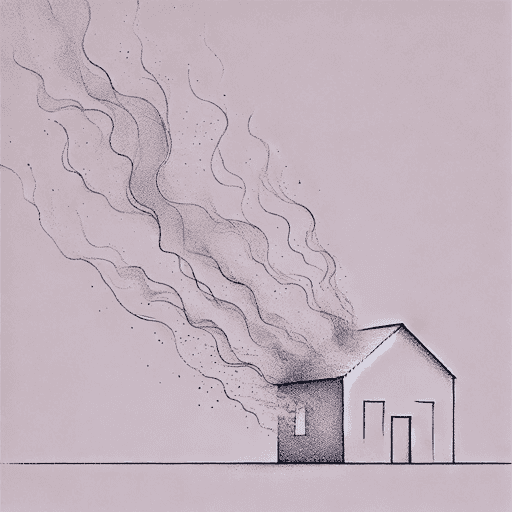
The titular poem of Morning in the Burned House utilizes remembered images to navigate loss. Throughout the collection as a whole, Atwood’s speakers recall memories, juxtaposing them with feelings that take place in the now, creating a shifting space between past and present. In “Morning in the Burned House” specifically, the speaker mentally “enters” a house that was important in their past and mourns both an earlier innocence while owning the experience of the self as it passes away from that previous time period.
The speaker situates themselves in “the burned house” (Line 1) at the beginning of the poem, which helps to ground the specific place. It is “morning,” so the speaker is “eating breakfast” (Line 1). However, the solidity of time and space is immediately distorted, as the speaker says, “[T]here is no house, there is no breakfast” (Line 2). Instead, the scene is a memory of a specific house that has now “burned” (Line 1). While the physical house no longer stands, the speaker is still present—“here I am” (Line 3)—in their memory of it. The speaker thus flits between the past (in which they exist in the house), the present (where the house does not exist), and the future (when their existence will cease as well). When grieving, many go back and forth to their different positions in time and revisit memories that are both happy and sad.
This idea of a grounded reality that no longer exists is enhanced by the second image, which solidifies the setting of the kitchen or dining room. The speaker sits with a “spoon” (Line 4) and a “bowl” (Line 5), perhaps eating oatmeal or cereal at a table. The feeling of loss is amplified by images that connect with domesticity and early memory. The memory is vivid enough that the speaker can hear the utensil “scrap[e] against / the bowl” (Line 4-5). However, these items no longer exist, as indicated by the adjective “melted” (Lines 4-5) used to describe them. They have been eradicated by the fire.
The speaker is made vulnerable by the fact that “[n]o one else is around” (Line 6). There is a lack of clarity regarding whether this isolation was in the past, as viewed from the child’s point of view, or in the present, with the now-adult speaker missing their position of child within the family. There is a plaintive quality to the question the speaker poses: “Where have they gone to, brother and sister / mother and father?” (Lines 7-8). The speaker provides a possibility. The family is perhaps “[o]ff along the shore” (Line 8). However, the abandoned items in the house suggest a deeper loss, as “[t]heir clothes are still on the hangers” (Line 9) and the “dishes [are] piled beside the sink” (Line 10), suggesting an unprepared departure. This adds to the tension of the scenario.
For the speaker, “every detail” (Line 13) is “clear” (Line 13), from the “woodstove […] and sooty kettle” (Lines 11-12) to the “tin cup and rippled mirror” (Line 14). Looking at the emptiness, the speaker marvels at how “the day is bright and songless / the lake is blue” (Lines 15-16). Here, the speaker presents a feeling that is common with grief. The memory is static, caught as if in a photograph. Further, its beauty is frozen for a moment as it is revisited.
There are signs of an imminent disruption. The “forest [is] watchful” (Line 16), and the speaker notes, “In the east a bank of cloud / rises up silently like dark bread” (Lines 17-18), which feels ominous. The family cabin in which Atwood spent her childhood was burned to the ground after a lightning strike, a fact that this imagery invokes. The brown tone of the sky feels portentous. Even if not directly biographical in reference, there is a sense of coming danger.
The speaker again grounds themselves in the landscape where they “see the swirls in the oilcloth” (Line 19) and “the flaws in the glass, those flares where the sun hits them” (Line 20). Nevertheless, this grounding is insufficient because the speaker realizes that “everything / in this house has long been over” (Lines 24-25). Suddenly, they are unable to see their “own arms and legs” (Lines 22). They no longer belong fully in this non-existent house. Symbolically, they are not the same as they were in the past and become unsure if this remembrance “is a trap or a blessing” (Line 23).
The speaker discerns that the physical objects are long gone, including “kettle and mirror, spoon and bowl” (Line 26), and so is the “body [they] had then” (Line 28). The speaker ascertains that their memory was from a time that is now past—and that the child they once were no longer exists. Further, the “body [they] have now” (Line 29) will also cease to exist both in the present (as they remember in the past) and as they move further into the future and confront death.
The speaker then decides to be grateful to the body’s stages as they pass from view. In the face of inevitable loss, the speaker begins to “almost see” (Line 32) themselves “happy” (Line 30) at the “morning table” (Line 30). The word “morning” (Line 30) used here conjures its homonym, “mourning,” as well. The vulnerable child sits there with “bare […] feet on the scorched floorboards” (Line 31), but then, as their “radiant flesh” (Line 36) turns “cindery” (Line 35) and “non-existent” (Line 35)—an acknowledgement that we all disintegrate–they transform to become “[i]ncandescent” (Line 36). This last image creates a sort of halo around the speaker, and the grief is transmuted into something holy.
The speaker, like the house, can thus be viewed from several different times—past, present, and future and in several different conditions—with nostalgia, with grief, and, finally, with reverence.

Get in-depth, chapter-by-chapter summaries and analysis from our literary experts.
- Grasp challenging concepts with clear, comprehensive explanations
- Revisit key plot points and ideas without rereading the book
- Share impressive insights in classes and book clubs