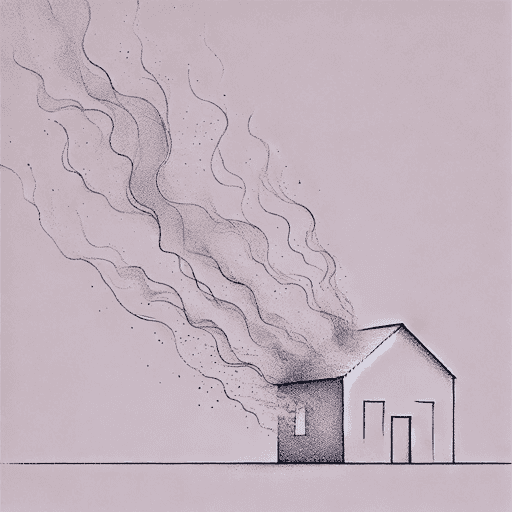
Morning in the Burned House
21 pages • 42-minute read
Margaret AtwoodMorning in the Burned House
A modern alternative to SparkNotes and CliffsNotes, SuperSummary offers high-quality Study Guides with detailed chapter summaries and analysis of major themes, characters, and more.
Background
Biographical Context: The Significance of the Small Cabin
Content Warning: This section of the guide includes discussion of death.
Although “Morning in the Burned House” can be read without this knowledge, a biographical component is present. The poem’s “burned house” is an allusion to Atwood’s childhood family cabin in rural Quebec, Canada, which was destroyed by a fire around 1968.
As Atwood recounts in an essay for The Times of London, this cabin “was an anchor point [for her family] for quite a long time”(See: Further Reading & Resources). Atwood helped her father build it when she was 11 years old, and the family lived there during the springs, summers, and autumns of her youth. Atwood notes that this cabin “was in existence for 18 years until it got struck by lightning and burned down.” While no one was injured during this event, Atwood speaks of the emotional loss she felt despite the fact that her family built a larger cabin at the same site. She explains that “when something burns down, in a location where you still go, it stays the same age it was when it vanished.”
This “layer[ing] of time” creates an eerie feeling that Atwood has explored in multiple poems throughout her career. As a pivotal spot connected to her childhood, the cabin is used to explore childhood innocence and/or traumatic memory in several of Atwood’s poems. Within these poems, Atwood uses the cabin’s location, and particularly the burning of it, to discuss time, explore haunted locales and people, and navigate loss. It is widely known that several poems in the collection Morning in the Burned House detail the author’s response to her father’s death. Since her father was intimately connected to the cabin and its surrounding woods due to his entomological work, a sense of personal loss is also associated with the loss of the cabin.
Psychological Context: Complex Grief
The scientific nature of the complexity of grief helps the reader navigate some of the circumstances and imagery within “Morning in the Burned House.” Loss is experienced by human beings in different ways. While some are able to go about their lives normally after a loved one’s death, others experience what is known as complex grief. Complex grief, as Dominick Flarey explains, is experienced emotionally and physically (Flarey, Dominck. “Memory and Grief.” American Institute of Health Care Professionals, 20 July 2023).
Due to the human physical responses (changes in hormones and blood pressure) that grief causes, it’s easy for those grieving to become overstimulated or oversensitive. This can create a heightened awareness that can make objects seem more vivid and may explain the presence of confusion between absence and corporeality in the speaker’s observation. As Flarey notes, in some intense cases of complex grief, memory can become a “haunting event that is triggered via sound, scent and place and can manifest in flashbacks or nightmares and night terrors.”
In other cases, the memory becomes a fixed experience due to the emotional connection that the grieving have with it. In this way, the memory acts as an emotional tribute by which the person memorializes the event by recalling “detailed accounts of […] the event itself, but also [the] side details of what one felt at the moment, the surrounding environment and people present” (Flarey), a fact clearly evidenced by Atwood’s speaker’s notations of who is and is not in the house, what is outside, and how they feel while wondering if it is a “trap or blessing” (Line 23). In dreams, those who grieve often find a way to relive the event, “albeit in symbolic form” (Flarey), which is also the language of poems. Whether the poem is a tribute to Atwood’s own emotions or to the larger audience, who “understand[s]” (Line 2) these emotions, “Morning in the Burned House” benefits from acknowledging its rendering of complex grief.

Unlock all 21 pages of this Study Guide
Get in-depth, chapter-by-chapter summaries and analysis from our literary experts.
- Grasp challenging concepts with clear, comprehensive explanations
- Revisit key plot points and ideas without rereading the book
- Share impressive insights in classes and book clubs