Mummies in the Morning
38 pages • 1-hour read
Mary Pope OsborneMummies in the Morning
A modern alternative to SparkNotes and CliffsNotes, SuperSummary offers high-quality Study Guides with detailed chapter summaries and analysis of major themes, characters, and more.
Summary
Background
Chapter Summaries & Analyses
Character Analysis
Themes
Symbols & Motifs
Important Quotes
Essay Topics
Tools
Chapters 1-5Chapter Summaries & Analyses
Content Warning: This section of the guide includes discussion of death.
Chapter 1 Summary: “Meow!”
Eight-year-old Jack lives in Frog Creek, Pennsylvania, with his seven-year-old sister, Annie. Two days ago, they found a magic tree house at the top of the tallest tree in the woods near their home. Their first adventure in the time-traveling tree house took them to the time of dinosaurs, and their second took them to medieval Europe. The day after their journey to the medieval castle, Jack and Annie return to the magic tree house. While Annie hurries up the rope ladder, Jack lingers behind on the forest floor because he thinks he heard someone. Jack wonders if the tree house’s creator is watching him and his sister. He promises to return the gold medallion that he and Annie found in the time of dinosaurs and the leather bookmark from the book about castles. Both objects are marked with the letter “M,” so the siblings think of the tree house’s creator as “the mysterious M person” (2).
Jack joins Annie in the tree house. She teases her brother by waving around the book about dinosaurs that took them back to the prehistoric era two days ago. The children were chased by a Tyrannosaurus rex, but a Pteranodon saved them. The siblings are astonished to see that the book about castles, which they used to travel back to the Middle Ages and dropped in a moat the day before, is dry and undamaged. Thinking back on this adventure, Jack gratefully remembers the knight who helped him and Annie find their way home.
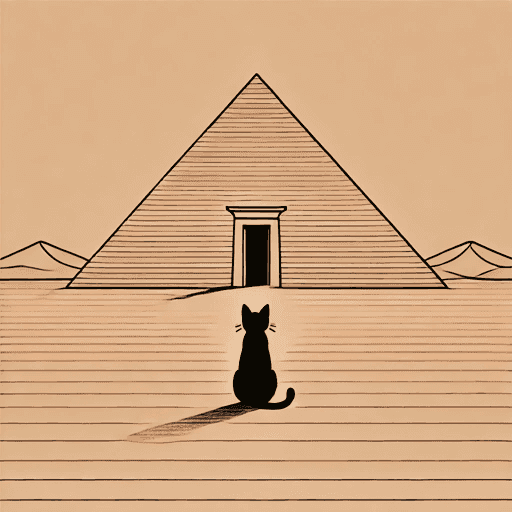
Annie selects a book about ancient Egypt, and Jack turns to a picture of a parade of people and a black cat processing toward a pyramid. At the head of the procession is a team of oxen pulling a long golden box. Annie wants to go to ancient Egypt, and Jack agrees because pyramids are “high on Jack’s list of favorite things” (4). However, he wants to be able to return home right away if necessary, so he asks Annie to hold onto the book about Frog Creek. Jack points to the illustration of the pyramid and wishes that they could travel there. Suddenly, a loud meow startles Jack. A black cat wearing a gold collar appears on a branch outside the tree house window and stares at the children. Annie observes that the cat looks exactly like the one in the book on ancient Egypt. The wind whistles louder and louder, and the tree house spins faster and faster as it travels through time and space. Then everything goes quiet and still.
Chapter 2 Summary: “Oh, Man. Mummies!”
The tree house comes to a stop at the top of a palm tree in the middle of a desert. When the children look out the window, they see the black cat gazing up at them from the base of the tree. The cat hurries toward a pyramid. A parade exactly like the one in the illustration is also on its way toward the structure. Jack consults the book about ancient Egypt and learns that they are witnessing a funeral procession for a deceased member of the royal family: “Family, servants, and other mourners followed the coffin. The coffin was called a sarcophagus. It was pulled on a sled by four oxen” (12). He takes some notes about this information in his notebook, which he then stows in his backpack along with the book about ancient Egypt.
Jack and Annie hurry toward the pyramid. Both children are excited about the prospect of seeing a mummy up close. As the children race toward the procession, it vanishes suddenly. Jack speculates that the parade was a mirage caused by sunlight reflecting off the desert heat, but Annie retorts, “How could sunlight look like people, a mummy box, and a bunch of cows?” (15). She believes that the people they saw were ghosts, but Jack dismisses this possibility because he doesn’t believe in ghosts. The black cat reappears and leads the children to an entrance in the side of the pyramid.
Chapter 3 Summary: “It’s Alive!”
The children peek inside the pyramid and see a long hallway dimly lit with torches. Annie is eager to begin exploring, but Jack urges her to be careful and quiet. He consults the book about ancient Egypt, which reveals that pyramids were also known as Houses of the Dead and provides a map to the burial chamber that sits at the center of the structure.
Jack and Annie enter the pyramid and follow a sloping stone floor toward the burial chamber. Suddenly, the children hear a strange cry, and a figure in white rushes toward them. Fearing that a mummy is after them, Jack drops the book. Annie shouts, “It’s alive!” (20).
Chapter 4 Summary: “Back from the Dead”
Jack pulls Annie out of the figure’s path, and it vanishes into the shadows as quickly as it appeared. Annie declares that the figure is a mummy that has returned from the dead. Although Jack is frightened by what he’s seen, he insists that such a thing is impossible. The figure left behind a golden stick about a foot in length, topped with a carving of a dog’s head. Jack recognizes the object as a scepter that represents royal authority. Annie wants to return the scepter to its rightful owner and calls out, “Come back, mummy! […] We want to help you!” (21). Jack urges his sister to be quiet because they don’t know for certain who they saw or what this person wants. Consulting the book once more, he learns that “[t]omb robbers often stole the treasure buried with mummies” and that pyramids were sometimes constructed with false passages to foil the thieves (22).
Annie wants to leave before the figure returns in case the person is a tomb raider, but Jack pauses to take some more notes. Annie cries out, and Jack looks up from his notebook to see a beautiful Egyptian woman wearing a white dress and gold jewelry slowly walking toward them. At Annie’s suggestion, he tries to give the woman the scepter, but she’s unable to take it because she’s intangible.
Chapter 5 Summary: “The Ghost-Queen”
The ghost introduces herself as Hutepi, the Queen of the Nile, and asks the children if they have come to help her. Jack is too frightened to speak, but Annie readily agrees to assist the ghost-queen. For thousands of years, Hutepi has been trapped in the pyramid, waiting for someone to find her copy of the Book of the Dead. The Book contains “the magic spells [she needs] to get through the Underworld” and reach the Next Life (26). The Underworld abounds with horrors and perils, including venomous snakes, monsters, demons, and lakes of fire. Hutepi’s brother hid the Book of the Dead to protect it from tomb raiders, and he left a secret message to help her locate it.
Hutepi can’t read the message due to her near-sightedness, and Annie suggests that she borrow Jack’s glasses. The ghost can’t wear them because she is made of air, so she asks Jack to help her by describing the hieroglyphics that make up the secret message. The boy takes one look at the intricate symbols and whispers, “Oh, man” (29).
Chapters 1-5 Analysis
In the novel’s first section, Osborne builds upon the patterns established by the first two Magic Tree House books while also expanding the series’ fantasy elements. Mummies in the Morning is preceded by Dinosaurs Before Dark and The Knight at Dawn, which use the device of the magic tree house to explore the Cretaceous Period and medieval Europe. These stories blend the genres of time-travel adventure and historical fiction, creating the distinctive combination of entertainment and education for which the children’s series is known.
Chapter 1 alludes to Jack and Annie’s earlier adventures, providing an overview of the series' premise and previous installments to contextualize the novel. Just as the series’ premise about the time-traveling tree house gives the author flexibility to explore a wide range of historical settings, the combination of history and fantasy gives the author freedom to explore a variety of literary genres. The ghost-queen’s appearance in this story takes Osborne’s series in a new direction, overtly incorporating elements of the supernatural to explore the cultural and religious practices of ancient Egypt.
Osborne uses the story’s supernatural elements to highlight the differences between Jack and Annie’s personalities. Jack’s detail-oriented and cautious attitude makes him skeptical of anything he cannot explain rationally, despite his experiences inside the magic tree house. As a result, he immediately insists that “[t]here’s no such thing as ghosts” (13). Jack’s conviction in his ‘logical’ worldview wavers as he and Annie encounter increasingly unusual phenomena. For example, in Chapter 4, Jack is unable to provide an immediate explanation for the identity of the figure who runs past the children and drops the scepter. He tries to preserve a sense of control in the midst of his fear by insisting that it’s “impossible” for the figure to be a reanimated mummy like Annie proposes (21). In contrast to her brother, Annie welcomes surprising and supernatural events without fear, introducing the theme of Confronting the Unknown With Courage, as evidenced by her ability to converse with Queen Hutepi’s ghost in Chapter 5 without sounding “scared at all” (26). Annie’s acceptance of the supernatural helps her face the unknown bravely, while Osborne situates Jack’s growth around his need to find his courage.
These opening chapters introduce the central mystery of the plot, foregrounding Osborne’s thematic focus on Solving Problems Through Cooperation—a skill the children will have to embrace to complete their quest. Chapter 5 raises the narrative stakes by introducing the search for Queen Hutepi’s Book of the Dead, which the ghost needs if she is to “pass through the horrors of the Underworld” and reach the Next Life (27). The children work together and go through a trial-and-error process to solve Hutepi’s “strange problem” (28). Since Jack can’t give the intangible queen his glasses so she can read the hieroglyphs, the children will describe the symbols to her. The joint effort to decode the secret message and hunt for the book guides the next section’s action.
Osborne hints at the larger mystery of the series—the identity of the tree house’s creator—which connects this book to the rest of the series. The letter “M” symbolizes this mysterious figure and links the clues the children have gathered across the first three novels: “Maybe M wanted the gold medallion back—the one Jack had found on their dinosaur adventure. Maybe M wanted the leather bookmark back—the one from the castle book” (2). The siblings’ uncertainty about M’s temperament and goals increases the story’s suspense.
Both books and the magic tree house itself serve as motifs for the novel’s thematic exploration of Learning Through Discovery. Osborne quickly establishes Jack as an avid reader, and Annie leverages his love of history to persuade him to go on another adventure despite the danger they faced earlier in the series: “‘Pyramids, Jack,’ said Annie. ‘You love pyramids’” (4). Like her brother, Annie is highly curious, but she favors an experiential model of education that makes her more eager to embrace the immersive learning opportunities that the magic tree house affords.
The book about Egypt provides an important resource that supports the children’s learning. The things they see along their journey, such as the funeral procession, spark their curiosity and lead them to consult the book, underscoring the idea that learning through discovery encompasses both research and experience. The Book of the Dead, which is mentioned in Chapter 5 and figures prominently in the second section, also serves as a motif of the theme. Finding the scroll requires the children to engage in hands-on learning about ancient Egypt, and the text is designed to help Queen Hutepi discover a safe route to the afterlife.

Unlock all 38 pages of this Study Guide
Get in-depth, chapter-by-chapter summaries and analysis from our literary experts.
- Grasp challenging concepts with clear, comprehensive explanations
- Revisit key plot points and ideas without rereading the book
- Share impressive insights in classes and book clubs