Mummies in the Morning
Mummies in the Morning
A modern alternative to SparkNotes and CliffsNotes, SuperSummary offers high-quality Study Guides with detailed chapter summaries and analysis of major themes, characters, and more.
Summaries & Analyses
Quizzes
NEWReading Tools
Chapters 6-10Chapter Summaries & Analyses
Content Warning: This section of the guide includes discussion of death.
Chapter 6 Summary: “The Writing on the Wall”
The secret message left by Queen Hutepi’s brother consists of a series of four hieroglyphics carved into a wall. The ghost-queen asks Jack and Annie to describe them to her one at a time so that she can translate the pictures into words. The first hieroglyph is a zigzag shape that represents a staircase. The second image is more complex. It is shaped like “a long box” topped with “squiggly lines” at either end (32). Jack thinks the shape looks a little like a hat, but Annie thinks it looks like a boat. Queen Hutepi is excited by Annie’s suggestion.
The third image looks like a jug for water or flowers. The fourth and final picture puzzles Jack and Annie. They try describing it as a drooping pole or a curved stick, but Queen Hutepi is mystified. Jack draws a large version of the image in his notebook so that the queen can see it clearly. She recognizes it as the hieroglyph for a folded cloth. Now that he has an idea of what to look for, Jack can see that the image resembles “a towel hanging over a bathroom rod” (35). Jack records what each of the four symbols represents in his notebook and asks Queen Hutepi what the message means. She invites the children to her burial chamber and then floats away.
Chapter 7 Summary: “The Scroll”
Jack puts Queen Hutepi’s scepter in his backpack along with his notebook and pencil. After getting to know the kind ghost, he no longer feels afraid of her. Queen Hutepi leads the children deeper into the pyramid. Jack and Annie grow excited when they see a staircase like the one the first hieroglyph depicts. The ghost-queen floats through a wooden door at the top of the stairs, and the children follow her. Inside the “cold, drafty room” (37), they see furniture, musical instruments, and a small boat, but no sign of their spectral friend.
The children are thrilled to see the boat because it matches the second hieroglyph in the secret message. Annie is puzzled why there would be a boat inside a pyramid, and Jack deduces that it’s meant to carry Queen Hutepi on her journey to the Next Life. The boat is filled with luxurious objects like goblets decorated with jewels, golden plates, statuary, and precious blue stones. The vessel also contains a clay jug that matches the third hieroglyph. The children’s excitement grows when Jack reaches into the jug and finds a folded cloth like the one at the end of the secret message.
The folded cloth is wrapped around an ancient scroll covered in hieroglyphics. Elated, Annie calls out to Queen Hutepi and announces that they’ve found her copy of the Book of the Dead. The ghost doesn’t reply verbally, but a door creaks open. Annie wonders aloud if the ghost is waiting for them in the next room. Jack is fearful to proceed, but his sister reminds him that Queen Hutepi has been trapped inside the pyramid for thousands of years. The children step into the burial chamber, where they find a long gold box. The box begins to glow when Annie says that they’ve found the Book of the Dead. Jack wants to put the scroll on the floor and leave, but Annie tells him not to be afraid. Together, they approach the glowing box and look inside.
Chapter 8 Summary: “The Mummy”
The sarcophagus contains Queen Hutepi’s mummy. Jack is fascinated by the withered remains, but Annie is disgusted and quickly heads for the door. Jack consults the book about Egypt and learns about the mummification process. He reads aloud about how ancient Egyptians sought “to protect the body so it would last forever” (45). They used salt to dry out the body, wrapped it in bandages, and removed the brain. Revolted, Annie darts from the chamber.
When Jack places Queen Hutepi’s scepter and the Book of the Dead inside the sarcophagus, the mummy’s face seems to grow calmer. Jack holds his breath as he carefully exits the burial chamber and then races back the way that he and Annie came. When he reaches the bottom of the stairs, he hears Annie calling for help in the distance. He returns to the room with the boat and discovers that there is a second door that leads to a staircase and a hallway that look just like the ones on the way out of the pyramid. Annie runs down the hall and crashes into Jack. He suspects that they’ve found “one of those false passages built to fool the tomb robbers” (50). Before the children can leave the false passage, the door creaks shut, and the torches extinguish.
Chapter 9 Summary: “Follow the Leader”
The children make their way through the pitch-dark hall to the top of the stairs, but the door won’t open no matter how hard they push. Jack tries to reassure Annie even though he is frightened. At her suggestion, they continue down the passage in the hope of finding an exit. Eventually, they reach a flight of stairs and a door that won’t budge, and Jack suspects that they’ve gone around in a circle.
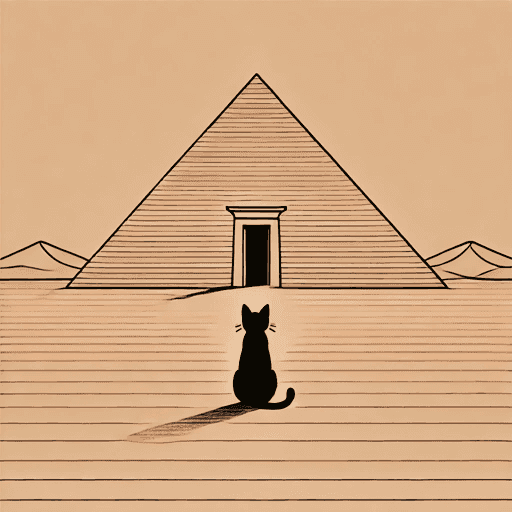
Suddenly, the children hear the black cat meowing. The sound leads them through the pyramid’s winding corridors out into the light of day. Jack marvels that the cat was able to find an exit when they couldn’t, and Annie declares that the animal has magic. The siblings thank the cat, who waves its tail at them before vanishing into the desert.
Jack and Annie trek through the hot sand to the palm tree that holds the magic tree house and scale the rope ladder. After the children climb inside the tree house, they hear a rumbling sound coming from the direction of the pyramid. They look out the tree house window and see a boat “gliding over the sand like a boat sailing over the sea” (57). Jack isn’t certain if this vision is just a mirage or truly Queen Hutepi beginning her journey to the Next Life at last. He opens the book about Pennsylvania, points to the picture of Frog Creek, and says, “I wish we could go home” (58). The wind begins to blow, and the tree house starts to spin.
Chapter 10 Summary: “Another Clue”
When the tree house reappears in the Frog Creek woods, it is late morning. Annie suggests that they tidy up the books in case the tree house’s creator returns. Their cleaning reveals a large shining “M” on the wooden floor. The children take this as proof that the person who owns the tree house is the same person who lost a medallion in the Cretaceous Period. When Jack touches the letter, his skin tingles, and the wind picks up. He quickly gathers his things and exits the tree house with Annie.
A rustling in the bushes makes Jack wonder if the tree house’s owner is nearby. He promises to return the medallion and the bookmark the next day. Just as Annie proposes that they search the woods for this mysterious person, their mother calls them home for lunch. The siblings agree to search tomorrow and run home to their mother.
Chapters 6-10 Analysis
In the novel’s second section, Jack and Annie’s search for the Book of the Dead and their escape from the pyramid depend on their commitment to Solving Problems Through Cooperation. In Chapter 6, the siblings work together to describe the hieroglyphics so that Queen Hutepi can decode the secret message. Cooperation is essential in this scene because the queen can’t see the pictures clearly, and the children don’t know what the images represent. When one of the siblings struggles with a hieroglyph, the other lends support: “‘Like a hat,’ said Jack. ‘Hat?’ said the ghost-queen. ‘No. More like a boat,’ said Annie” (32). Osborne ensures that the children need to cooperate because, although Queen Hutepi guides them to her burial chamber, Jack and Annie have to find the Book of the Dead themselves by recalling the secret message.
When the children’s cooperation breaks down, things begin to go wrong in their journey, reinforcing the importance of working together. The siblings’ teamwork falters when Annie runs off without Jack and gets lost, leading the children to become trapped in the false passage: “It was no use. They were trapped” (52). This tense scene underscores the importance of cooperation. In contrast, the final chapter depicts the siblings as a united front as they face the ongoing mystery of the tree house’s creator: “Annie’s eyes grew wide. ‘Should we look for M?’ […] ‘Tomorrow,’ they said together” (64). Although Jack and Annie’s cooperation sometimes stumbles, they ultimately succeed because of their ability to work together.
Jack’s growth in these chapters illustrates the theme of Confronting the Unknown With Courage. Osborne portrays learning and understanding as effective tools against fear by showing how the boy’s concern eases as he comes to know Queen Hutepi: “The ghost-queen seemed so kind and gentle. He wasn’t afraid of her at all anymore” (37). Annie’s bravery and encouragement also play a pivotal role in Jack’s journey toward finding his own courage. For example, she helps him persevere when he’s afraid to approach the sarcophagus: “‘Come on.’ Annie took Jack by the arm” (42). His reluctance vanishes once he knows what’s inside “the glowing gold box” (42), and he isn’t at all afraid of the mummy, even though the usually dauntless Annie finds it unsettling.
In the penultimate chapter, Jack applies what he has learned about facing the unknown with courage by trying to be a brave big brother for Annie—a role reversal that evidences his growth. Even though he still feels frightened and unsure, he tells Annie, “Don’t worry. Everything’s going to be okay” (51). Jack’s shifting stance toward the supernatural represents another way he learns to embrace the unknown. At the start of the story, he quickly dismisses the existence of ghosts. However, after befriending Queen Hutepi, he entertains the possibility that the floating boat in Chapter 9 isn’t merely a mirage. In just a few days, Jack’s experiences with the magic tree house have broadened his horizons in multiple ways, including increasing his courage and making him more open to unexpected possibilities.
Osborne’s prose and Sal Murdocca’s illustrations work together to capture the excitement of discovery and help the reader visualize Jack and Annie’s journey into the past. For example, the illustrations of the secret message allow the readers to try to decode the message alongside the characters, creating an interactive element to the novel. The author’s use of capitalization expresses the thrill the siblings feel as they match objects in the pyramid, such as the “JUG” and the “FOLDED CLOTH” to the hieroglyphics in the secret message (38). The illustration on page 41 depicts the key moment in which the children discover the Book of the Dead. In addition to showing Annie’s wide-eyed excitement, the image also gives an idea of the pyramid’s size and majesty through details like the intricate hieroglyphics on the wall and the treasures piled into the boat.
Jack’s face-to-face encounter with the queen’s mummy in Chapter 8 marks the culmination of Osborne’s thematic focus on Learning Through Discovery. Murdocca draws Jack with an intent expression on Page 46, and the narrator’s detailed descriptions in this scene reflect Jack’s fascination with his discovery: “It had broken teeth, little wrinkled ears, and a squashed nose. Its flesh had withered” (44). The children’s interest in mummies inspires Jack and Annie to choose the book about ancient Egypt in the first place. Finding the mummy marks the climax of their adventure and signals their readiness to return home to their own time period.

Get in-depth, chapter-by-chapter summaries and analysis from our literary experts.
- Grasp challenging concepts with clear, comprehensive explanations
- Revisit key plot points and ideas without rereading the book
- Share impressive insights in classes and book clubs