Mummies in the Morning
38 pages • 1-hour read
Mary Pope OsborneMummies in the Morning
A modern alternative to SparkNotes and CliffsNotes, SuperSummary offers high-quality Study Guides with detailed chapter summaries and analysis of major themes, characters, and more.
Summary
Background
Chapter Summaries & Analyses
Character Analysis
Themes
Symbols & Motifs
Important Quotes
Essay Topics
Tools
Important Quotes
Content Warning: This section of the guide includes discussion of death.
“Was the mysterious M person watching him now? Maybe M wanted the gold medallion back—the one Jack had found on their dinosaur adventure. Maybe M wanted the leather bookmark back—the one from the castle book. There was an M on the medallion and an M on the bookmark. But what did M stand for?”
(Chapter 1, Page 2)
In literature, anaphora refers to the repetition of a word or phrase at the beginning of consecutive sentences or phrases, such as the repetition of “[m]aybe” at the start of the second and third sentences. This repetition and the narrator’s use of questions reveal Jack’s nervousness as he wonders whether someone is watching him and if he’s in trouble for finding the monogrammed objects. The repetition of the letter “M” connects to the clues the siblings have collected thus far in the series, reflects Jack’s methodical thought processes and interest in problem-solving, and foreshadows the eventual revelation that Morgan Le Fay is the magic tree house’s creator later in the series.
“A green silk bookmark was sticking out from between the pages. Jack turned to the page with the bookmark. There was a picture of a pyramid. Going toward the pyramid was a long parade. Four huge cows with horns were pulling a sled. On the sled was a long gold box. Many Egyptians were walking behind the sled. At the end of the parade was a sleek black cat.”
(Chapter 1, Page 4)
Osborne helps her readers imagine the book about ancient Egypt through imagery that appeals to the sense of sight, such as “green,” “gold,” and “black,” and the sense of touch, such as “silk.” These sensory details communicate the importance of the “parade” and the “long gold box” in the illustration, foreshadowing their appearance when the children travel back in time.
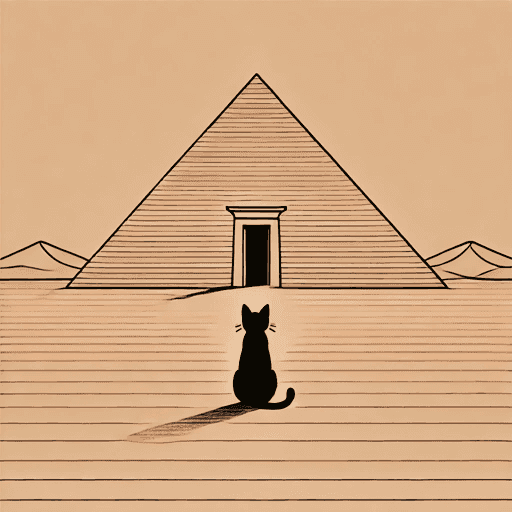
“‘Meow!’ ‘What was that?’ Jack looked out the tree house window. A black cat was sitting on a branch right outside the window. The cat was staring at Jack and Annie. It was the strangest cat Jack had ever seen. It was very sleek and dark, with bright yellow eyes and a wide gold collar. ‘It’s the cat in the Egypt book,’ whispered Annie.”
(Chapter 1, Page 6)
Osborne makes frequent use of onomatopoeia, words that imitate or evoke sounds. In this passage, “Meow” is an example of onomatopoeia that mimics an animal sound. The italics on the sound effect and in Jack’s dialogue indicate the boy’s surprise at the cat’s sudden arrival. Visual imagery depicting the cat’s “dark fur,” “bright yellow eyes,” and “gold collar” indicates the animal’s importance to the narrative and hints that it is the same cat as the one pictured in the book about ancient Egypt.
“Jack closed his eyes as the tree house started to spin. It spun faster and faster. Then everything was still. Absolutely still.”
(Chapter 1, Page 8)
This passage utilizes repetition to create rhythm and suspense. Repeated words like “faster and faster” and “still. Absolutely still” create a sense of excitement and motion, reflecting the tree house’s movement through time and space. The repetition also operates on a series-wide level. A close variation of this passage appears each time the tree house travels, so this excerpt signals the start of another adventure to readers familiar with Osborne’s books.
“When a royal person died, a grand funeral procession took place. Family, servants, and other mourners followed the coffin. The coffin was called a sarcophagus. It was pulled on a sled by four oxen.”
(Chapter 2, Page 12)
The nonfiction book about ancient Egypt functions as a narrative tool that allows Osborne to intersperse facts throughout the time-travel adventure. As this passage demonstrates, the author keeps the sentence structure in these informational segments brief and straightforward. This simple phrasing helps young readers acquire new facts and terminology like “sarcophagus.” Osborne’s incorporation of historical details through the book about ancient Egypt adds another layer to the story’s celebration of learning and discovery.
“Jack took a deep breath. Then he stepped out of the hot, bright sunlight into the cool, dark pyramid. The hallway was silent. Floor, ceiling, walls—everything was stone.”
(Chapter 3, Page 18)
The phrases “hot, bright sunlight” and “cool, dark pyramid” utilize parallel phrasing and contrasting visual and tactile imagery to signal a tonal shift as the main characters leave the desert behind and enter the story’s focal setting. The hushed atmosphere of the “silent” hallway adds to the sense of anticipation in this scene. The “deep breath” that Jack takes before entering the pyramid points to the story’s thematic interest in Confronting the Unknown With Courage, underscoring his efforts to summon up his bravery as he ventures into the unknown.
“‘Eee-eee!’ A strange cry shot through the pyramid. Jack dropped the Egypt book. Out of the shadows flew a white figure. It swooshed toward them! A mummy! Jack thought.”
(Chapter 3, Page 19)
This passage employs a number of literary techniques to build suspense. The onomatopoeia “Eee-eee!” imitates the cry that startles the children, and the onomatopoeia “swooshed” gives an idea of the figure’s swift approach. Verbs like “shot” and “flew” and the use of exclamation points add to the tension and help to communicate Jack’s fright.
“The white figure moved swiftly past them, then disappeared into the shadows. ‘A mummy,’ said Annie. ‘Back from the dead!’ ‘F-forget it,’ stammered Jack. ‘That’s impossible.’ He picked up the Egypt book.”
(Chapter 4, Page 21)
Osborne uses the spelling of the verb “F-forget” to indicate Jack’s fear. His insistence that it’s “impossible” for mummies to come back to life despite his firsthand experience with supernatural occurrences like time travel provides an element of irony. The passage highlights Jack and Annie’s distinct character traits, particularly her boldness and imagination, and his caution and preference for hard facts.
“Jack felt a whoosh of cold air. He looked up. A wave of terror shot through him. Another figure was moving slowly toward them. It wasn’t a tomb robber. It was a lady. A beautiful Egyptian lady. The lady wore flowers in her black hair. Her long white dress had many tiny pleats. Her gold jewelry glittered.”
(Chapter 4, Page 24)
The phrase “whoosh of cold air” uses onomatopoeia and tactile imagery to mark the supernatural occurrence of the ghost’s appearance, and the phrase “wave of terror” uses metaphorical language to make Jack’s reaction more vivid. Short sentence structure and the repetition of the word “lady” give the passage a slow, deliberate pace that draws out this suspenseful moment and reflects the woman’s slow approach toward the children. Osborne depicts the mysterious figure through visual imagery, such as “black hair” and “white dress.” Details like the woman’s “gold jewelry” offer clues that she is the deceased royal whose procession the children witnessed.
“‘Alas, my brother forgot my strange problem. I cannot see clearly that which is close to my eyes. I have not been able to read his message for thousands of years.’ ‘Oh, that’s not strange,’ said Annie. ‘Jack has the same problem. That’s why he wears glasses.’”
(Chapter 5, Page 28)
Queen Hutepi’s description of her “strange problem” resembles a literary technique called defamiliarization that presents common things in a novel way. Queen Hutepi lived before the invention of eyeglasses, but Annie recognizes her “problem” of being unable to “see clearly that which is close to [her] eyes” as nearsightedness. The moment illustrates Osborne’s characters’ efforts to navigate the differences in their historical backgrounds to understand and assist one another. Annie’s eagerness to find a solution to Queen Hutepi’s conundrum emphasizes the story’s thematic focus on Solving Problems Through Cooperation.
“‘Wait,’ said Jack. ‘I’ll draw it in my notebook. Big! So you can see it.’ Jack put down the scepter and got out his pencil. He drew the hieroglyph. ‘A folded cloth,’ said the ghost-queen. ‘Really?’ said Jack. ‘Yes. That is the hieroglyph for a folded cloth,’ said the ghost-queen. ‘Oh. Okay,’ said Jack.”
(Chapter 6, Page 35)
Osborne makes Jack’s dialogue more realistic by including fragments: “I’ll draw it in my notebook. Big! So you can see it.” Breaking the ideas apart in this manner helps to depict the character’s thought process as he approaches the problem. At the end of the passage, Jack’s one-word-sentence responses to Queen Hutepi’s explanations add a touch of humor by showing how this particular hieroglyph stumps him.
“Jack and Annie followed her deeper into the pyramid. Finally they came to some stairs. ‘The STAIRS!’ said Jack and Annie together. The ghost-queen floated up the stairs.”
(Chapter 7, Page 37)
Repetition and capitalization underline the children’s excitement at seeing the stairs, which match the first image in the secret message. A similar scene plays out with the other three images. This emphasis invites young readers to note the narrative significance of Jack and Annie’s discovery as a clue that they are coming closer to solving the mystery of the Book of the Dead’s location.
“Jack and Annie pushed on the door. It opened slowly. They stepped into a cold, drafty room. The ghost-queen was nowhere in sight. Dim torchlight lit the huge room. It had a very high ceiling. On one side was a pile of tables, chairs, and musical instruments. On the other side of the room was a small wooden boat.”
(Chapter 7, Page 37)
Tactile imagery, such as “cold and drafty,” and visual imagery like “[d]im” depict a key location in the novel, the chamber where the Book of the Dead is hidden. The second hieroglyph in the secret message depicts a boat, so the presence of the “small wooden boat” is another sign that the children are nearing their goal.
“The boat was filled with many things—gold plates, painted cups, jeweled goblets, woven baskets, jewelry with blue stones, and small wooden statues.”
(Chapter 7, Page 38)
The author uses colors to provide visual imagery in her description of the “gold plates” and “jewelry with blue stones.” These sensory details accentuate the opulence of the items in the boat, reflecting Queen Hutepi’s wealth and status as Queen of Egypt.
“‘Queen Hutepi!’ called Annie. ‘We have it! We found your Book of the Dead!’ Silence. ‘Queen Hutepi!’ A door on the side of the chamber creaked open.”
(Chapter 7, Page 38)
Osborne builds mystery and suspense by focusing on sound. The passage contrasts Annie’s shouts with the stillness of the chamber. Setting the word “[s]ilence” apart as a fragment emphasizes how absolute and eerie the quiet is. The onomatopoeia of the door’s creaking at the end of the passage following the silence suggests that the movement has supernatural causes.
“Jack’s heart was pounding. Cold air was coming through the open doorway.”
(Chapter 7, Page 42)
Most of the story is written in the past tense, which makes the change to past progressive (“was pounding,” “was coming”) in this excerpt more noticeable. The tense shift draws out the suspense and stretches out a moment in which Jack must prepare himself and choose to face the unknown once again, advancing the theme of courage.
“‘I think we should leave it in there,’ said Annie. She pointed to the gold box. ‘No,’ said Jack. ‘Don’t be afraid,’ said Annie. ‘Come on.’ Annie took Jack by the arm. They walked together across the room to the glowing gold box. They stopped in front of the box and peered inside.”
(Chapter 7, Page 42)
Osborne refers to Queen Hutepi’s coffin as a “box” rather than a sarcophagus, but its purpose is hinted at by its prominent placement, the supernatural glow that surrounds it, and the tense mood. The author’s diction invites readers to deduce the box’s significance before it’s revealed, encouraging them to feel more involved in the mystery. The chapter’s cliffhanger ending is another narrative technique that adds to the scene’s suspense. Osborne stops the chapter just as the children look into the coffin, which increases the buildup to the reveal of the titular mummy.
“Hutepi’s mummy wasn’t beautiful. It had broken teeth, little wrinkled ears, and a squashed nose. Its flesh had withered. Its eyes were hollow sockets. The rotting bandages on the mummy’s body were coming off. Jack could see bones.”
(Chapter 8, Page 44)
The detailed descriptions in this scene emphasize the moment’s importance to the main plot and the theme of discovery. Precise adjectives about the queen’s remains, such as “broken,” “withered,” and “rotting,” create an eerie mood, but a methodical tone, reflecting Annie’s appalled reaction to the body and Jack’s fascination with mummies.
“He pulled out the scroll and the scepter. He put them next to the mummy’s skull. Was it just his imagination? Or did a deep sigh seem to shudder throughout the room? Did the mummy’s face grow calmer? Jack held his breath as he backed out of the mummy room. He hurried through the boat room and headed down the stairs. At the bottom of the stairs, Jack heaved his own sigh, a sigh of relief.”
(Chapter 8, Page 47)
The narrator’s questions indicate that, although Jack isn’t certain what he hears or sees in the burial chamber, Queen Hutepi has found peace and can reach the Next Life at last. The repetition of the word “sigh” emphasizes Queen Hutepi and Jack’s mutual relief. The passage’s mood lightens to indicate the release of tension now that the main characters have solved the mystery and achieved their goal.
“Just then they heard a creaking noise. Jack and Annie turned around. They looked up the stairs. They watched in horror as the door slowly creaked shut. A deep sound rumbled in the distance and all the torches went out.”
(Chapter 8, Page 50)
Onomatopoeia like “creaking,” “creaked,” and “rumbled” create a fearful mood as the pyramid moves on its own. The sudden darkness Jack and Annie are plunged into when “all the torches [go] out” at once adds to the tension. This escalation of the suspense occurs after the children have already solved the story’s main mystery by locating and returning the Book of the Dead, revealing that more obstacles lie between the characters and their happy ending.
“‘Don’t worry. Everything’s going to be okay,’ said Jack. He was trying to stay calm. They leaned against the wooden door and pushed. It wouldn’t budge. They pushed harder. It was no use. Jack took a deep breath. It was getting harder to breathe and harder to stay calm.”
(Chapter 9, Page 52)
The repetition of the verb “pushed” and the adjective “harder” in phrases like “harder to breathe and harder to stay calm” underscores the stakes of the children’s predicament. The repetition of the phrase “stay calm” shows how Jack’s fear grows over the course of this passage as the seriousness of the children’s situation gradually sinks in. The brevity of the sentence, “It was no use,” adds to the sense of foreboding in this scene.
“‘Meow.’ Jack and Annie kept following the sound, all the way through the winding hallway. They went around one corner, then another, and another…Finally, they saw a light at the end of the tunnel. They rushed forward—out into the bright sunlight.”
(Chapter 9, Page 54)
The onomatopoeia “Meow” helps to make the scene more vivid. The sound effect is important as a narrative device because the cat’s meows guide the children out of the false passage. The feline’s intervention brings Jack and Annie’s adventure full circle because the cat led them to the pyramid at the start of the story. The author’s choice of punctuation in this passage supports the story’s mood. For example, the ellipsis shows how the route through the pyramid is long and winding, and the dash before “out into the bright sunlight” captures the moment when the children make their exit. The contrast between the pyramid’s dark interior and “the bright sunlight” that shines on the children when they go outside underscores the relief of their escape.
“Jack looked toward the palm trees. The magic tree house sat like a bird’s nest at the top of one. ‘Time to go home,’ said Jack.
(Chapter 9, Page 54)
The description of the magic tree house sitting at the top of the palm tree, “like a bird’s nest,” is an example of a simile. The author’s use of figurative language creates an image of the tree house’s perch. The simile also fosters a sense of safety and comforting familiarity despite the unusual nature of the sight. In another indication that the children’s adventure is nearing its conclusion, Jack’s dialogue highlights that the tree house is important to the children not just because it takes them to distant times and places but also because it provides them with a way home.
“Jack took a deep breath. The tree house was back in the Frog Creek woods. ‘I wonder what Mom’s making for lunch,’ said Annie. She was looking out the window. Jack smiled. Lunch. Mom. Home. It all sounded so real, so calm, so safe.”
(Chapter 10, Page 60)
By breaking the words “Lunch. Mom. Home.” into fragments, the author slows down the passage’s pace. The change in tempo gives the excerpt a contented mood that reflects the relief that settles over Jack after the children return to Frog Creek. The repetition in the phrase “so real, so calm, so safe” also signals that the dangers Jack and Annie faced are behind them and that the story’s happy ending is secured.
“They ran down their street. They ran across their yard. They ran into their house. They ran into their kitchen. They ran right into their mom.”
(Chapter 10, Page 64)
The author creates anaphora by beginning each sentence in this passage with the words, “They ran.” The repetition creates a sense of rhythm and emphasizes the children’s eagerness to be home. Their excitement indicates that, although they enjoy their adventure in ancient Egypt, the time away from their familiar world increases their appreciation for their home and family. This passage gives the story a happy ending, which aligns with the tone of Osborne’s adventure stories.

Unlock every key quote and its meaning
Get 25 quotes with page numbers and clear analysis to help you reference, write, and discuss with confidence.
- Cite quotes accurately with exact page numbers
- Understand what each quote really means
- Strengthen your analysis in essays or discussions