Mummies in the Morning
38 pages • 1-hour read
Mary Pope OsborneMummies in the Morning
A modern alternative to SparkNotes and CliffsNotes, SuperSummary offers high-quality Study Guides with detailed chapter summaries and analysis of major themes, characters, and more.
Summary
Background
Chapter Summaries & Analyses
Character Analysis
Themes
Symbols & Motifs
Important Quotes
Essay Topics
Tools
Character Analysis
Content Warning: This section of the guide includes discussion of death.
Jack
Jack, one of the novel’s two main characters, is eight years old and brother to Annie. Osborne’s decision to make him a modern-day elementary school student helps to make him a relatable protagonist for her young audience. Jack is methodical, and his accessories fit with his academic, detail-oriented personality: His glasses help him read, and he carries his books and notebook around in his ever-present red backpack. Because the third-person narration follows Jack’s point of view, his apprehensive perspective enhances the story’s suspense from the opening chapter: “Was the mysterious M person watching him now? Maybe M wanted the gold medallion back” (2). Jack’s caution also makes him protective of his impetuous little sister, such as when he pulls Annie out of the tomb raider’s path in Chapter 4. Notably, Jack’s curiosity is even stronger than his caution, and his love of learning leads him to embark on another trip through time despite the dangers he has encountered on his previous journeys in the magic tree house.
Jack’s arc aligns with Osborne’s goals to teach young readers about different historical eras and values. For example, his love of reading and his excitement about exploring a pyramid and seeing a mummy face-to-face advance the theme of Learning Through Discovery. He also shapes the story’s main plotline and models Solving Problems Through Cooperation by working with Annie and Queen Hutepi to find the Book of the Dead. When Queen Hutepi can’t see the hieroglyphs, Jack problem solves by drawing them on a larger scale: “Wait,’ said Jack. ‘I’ll draw it in my notebook. Big! So you can see it’” (35). The boy’s efforts to be prepared for any eventuality, such as always having a notebook and pencil at the ready, become an asset in helping to find the Book of the Dead.
Much of Jack’s growth revolves around the theme of Confronting the Unknown With Courage. An important part of his character development entails learning how to respond when the unexpected arises and even to enjoy some of life’s surprises. At the start of the story, he insists that “[t]here’s no such thing as ghosts” (13), and he’s terrified when he first sees the ghost-queen. Befriending Queen Hutepi soothes his fears and helps him accept that there are aspects of the world that defy his rational explanations. By the end of the story, he demonstrates his changed perspective by considering the possibility that the spectral boat isn’t just a mirage but rather “the ghost-queen finally on her way to the Next Life” (57). Jack’s third adventure in the magic tree house focuses on the lesson that it’s all right not to know all the answers. He becomes braver by facing his fears, a pattern that repeats throughout the series.
Annie
Annie is Jack’s seven-year-old little sister and the story’s other main character. Even though she’s the younger sibling, Annie is daring and actively charts the course of their adventure rather than tagging along behind her big brother. Osborne establishes Annie as an equal team member and a fellow protagonist with Jack by making her the first to scale the tree house’s ladder and the one who proposes ancient Egypt as their destination. Two of her most prominent traits are her bravery and her strong conscience. She demonstrates both when she fearlessly calls out to the mysterious figure because she wants to return the scepter to its rightful owner: “Come back, mummy! […] We want to help you!” (21). These strengths propel the plot forward because she’s not “scared at all” of Hutepi and promises to aid the ghost-queen while Jack remains paralyzed with fear (26).
Annie has a playful personality and sometimes teases her nervous brother, but she cares deeply about Jack and encourages him when he’s afraid, supporting the novel’s thematic interest in Confronting the Unknown With Courage. Another characteristic that differentiates the siblings is Annie’s imagination. The young girl believes in magic, and this belief is vindicated by her encounters with the ghost-queen and the supernatural cat. The siblings’ contrasting views of the world provide humor, as in the scene when they debate the true nature of the procession. Jack’s argument that it’s only a mirage evidences his trepidation and fear. Annie forms a matter-of-fact rebuttal: “‘How could sunlight look like people, a mummy box, and a bunch of cows?’ […] ‘Ghosts,’ Annie said.” This introduces the existence of the supernatural within the world of the novel (15). Annie prefers hands-on educational opportunities that celebrate learning through discovery, making the chance to explore a pyramid highly appealing to her learning style.
Osborne illustrates the importance of Solving Problems Through Cooperation through the way that Annie works with Jack to find the Book of the Dead, and by giving the siblings complementary traits that support their teamwork. By modeling how to face the unknown with courage, Annie helps Jack find his own bravery. For example, when Jack hesitates outside Queen Hutepi’s burial chamber, Annie keeps both Jack and the plot moving forward by reminding him, “She’s waited thousands of years for her book. Don’t make her wait anymore” (42). Annie’s daring is often a helpful counterbalance to her brother’s caution, but sometimes her impulsivity lands her and Jack in trouble. The scene in which the siblings become trapped in the false passage after Annie runs off by herself functions as a reminder of the importance of cooperation.
Queen Hutepi
Queen Hutepi is the spirit of an ancient Egyptian royal laid to rest in the pyramid that Jack and Annie visit. Osborne conveys her regal nature through her poise, the opulent funerary treasures outside her burial chamber, and the narrator’s description of her majestic appearance in Chapter 4: “It was a lady. A beautiful Egyptian lady. The lady wore flowers in her black hair. Her long white dress had many tiny pleats. Her gold jewelry glittered” (24). One of the ghost-queen’s key traits is her patience. She waits thousands of years to enter the afterlife instead of risking passage through the Underworld without the Book of the Dead. She patiently teaches Jack and Annie about her culture and remains composed throughout the trial-and-error process of decoding the secret message. Osborne portrays the ghost as sympathetic rather than frightening, and Jack admires Queen Hutepi’s “kind and gentle” personality (37). The Magic Tree House books are known for being mild adventure stories suitable for very young readers, and Hutepi’s characterization helps to preserve this dynamic. Queen Hutepi’s kindness and plight appeal to the audience’s sense of empathy and increase Jack and Annie’s desire to help her.
Queen Hutepi is an essential supporting character, introducing the quest that serves as the plot’s main engine. Her request for help allows Jack and Annie to take on heroic roles and supports the novel’s key themes. Queen Hutepi contributes to the theme of learning through discovery by teaching the siblings about ancient Egyptian culture and the Book of the Dead. Seeing her mummy provides both Jack and Annie with an important learning experience. The children must collaborate with one another and with the ghost-queen to find her scroll, reinforcing the role of cooperation in solving problems. The stakes of the children’s quest center on Queen Hutepi's ability to escape the pyramid where she’s been trapped for millennia, find the Book of the Dead to secure her best hope of surviving perils like “[l]akes of fire. Monsters. Demons,” and finally gain access to the Next Life (27). The ghost-queen’s very existence forces Jack to confront his fear of the unknown and the limits of his knowledge because he doesn’t believe in specters before he meets her. Befriending the kindly ghost teaches the protagonist that the unexpected can be something positive rather than something frightening, and his determination to assist her helps him persevere through his fears and grow in courage.
The Cat/Morgan Le Fay
The cat who assists the children on their journey is secretly Morgan Le Fay, the creator of the magic tree house. Although Morgan Le Fay does not introduce herself to the children until the series’ next book, Pirates Past Noon, in this book Osborne continues to foreshadow Morgan Le Fey’s importance. She is an enchantress from King Arthur’s realm of Camelot, offering another example of Osborne’s ability to mingle fact and fantasy to position learning as a magical adventure. Unbeknownst to Jack and Annie, they have already encountered the shape-shifting enchantress twice when this story opens. In Dinosaurs Before Dark, Morgan Le Fay appears as “the Pteranodon who [saves Jack] from the Tyrannosaurus Rex” (4), and she’s also “the mysterious knight who had rescue[s] them” when they became lost in the Middle Ages in The Knight at Dawn (4). Osborne foreshadows the eventual revelation that these three helpers are all manifestations of the same entity by giving them similar characteristics, such as mysterious personalities, caring natures, and fortuitous timing.
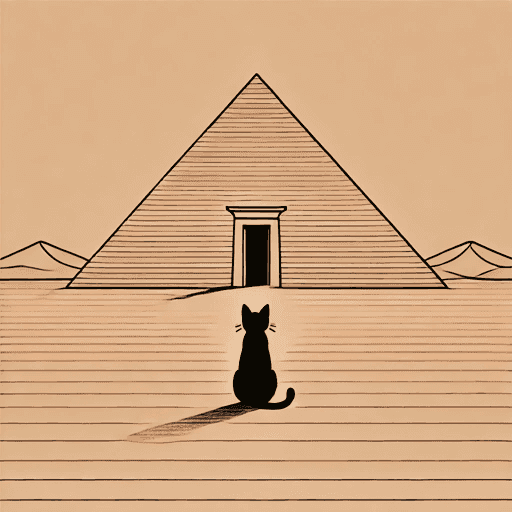
In Mummies in the Morning, Osborne hints at the cat’s supernatural powers and close connection to the tree house when it appears while the structure is still in Pennsylvania. Jack notes that it’s “the strangest cat [he’s] ever seen […] very sleek and dark, with bright yellow eyes and a wide gold collar” (6). It’s fitting that Morgan Le Fay takes feline form in this story because ancient Egyptians respected cats so highly that they were sometimes mummified when they died. The author depicts the cat as both a mysterious figure and a caring helper when it guides the children out of the false passage, where there was previously no exit. Although Jack feels a measure of trepidation about the tree house’s unknown owner, the cat’s actions make Morgan’s caring, protective stance toward the children clear, even though she’s not prepared to reveal her identity to them yet.
Morgan Le Fay sets the story into motion by creating the magic tree house and by serving as the children’s guide throughout the series. She supports the theme of Learning Through Discovery by filling the time-traveling tree house with informative books and leading the children to the entrance of the pyramid, where they embark on an educational adventure. Significantly, the enchantress only intervenes when necessary, such as when the siblings are trapped in the false passage, encouraging them to confront the unknown with courage. She allows Jack and Annie to solve problems for themselves, which demonstrates the high value both she and the author place on learning.
By allowing the children to aid Queen Hutepi by themselves, Morgan Le Fay helps them strengthen their confidence, self-efficacy, and teamwork. The monogrammed clues that Jack and Annie gather add an element of mystery to the story, and their progress in their search for the identity of the tree house’s creator foreshadows that Morgan Le Fay introduces herself to the children in the series’ next book, Pirates Past Noon.

Unlock analysis of every major character
Get a detailed breakdown of each character’s role, motivations, and development.
- Explore in-depth profiles for every important character
- Trace character arcs, turning points, and relationships
- Connect characters to key themes and plot points