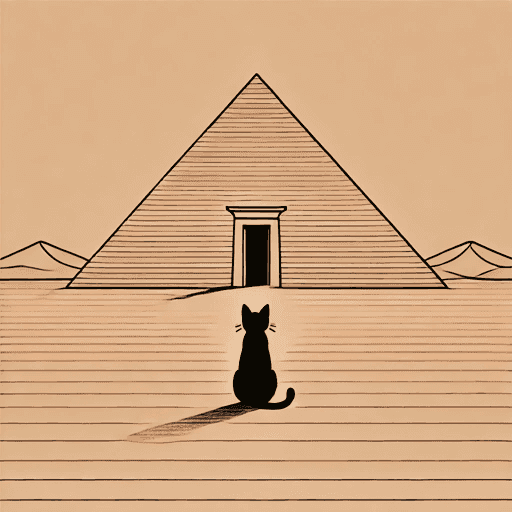
Mummies in the Morning
38 pages • 1-hour read
Mary Pope OsborneMummies in the Morning
A modern alternative to SparkNotes and CliffsNotes, SuperSummary offers high-quality Study Guides with detailed chapter summaries and analysis of major themes, characters, and more.
Summary
Background
Chapter Summaries & Analyses
Character Analysis
Themes
Symbols & Motifs
Important Quotes
Essay Topics
Tools
Themes
Content Warning: This section of the guide includes discussion of death.
Learning Through Discovery
In Mummies in the Morning, Osborne combines factual details about ancient Egypt with time-travel fantasy to portray learning as an exciting adventure. Throughout the Magic Tree House series, the author emphasizes the link between reading and discovery by having the books in the tree house function as portals that transport the siblings through time and space. Significantly, the siblings are brought to ancient Egypt when Jack points at an illustration in the book on the subject and says, “I wish we could go to this place” (5). The element of wishing reinforces curiosity as the guiding force of learning and emphasizes Jack and Annie’s ownership over their education.
The book on ancient Egypt that accompanies the children throughout their adventure provides a reference for them to consult when prompted by their natural desire to learn. For example, the appearance of the mysterious figure in white leads them to read about tomb raiders, foreshadowing their discovery of the false passage: “‘What kind of person would be inside a pyramid,’ asked Annie. ‘I don’t know,’ said Jack. ‘Maybe the book can help us’” (22). Just as the book guides the siblings on their journey, the story itself offers Osborne’s audience an introductory exploration of ancient Egyptian funerary practices and mythology. Books’ prominence throughout the story situates reading as a vital method of learning.
Although books support the children’s journey of discovery, there are several experiences that Jack and Annie have to facilitate for themselves. They uncover the location of the Book of the Dead by interacting with Queen Hutepi, decoding hieroglyphics, and exploring the pyramid. In addition, Jack learns of the existence of ghosts through firsthand experience, and the story’s supernatural elements teach him that there is more to the world than what he has learned in books. The theme of learning through discovery reaches its peak with Jack’s face-to-face encounter with Queen Hutepi’s mummy: “Was it just his imagination? Or did a deep sigh seem to shudder throughout the room? Did the mummy’s face grow calmer?” (47). This learning opportunity is significant because it marks the completion of the children’s quest to return Queen Hutepi’s scroll, and helping her find peace is far more meaningful and personal for Jack than simply reading about mummies. Jack and Annie’s ongoing search for the magic tree house’s creator adds an element of mystery to the series, and their excitement upon discovering clues like the “M” on the tree house’s floor further illustrates the joys of experiential learning.
Solving Problems Through Cooperation
Throughout the story, Jack and Annie model the importance of solving problems through cooperation. The theme is established in the opening chapter when the siblings collaboratively decide on the time period that will be their destination. In part, Annie suggests ancient Egypt because “[p]yramids were high on Jack’s list of favorite things” (5), and she knows this destination is likely to persuade him to go on another adventure despite the perils they faced on their previous trips in the magic tree house. She demonstrates a cooperative spirit by taking his interests into account. Osborne gives the siblings contrasting personality traits that further encourage their collaboration. Rather than presenting these differences as a source of conflict, the author portrays them as strengths that balance one another and make the siblings an effective team. For example, Annie’s daring keeps the duo moving forward toward their goals while Jack’s attention to detail keeps them on course, such as when he finds directions to the burial chamber by consulting the book about ancient Egypt.
The siblings face their greatest moment of peril in this story as a result of their teamwork faltering. They become trapped in a false passage after Annie runs off without Jack, reinforcing the importance of cooperation: “They watched in horror as the door slowly creaked shut. A deep sound rumbled in the distance and all the torches went out” (50). Jack immediately refocuses on teamwork, reassuring Annie that everything will be alright and helping her follow the sounds of the cat leading them through the tunnel to safety. At the end of the story, the siblings find the “M” on the floor because they work together to tidy the tree house. Jack and Annie’s cooperation helps them solve problems during their visit to ancient Egypt and brings them closer to discovering the identity of the tree house’s creator.
In addition to cooperating with each other, Jack and Annie have to work with the story’s supporting characters to achieve their goals. Osborne structures the story’s main plotline as a problem-solving exercise that requires Jack and Annie to work closely with Queen Hutepi to search for the Book of the Dead. Decoding the secret message takes cooperation as well as patience and perseverance. At first, the children try to solve Hutepi’s “strange problem” of being unable to see nearby objects by offering her Jack’s glasses (28), but her intangibility requires them to find another strategy. The trio builds on one another’s ideas as they collaborate to decode the hieroglyphics, and Queen Hutepi helps the children find the Book of the Dead by guiding them to her burial chamber. By making the cat the children’s guide into the pyramid and out of the false passage, Osborne shows her young readers that an important part of problem-solving is knowing when to accept help.
Confronting the Unknown With Courage
Over the course of the story, Jack gains courage by facing his fear of the unknown. The eight-year-old has a cautious, detail-oriented personality, and he grows frightened when he experiences things that his tidy, rational view of the world can’t explain. For example, the mysterious “white figure” that drops the queen’s scepter scares him because he doesn’t know the person’s identity and wonders if they are a reanimated mummy (19). The existence of such a figure challenges his skepticism of the supernatural. To reach the story’s climax, Jack must face his fear of the unknown, which makes him hesitant to enter Queen Hutepi’s burial chamber: “A door on the other side of the chamber creaked open. […] Jack’s heart was pounding. Cold air was coming through the open doorway” (39). The image of the open doorway emphasizes his fear because any number of unseen possibilities could be waiting beyond the threshold. Jack’s mission to explore the pyramid and return Queen Hutepi’s scroll requires him to confront his fears.
Along his journey, Annie and Queen Hutepi help Jack grow in courage. Annie’s outgoing nature and belief in magic make her much more comfortable with the unknown, as evidenced by her ease in speaking to the ghost-queen while Jack “could only stare in horror” (26). His sister’s brave example and encouragement help Jack persevere, such as when he’s afraid to approach the sarcophagus: “‘Don’t be afraid,’ said Annie. ‘Come on.’ Annie took Jack by the arm” (42). Jack’s friendship with Queen Hutepi also helps him find his courage. He isn’t “afraid of her at all anymore” once he gets to know the kind ghost-queen (37), a development that highlights understanding and empathy as effective tools against fear.
Osborne structures the story so that Jack is rewarded for facing his fears. One such reward is simply finding answers to his questions. For example, Jack’s fear of the unknown makes him reluctant to approach “the glowing gold box” (42), but his apprehension dissipates instantly when he realizes that it’s a sarcophagus. Seeing a mummy in person is a significant reward for Jack, who is fascinated by Egyptian history and sees the preserved remains as an “interesting” learning opportunity rather than something to fear (44).
The experience increases Jack’s courage, empowering him to be brave for his younger sister. When they’re trapped in the false passage, he tells Annie, “Don’t worry. Everything’s going to be okay” (51). Facing the unknown teaches Jack that the unexpected can be a source of wonder and excitement rather than fear. This growth is seen in his awed reaction to Queen Hutepi’s floating boat and his resolution to look for the magic tree house’s creator at the end of the story. Jack’s arc from fear to courage is a pattern that repeats throughout the series rather than something he resolves once and for all in this book. At the same time, the bravery that Jack develops in this story contributes to his willingness to embark on future adventures in the magic tree house.

Unlock every key theme and why it matters
Get in-depth breakdowns of the book’s main ideas and how they connect and evolve.
- Explore how themes develop throughout the text
- Connect themes to characters, events, and symbols
- Support essays and discussions with thematic evidence