Summaries & Analyses
Quizzes
NEWReading Tools
Key Figures
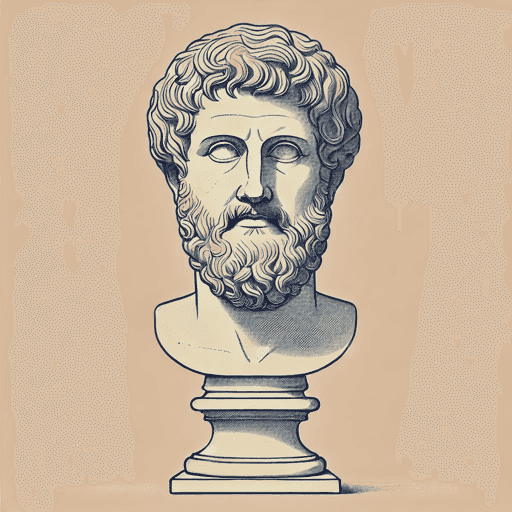
Aristotle
Aristotle (384–322 BCE) is the author of Physics and is considered one of the most influential philosophers in Western philosophy. Born in Stagira in northern Greece, he studied for approximately 20 years at Plato’s Academy in Athens before founding his own school, the Lyceum. His relationship with Plato, including the rejection of his former mentor’s ideas, recurs throughout Physics. Aristotle’s work covered a wide intellectual range, though many of his works have been lost. His surviving works cover logic, metaphysics, ethics, politics, biology, psychology, rhetoric, and natural philosophy. Among these writings, Physics occupies a key place because it establishes the principles that guide Aristotle’s understanding of the natural world.
Aristotle’s background prepared him to write a systematic treatise on nature. His father, Nicomachus, was a physician to the Macedonian royal court, a position which would later lead to controversy among Athenians considering Aristotle’s significance and loyalty to their city. This background also exposed the young Aristotle to empirical observation and biological inquiry. This influence is visible throughout his natural philosophy and in Physics. Unlike earlier philosophers who relied primarily on abstract speculation, Aristotle emphasized careful observation of natural phenomena. His extensive studies of plants and animals helped shape his broader philosophical account of motion and time, as evidenced by his citation of examples throughout Physics.
In the modern day, Aristotle’s influence is well established. For nearly 2,000 years, his works shaped scientific and philosophical thought throughout the Mediterranean, the Islamic intellectual tradition, and medieval Europe. Although modern science has replaced many of Aristotle’s specific physical theories, the conceptual framework he developed—especially his emphasis on causal explanation and systematic inquiry—continues to influence philosophical discussions of nature and science. In this regard, Aristotle and Physics have had a far reaching influence on the development of Western science and philosophy, with Aristotle himself having become a symbol and an embodiment of the Greek school of intellectual thought and philosophy.
Parmenides
Parmenides of Elea (c. 6th/5th century BCE) was an important philosophical figure in Ancient Greece whose ideas are addressed by Aristotle in Physics. Parmenides is best known for arguing that reality is—on a fundamental level—unchanging. True being, he suggested, must be eternal, indivisible, and immobile. Change and motion, at the same time, are logically impossible according to Parmenides because they would require something to arise from non-being or to pass into non-being.
Parmenides’s argument posed a profound challenge to natural philosophy, which is why he is cited and rebutted throughout Physics. If change is impossible, he reasoned, then the observable world of growth, movement, and transformation cannot be real. Instead, these appearances must be illusions produced by unreliable human perception. This conclusion forced later philosophers such as Aristotle to interrogate the tension between rational argument and sensory experience. If Parmenides’s reasoning was correct, the entire project of explaining natural change was under threat of being deemed impossible.
Aristotle’s Physics can be understood partly as an attempt to respond to this challenge. Aristotle accepts Parmenides’s insight that something cannot come from absolute non-being. He rejects, however, the conclusion that change is therefore impossible. Instead, Aristotle proposes that change occurs when something moves from a state of privation to a state of form, all while the underlying matter persists. This change in understanding allows Aristotle to preserve logical coherence and the reality of change that Aristotle observed in nature.
Parmenides’s influence is, therefore, a key part of the philosophical background of the Physics. By interrogating and taking apart the Eleatic denial of change, Aristotle establishes the foundation for his own theory of motion and natural processes. Physics defends the intelligibility of change, while preserving the logical framework that Parmenides outlined.
Melissus of Samos
Melissus (c. 500 BCE), was a philosopher associated with the Eleatic tradition. Like his contemporaries—and much to Aristotle’s disapproval—he denied the possibility of change. Although less famous than Parmenides, Melissus developed and expanded the Eleatic arguments in ways that directly influenced later philosophical discussions and which can be found throughout Physics. He argued that reality must be infinite and indivisible, as well as unchanging. At the same time, he rejected the possibility that the world could contain motion or plurality.
In certain ways, however, Melissus’s version of Eleatic philosophy differed from that of Parmenides. While Parmenides described being as finite and spherical, Melissus argued that true being must be infinite. If reality had limits, he reasoned, something beyond those limits would have to exist. This would contradict the idea that being is all that exists. This emphasis on infinity became an important topic in later philosophical debates.
Aristotle takes on Melissus in the opening books of Physics during his discussions of the principles of natural science. Aristotle criticizes the Eleatic claim that change is impossible, arguing that it rests on an overly simplistic understanding of being and non-being. According to Aristotle, change does not require something to emerge from absolute non-existence. Instead, it involves the transformation of something that already exists in potential into a new actual state.
By responding to Melissus and other Eleatic thinkers, Aristotle clarifies the philosophical starting point for natural inquiry. Physics insists that change is real and intelligible, as well as that philosophical reasoning must account for the evidence of motion and transformation observed in the natural world.
Anaxagoras
Anaxagoras (c. 500 BC – 428 BCE) was a philosopher whose ideas play an important role in Aristotle’s Physics. One of the key ideas that Anaxagoras proposed was that the cosmos originated from a primordial mixture in which all things were mixed together. According to his theory, the world came into its present order when an intelligent principle called Nous (sometimes translated as Mind) initiated motion. This initiation, Anaxagoras says, separated the mixture into distinct substances.
The concept of Nous is a key part of Anaxagoras’s work and it introduced a new explanatory element into Greek philosophy, one which Aristotle critiques in Physics. Anaxagoras differed from many of his contemporaries, in that they explained change through impersonal forces. Instead, Anaxagoras believed that an intelligent ordering principle—Nous—was responsible for the organization of the cosmos. This idea foreshadowed later philosophical attempts to explain natural order through rational causes, as well as Aristotle’s own ideas about the unmoved mover that are found in Physics.
Aristotle discusses Anaxagoras in Physics when examining the causes of motion. Although Aristotle criticizes aspects of Anaxagoras’s theory, he acknowledges the importance of introducing an intelligent source of motion. Aristotle’s own concept of the unmoved mover shares certain similarities with Anaxagoras’s Nous, although Aristotle develops the idea in a more systematic and metaphysical way.
The influence of Anaxagoras can also be seen in Aristotle’s broader method in Physics. Rather than rejecting earlier philosophers entirely, Aristotle analyzes their ideas with care and attention, identifies their strengths and weaknesses, and then incorporates their insights into a more comprehensive philosophical system.
Empedocles
Empedocles (c. 494 – 434 BCE) was a major pre-Socratic philosopher who proposed a cosmological theory based on four fundamental elements: Earth, air, fire, and water. According to his view, these elements are eternal and unchanging. The world as experienced by people, however, arises from their combination and separation.
Empedocles explained these processes through the interaction of two opposing forces: Love, which he claimed unites the elements, and Strife, which he claims separates the elements. With this theory, Empedocles addressed the Eleatic problem of change. At the same time, he also sought to preserve the idea that fundamental substances are permanent. In his account, change does not involve the creation or destruction of the basic elements. It consists, rather, of different mixtures of those elements forming various natural objects. The universe, he suggests, undergoes cyclical transformations as Love and Strife take turns to dominate.
Aristotle refers to Empedocles in Physics because Empedocles’s theory represents an attempt to explain change through natural processes. Aristotle appreciates Empedocles’s effort to account for motion and transformation, but he criticizes aspects of the theory. In particular, Aristotle argues that Empedocles fails to explain why the cycles of Love and Strife occur in the specific pattern they do. Without a clear causal explanation, Aristotle says, the theory relies too heavily on unexplained assumptions.
Empedocles’s ideas are significant in the context of Physics, even if Aristotle diverges from them. Empedocles’s attempt to reconcile permanence with change, for example, helped to shape later discussions about the structure of the natural world and Aristotle’s sincere (and occasionally appreciative) engagement with Empedocles demonstrates how Physics builds upon earlier philosophical theories.
Plato
Plato (c. 428 – 347 BCE) as one of the most influential philosophers of ancient Greece and the teacher of Aristotle. In Physics, he plays a dual role of antagonist and mentor, providing an intellectual device against which Aristotle can measure his own ideas. Born into an aristocratic family in Athens, Plato founded the Academy, one of the earliest institutions of higher learning in the Western world. The existence of this academy provides a mirror to Aristotle’s own establishing of the Lyceum, showing how Aristotle sought to set up his own intellectual school of thought in rivalry to his former teacher.
The writings of Plato—composed primarily in dialogue form—explore a range of subjects including metaphysics, ethics, politics, and the nature of knowledge. Plato’s theory of Forms, for example, became one of the defining doctrines of ancient philosophy. In Forms, Plato posits that true reality consists of eternal and unchanging intelligible entities rather than the mutable objects of sensory experience.
Aristotle spent decades studying at Plato’s Academy. Plato’s influence can be seen in Aristotle’s philosophical development and it is evident in Physics. Despite this, Aristotle splits from his teacher on several key issues. Plato theorized the separation between the intelligible world of Forms and the changing world of sensory experience. In contrast, Aristotle argues that form exists within individual substances, rather than in a separate realm. This disagreement shaped Aristotle’s approach in Physics, as Aristotle focuses on explaining change and motion within the natural world itself, rather than appealing to transcendent forms. This subtle difference shows how Aristotle is both beholden to and in opposition to his mentor.
Nevertheless, Plato’s ideas operate as an important point of reference in Physics. Aristotle occasionally refers to Plato’s views, particularly regarding time and cosmology. In the dialogue Timaeus, for example, Plato suggests that time began with the creation of the heavens. He believes that time is closely tied to the motions of the celestial bodies. Aristotle rejects this claim in Physics, instead arguing that time and motion must be eternal. Aristotle responds to Plato’s claim, saying that if time had a beginning, there would need to be a moment before time itself existed. Aristotle believes that this would lead to logical contradictions.
Physics illustrates the philosophical transition from Plato’s metaphysics to Aristotle’s natural philosophy. Aristotle retains Plato’s commitment to rational explanation and systematic inquiry, but he grounds his investigations in the observable processes of the natural world. In Physics, this shift is shown in Aristotle’s emphasis on motion and empirical observation as the foundations for understanding nature.

Unlock analysis of every key figure
Get a detailed breakdown of each key figure’s role and motivations.
- Explore in-depth profiles for every key figure
- Trace key figures’ turning points and relationships
- Connect important figures to a book’s themes and key ideas